

Compounds

Presentation
•
Science
•
6th Grade
•
Practice Problem
•
Easy
Standards-aligned

Barbara White
Used 19+ times
FREE Resource
11 Slides • 11 Questions
1

Middle School

2
Define a compound and provide examples of common compounds.
Explain how a compound’s properties differ from the properties of its elements.
Learn the key differences between molecules and compounds.
Interpret a chemical formula to count the atoms in a compound.


3
Key Vocabulary

Compound
A unique substance that is formed when two or more elements are chemically combined.

Molecule
The smallest particle of a compound that still has the chemical properties of that compound.

Chemical Formula
A way of representing a compound using symbols for elements and numbers for atoms.

Organic Compound
A chemical substance that is created within a living organism and is essential for life.

Ionic Bond
A chemical bond is formed by the complete transfer of valence electrons between atoms.

Covalent Bond
A chemical bond that involves the equal sharing of electron pairs between atoms.
4
What Is a Compound?
A pure substance made when different elements combine chemically, like carbon dioxide (CO2).
Compounds always have the same elements in the same proportions, like water (H2O).
A compound’s properties are very different from the properties of its original elements.
For example, sodium and chlorine form harmless sodium chloride, which is table salt.


5
Multiple Choice
Which of the following statements about compounds is TRUE?
The proportions of elements in a compound can vary.
Compounds have the same properties as the elements that form them.
Compounds are formed from a single type of element.
A compound always has the same elements in the same proportions.
6
Crystals
Some compounds form rigid, repeating structures that are called crystals.
These are frameworks of many ions locked together in a specific pattern.
A common example of a compound that forms crystals is sodium chloride, or table salt.

Molecules

Other compounds are made of individual units that are known as molecules.
A molecule is the smallest particle of a compound that has the compound's properties.
Examples include carbon dioxide (CO2) and water (H2O).
7
Multiple Choice
What is the main difference between the structure of a crystal and a molecule?
Only molecules contain electrically charged atoms.
Crystals are found in gases like carbon dioxide, while molecules are found in solids like salt.
Molecules form rigid frameworks, while crystals are individual particles.
Crystals are made of ions in a repeating pattern, while molecules are individual particles of bonded atoms.
8
Molecules
A molecule is made of two or more atoms that are chemically joined together.
Some molecules have only one type of atom, like the oxygen we breathe (O2).
Because it has only one type of atom, O2 is an element, not a compound.

Compounds

A compound is a type of molecule made of at least two different elements.
The different atoms in a compound are always chemically bonded together.
Water (H2O) is a compound as it contains hydrogen and oxygen atoms.
9
Multiple Choice
Based on the definitions, which of the following is a molecule but NOT a compound?
NaCl
CO2
H2O
O2
10
Representing Compounds
Compounds have chemical formulas that use symbols for each element.
Subscripts show atom count; in H2O, the 2 means two hydrogen atoms.
Coefficients show molecule count; 2H2O means two molecules of water.
In 2H2O, there are 4 hydrogen atoms and 2 oxygen atoms in total.


11
Multiple Choice
How many hydrogen atoms and oxygen atoms are in three molecules of water (3H2O)?
6 hydrogen atoms and 1 oxygen atom
2 hydrogen atoms and 1 oxygen atom
6 hydrogen atoms and 3 oxygen atoms
3 hydrogen atoms and 3 oxygen atoms
12
Ionic Bonds
One atom transfers one or more of its electrons to another atom.
This transfer creates oppositely charged ions that attract one another.
This type of bond usually forms between a metal and a nonmetal.

Covalent Bonds
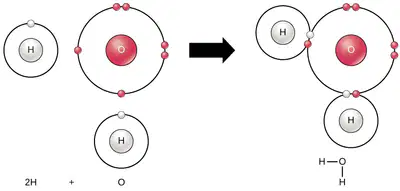
Atoms are joined together by sharing one or more pairs of valence electrons.
By sharing, both atoms can achieve a full and stable outer electron shell.
This type of bond most commonly occurs between atoms of nonmetals.
13
Multiple Choice
What is the key difference between ionic and covalent bonds?
Ionic bonds involve sharing electrons, while covalent bonds involve transferring electrons.
Only covalent bonds involve the Octet Rule.
Ionic bonds occur between two nonmetals.
Ionic bonds involve transferring electrons, while covalent bonds involve sharing electrons.
14
What Are Organic Compounds?
Organic compounds are essential life chemicals built around the element carbon.
Carbohydrates provide and store energy for cells and help build body structures.
Lipids store large amounts of energy and form the membranes of cells.
Proteins build muscles, while nucleic acids like DNA hold genetic instructions.


15
Multiple Choice
Which class of organic compounds contains the genetic instructions for building proteins?
Lipids
Nucleic Acids
Carbohydrates
Proteins
16
Misconception | Correction |
|---|---|
All molecules are compounds. | Molecules can be elements, like an oxygen molecule (O2). |
Compounds have the same properties as their elements. | Compounds have unique properties, different from the elements they are made of. |
Compounds are a type of mixture. | Compounds are pure substances with chemically bonded elements. |
The formula H2O means two oxygen atoms. | H2O means two hydrogen atoms and one oxygen atom. |
17
Multiple Choice
Sodium is a highly reactive metal and chlorine is a poisonous gas. Why is it safe to eat sodium chloride (table salt)?
Because forming a compound creates a new substance with different properties.
Because the salt crystals hide the dangerous properties of the elements.
Because the amount of sodium and chlorine in salt is very small.
Because salt is a mixture, not a compound.
18
Multiple Choice
A substance is made of molecules that each contain one carbon atom and four hydrogen atoms (CH4). How would you classify this substance?
As a mixture.
As an ion.
As an element.
As a compound.
19
Multiple Choice
Magnesium (a metal) and Oxygen (a nonmetal) combine to form Magnesium Oxide. What type of bond would you predict holds this compound together and why?
A hydrogen bond, because oxygen is involved.
A metallic bond, because magnesium is a metal.
A covalent bond, because the atoms share electrons to become stable.
An ionic bond, because a metal and a nonmetal typically transfer electrons.
20
Multiple Choice
Analyze the chemical formula for Ammonium Phosphate, (NH4)3PO4. What is the total number of hydrogen atoms in one molecule of this compound?
3
12
7
4
21
Compounds are pure substances of bonded elements with unique properties.
Atoms form ionic or covalent bonds, creating crystals or molecules.
Some compounds are made of molecules, while others are not. Some substances, like O₂, are elements made of molecules.
Organic compounds like carbohydrates and proteins are essential for life.
22
Poll
On a scale of 1-4, how confident are you with the concepts covered in today's review?
1
2
3
4
Middle School
Show answer
Auto Play
Slide 1 / 22
SLIDE
Similar Resources on Wayground

17 questions
Weather vs climate
Presentation
•
6th Grade
16 questions
Types of Maps
Presentation
•
6th Grade
15 questions
Thermal Energy and Phase Change Review
Presentation
•
6th Grade
19 questions
Lesson 9 Volcanic Eruptions
Presentation
•
6th Grade
19 questions
Mars vs Earth
Presentation
•
6th Grade
20 questions
Heat Transfer
Presentation
•
6th Grade
20 questions
Human Impact on Air
Presentation
•
6th Grade
17 questions
Water Quality
Presentation
•
6th Grade
Popular Resources on Wayground
10 questions
How much do you know about our Portrait of an Eagle?

Quiz
•
10th Grade
10 questions
Fast Food Slogans
Quiz
•
6th - 8th Grade
21 questions
Continents and Oceans
Quiz
•
6th Grade
20 questions
Parts of Speech
Quiz
•
5th Grade
16 questions
Subject & Predicate
Quiz
•
5th Grade
25 questions
Multiplication Facts
Quiz
•
5th Grade
12 questions
Map Skills
Quiz
•
3rd Grade
22 questions
Continents and Oceans
Quiz
•
5th Grade
Discover more resources for Science
10 questions
6.6D - Relative Density Review
Quiz
•
6th Grade
20 questions
Claim, Evidence and Reasoning (CER)
Quiz
•
6th - 8th Grade
20 questions
Density
Quiz
•
6th Grade
10 questions
Exploring Chemical and Physical Changes

Interactive video
•
6th - 10th Grade
20 questions
Food Chains & Food Webs
Quiz
•
5th - 7th Grade
18 questions
Interpreting Distance/Time Graphs
Quiz
•
6th Grade
10 questions
Decoding the Periodic Table of Elements
Interactive video
•
6th - 10th Grade
15 questions
Potential and Kinetic Energy
Quiz
•
6th Grade