

Argumentative Text

Presentation
•
English
•
11th Grade
•
Practice Problem
•
Easy

Mohammad Nur Hadiyansyah
Used 6+ times
FREE Resource
15 Slides • 10 Questions
1
Text
By Mohammad Nur Hadiyansyah
2
By the end of the lesson, students are able to:
Showing expression agreement and dissagreement
Review the structure of an argumentative text (thesis, arguments, conclusion).
Review the function of each part in the text
3
Poll
Using AI tools for homework.
AGREE
DISAGREE
4
Poll
Social media does more harm than good.
AGREE
DISAGREE
5
Poll
Online learning is more effective than face-to-face learning.
AGREE
DISAGREE
6
Poll
Plastic should be completely banned.
AGREE
DISAGREE
7
Poll
People should use public transportation instead of private cars.
AGREE
DISAGREE
8
Poll
Students should have less homework.
AGREE
DISAGREE
9
The Necessity of Banning Smartphones in Classrooms
Those who support smartphones argue that they provide quick access to dictionaries, online resources, and educational apps. Students can search for information instantly, join online discussions, and even use language-learning applications. Smartphones also help communication between teachers and students outside the classroom.
On the other hand, many teachers believe smartphones are more distracting than helpful. Notifications from social media or games can easily take students’ attention away from lessons. Too much screen time also reduces face-to-face interaction, which is important for building teamwork and social skills.
In conclusion, smartphones have both benefits and drawbacks in classrooms. Schools should not completely ban them, but they need clear rules. Smartphones can be allowed for research and learning activities, while their use for entertainment should be restricted during lessons.
10
The Necessity of Banning Smartphones in Classrooms
Those who support smartphones argue that they provide quick access to dictionaries, online resources, and educational apps. Students can search for information instantly, join online discussions, and even use language-learning applications. Smartphones also help communication between teachers and students outside the classroom.
On the other hand, many teachers believe smartphones are more distracting than helpful. Notifications from social media or games can easily take students’ attention away from lessons. Too much screen time also reduces face-to-face interaction, which is important for building teamwork and social skills.
In conclusion, smartphones have both benefits and drawbacks in classrooms. Schools should not completely ban them, but they need clear rules. Smartphones can be allowed for research and learning activities, while their use for entertainment should be restricted during lessons.
(Thesis Statement)
Supporting Arguments
Counter
Arguments
Conclusion
11
Based on the text, which of the following conclusions shows the best balanced recommendation?
A. Smartphones should be completely banned because they only distract students.
B. Smartphones should be allowed freely because they are useful for research.
C. Schools should allow smartphones for learning purposes but restrict them during lessons to avoid distraction.
D. Smartphones should not be discussed because they are not important in education.
12
If you were a school leader, what balanced policy would you recommend?
What are the arguments for and against smartphones in classrooms?
13
Reflection
What is one new insight you gained today about argumentative texts?
Which part of the argumentative structure (thesis, arguments, conclusion) was easiest or most challenging for you — and why?
How did today’s activity help you express your opinion more clearly or confidently?
If you could revise your group’s analysis, what would you improve or add?
What skill from today’s lesson do you think will be most useful in real-life discussions or debates?
14
Poll
Exams should be replaced by projects.
AGREE
DISAGREE
15
Poll
Smartphones should not be allowed in classrooms.
AGREE
DISAGREE
16
Poll
Influencers affect teenagers’ behavior too much.
AGREE
DISAGREE
17
Poll
Celebrities are good role models for teenagers.
AGREE
DISAGREE
18
The Necessity of Banning Smartphones in Classrooms
Smartphones represent an unparalleled source of cognitive distraction that compromises academic performance. The mere presence of a personal device—even in silent mode—fragments the student's attention, as their mind is constantly anticipating notifications from social media or games. This divided attention is scientifically proven to lower cognitive capacity, impede information retention, and lead directly to diminished learning outcomes. If the primary goal of the school is deep, focused learning, then any tool that systematically disrupts this attention must be removed.
Furthermore, these devices actively undermine social and emotional development. The classroom is a vital setting for practicing collaboration, empathy, and essential face-to-face interpersonal skills. However, when students are tethered to their private screens, opportunities for genuine interaction and teamwork are lost, fostering social isolation and hindering the development of crucial Relationship Skills and Social Awareness.
Opponents often argue that smartphones are essential research and learning tools in the digital era, enriching students' access to information. However, this argument is refutable. Schools can, and should, provide controlled learning devices (such as shared tablets or school laptops) that limit access exclusively to educational resources. This retains the benefits of technology while eliminating the serious risks of distraction and dependency inherent in personal communication devices.
Given the undeniable detrimental effects on student focus and the critical nature of social development, educational priorities must prevail over digital convenience. Therefore, a comprehensive ban on smartphones during instructional time is a strategic and prudent step necessary to cultivate a truly interactive, focused, and productive learning environment.
19
The Necessity of Banning Smartphones in Classrooms
Smartphones represent an unparalleled source of cognitive distraction that compromises academic performance. The mere presence of a personal device—even in silent mode—fragments the student's attention, as their mind is constantly anticipating notifications from social media or games. This divided attention is scientifically proven to lower cognitive capacity, impede information retention, and lead directly to diminished learning outcomes. If the primary goal of the school is deep, focused learning, then any tool that systematically disrupts this attention must be removed.
Furthermore, these devices actively undermine social and emotional development. The classroom is a vital setting for practicing collaboration, empathy, and essential face-to-face interpersonal skills. However, when students are tethered to their private screens, opportunities for genuine interaction and teamwork are lost, fostering social isolation and hindering the development of crucial Relationship Skills and Social Awareness.
Opponents often argue that smartphones are essential research and learning tools in the digital era, enriching students' access to information. However, this argument is refutable. Schools can, and should, provide controlled learning devices (such as shared tablets or school laptops) that limit access exclusively to educational resources. This retains the benefits of technology while eliminating the serious risks of distraction and dependency inherent in personal communication devices.
Given the undeniable detrimental effects on student focus and the critical nature of social development, educational priorities must prevail over digital convenience. Therefore, a comprehensive ban on smartphones during instructional time is a strategic and prudent step necessary to cultivate a truly interactive, focused, and productive learning environment.
(Thesis Statement)
Supporting Arguments
Supporting Arguments
Counter-argument and Rebuttal
Conclusion
20
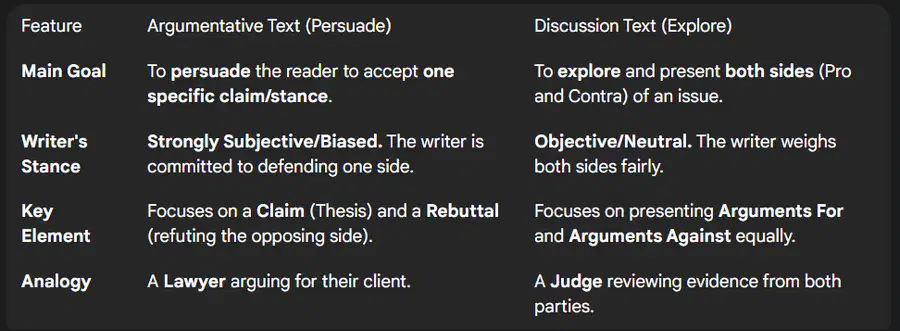
The Difference
21
The class is divided into 5 small groups.
Each group listens to the assigned audio and discusses their identification of the argumentative text structure.
Each group records their findings on a worksheet, focusing on the following components:
Thesis
Arguments
Counter-argument and Rebuttal
Conclusion
Each group presents their analysis in front of the class.
Other groups may respond by asking questions, expressing agreement or disagreement, and providing constructive feedback.
Argumentation Analysis
22
Concise Argumentative Statements
Governments should regulate social media to protect teen mental health.
Keeping exotic animals as pets is unethical due to risks.
A rapid shift to electric vehicles burdens average citizens.
Eliminating cash harms small businesses and older generations.
AI use for chores causes a decline in essential life skills.
The environmental impact of veganism is often overstated.
Mandatory curfews for teens reduce delinquency rates effectively.
Parents must enforce strict screen time limits for adolescents.
Animal testing for cosmetics should be banned completely.
Social media platforms should monitor private data for public safety risks.
Argumentation Analysis
23
State your opinion clearly, ex: I believe that… / In my opinion…
Use linking words, ex: Firstly, because, however, therefore, in conclusion.
Give reasons and examples, ex: Explain why you agree or disagree.
Use strong and formal words, ex: important, harmful, beneficial, necessary.
Add a counter-argument (optional), ex: Some people think that…, but I believe…
End with a clear conclusion, ex: In conclusion, I think…
Writing Tips
24
State your opinion clearly, ex: I believe that… / In my opinion…
Use linking words, ex: Firstly, because, however, therefore, in conclusion.
Give reasons and examples, ex: Explain why you agree or disagree.
Use strong and formal words, ex: important, harmful, beneficial, necessary.
Add a counter-argument (optional), ex: Some people think that…, but I believe…
End with a clear conclusion, ex: In conclusion, I think…
Mini Outline
25

Instructions:
Choose one topic that you feel most interested in.
People should take a one-week digital detox every month.
Cancel culture does more harm than good.
Using AI in art and writing is still creative.
Write a mini-outline for your argumentative text. Your outline should include:
Thesis: your main opinion or point of view.
Arguments: 2–3 reasons or examples that support your opinion.
Conclusion: a short closing statement that restates your opinion.
Use clear and persuasive language.
Add at least one counter-argument and how you would respond to it
Writing Mini Outline
Text
By Mohammad Nur Hadiyansyah
Show answer
Auto Play
Slide 1 / 25
SLIDE
Similar Resources on Wayground

21 questions
Oro A1 Entrance Test
Presentation
•
KG
18 questions
IELTS WRITING TASK 2 - OPINION ESSAY
Presentation
•
11th - 12th Grade
21 questions
A Christmas Carol. Stave One - Scrooge
Presentation
•
10th - 11th Grade
21 questions
Narrative Tenses
Presentation
•
10th - 11th Grade
21 questions
Writing process
Presentation
•
11th - 12th Grade
20 questions
Rhetorical Analysis
Presentation
•
11th Grade
16 questions
PRESENT SIMPLE
Presentation
•
11th Grade
22 questions
ACT Practice Reading
Presentation
•
11th Grade
Popular Resources on Wayground
10 questions
Safety Day 2026 – Student Review

Quiz
•
9th Grade
21 questions
Continents and Oceans
Quiz
•
6th Grade
20 questions
Parts of Speech
Quiz
•
5th Grade
16 questions
Subject & Predicate
Quiz
•
5th Grade
25 questions
Multiplication Facts
Quiz
•
5th Grade
12 questions
Map Skills
Quiz
•
3rd Grade
22 questions
Continents and Oceans
Quiz
•
5th Grade
15 questions
Rounding Decimals
Quiz
•
5th Grade
Discover more resources for English
16 questions
Complete Sentences vs Fragments and Run-Ons
Presentation
•
5th - 12th Grade
19 questions
Unit 1 Assessment Review
Quiz
•
11th Grade
28 questions
AP Vocab Group 7
Quiz
•
9th - 12th Grade
20 questions
Appositives & Commas
Quiz
•
9th - 12th Grade
40 questions
11th Grade ELA Fall 2026 Interim Review Quiz
Quiz
•
11th Grade
28 questions
The Lottery
Quiz
•
11th Grade
20 questions
The Crucible Act 1 and 2 Quiz
Quiz
•
9th - 12th Grade
40 questions
Of Mice & Men Major Test Ch. 1-6
Quiz
•
9th - 12th Grade