
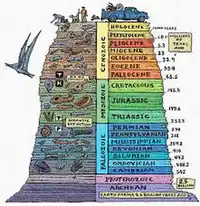
8th Clues to Earth's Past Chapter 11

Presentation
•
Science
•
8th Grade
•
Practice Problem
•
Hard
+3
Standards-aligned

Anna Rogers
Used 2+ times
FREE Resource
31 Slides • 18 Questions
1

2

3
Multiple Choice
Why is it important to study catastrophic events in Earth's history?
To understand how life on Earth has changed over time
To predict future volcanic eruptions
To learn about the formation of mountains
To discover new species of plants
4

5
Multiple Choice
Which observation led James Hutton to propose that the Earth is much older than a few hundred years?
The presence of fossils in rocks
Erosion observed on his farm
The discovery of petrified wood
The study of dinosaur bones
6

7
Multiple Select
Which of the following are necessary conditions for fossil formation?
Organism must have hard parts
Organism must be buried quickly
Organism must be exposed to sunlight
Organism must be encased in amber, tar, or cement
8

9
Fill in the Blanks
Type answer...
10

11

12
Multiple Choice
What happens to an organism's tissues during the formation of carbon films?
They are replaced by minerals
They are forced out by heat and pressure
They are buried in amber
They are frozen
13

14

15
Multiple Choice
Which type of fossil is formed when sediment hardens around a buried organism and the organism decays, leaving an imprint or impression?
Mold fossil
Cast fossil
Trace fossil
Amber fossil
16

17

18
Multiple Select
Which of the following are examples of trace fossils?
Footprints
Nests
Tracks
Bones
19

20
Fill in the Blanks
Type answer...
21

22

23
Fill in the Blanks
Type answer...
24

25

26
Multiple Choice
Which principle of relative age dating states that younger rock layers are always on top unless disturbed?
Original Horizontality
Superposition
Lateral Continuity
Cross-Cutting Relationships
27

28

29
Multiple Choice
Which of the following principles states that sediments are deposited in large, continuous sheets in all lateral directions?
Superposition
Original Horizontality
Lateral Continuity
Inclusions
30

31
Fill in the Blanks
Type answer...
32

33
Multiple Select
Select all principles that help geologists compare the ages of rock layers by relative age.
Superposition
Original Horizontality
Lateral Continuity
Cross-Cutting Relationships
34

35
Multiple Choice
Which process is responsible for creating gaps in the rock record, as shown in the images and described in the text?
Weathering and erosion
Volcanic activity
Earthquakes
Glacial movement
36

37

38
Multiple Select
Which of the following are types of unconformities?
Disconformity
Angular unconformity
Nonconformity
Conformity
39

40
Fill in the Blanks
Type answer...
41

42

43
Multiple Choice
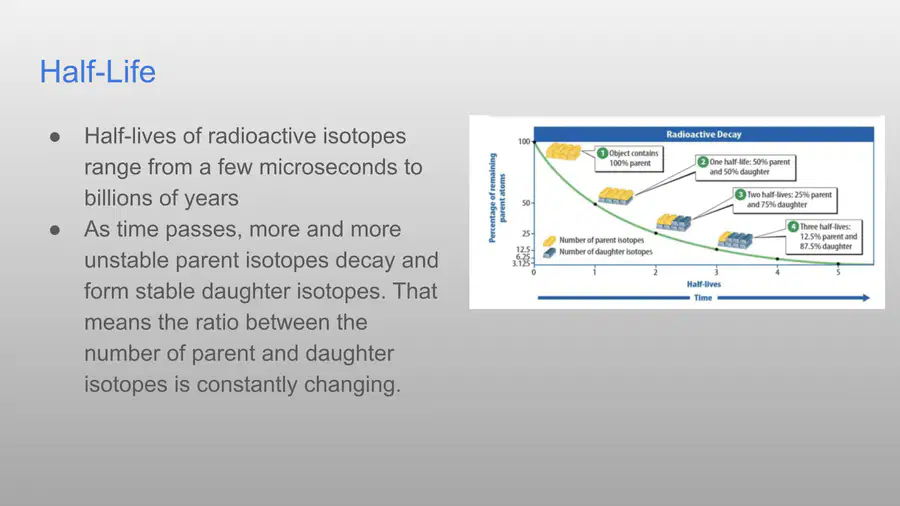
In the process of radioactive decay, what happens to the extra neutron in hydrogen-3 to form helium-3?
It decays and forms a proton
It is absorbed by the nucleus
It is ejected as radiation
It combines with another neutron
44
45
46

47

48
49
Multiple Choice
How did early scientists explain the presence of fossils according to the theory of catastrophism?
They believed fossils formed gradually over time.
They thought great, sudden disasters killed organisms that became fossils.
They believed fossils were created by supernatural forces.
They thought fossils appeared due to climate change.
Show answer
Auto Play
Slide 1 / 49
SLIDE
Similar Resources on Wayground

42 questions
Andrew Jackson
Presentation
•
8th Grade
44 questions
Physical Properties of Stars
Presentation
•
8th Grade
45 questions
em spectrum
Presentation
•
8th Grade
42 questions
1-Chemistry Basics Lesson
Presentation
•
8th Grade
45 questions
Characteristics of Stars
Presentation
•
8th Grade
45 questions
Human impacts and Global warming
Presentation
•
8th Grade
44 questions
4/12 - Blitz - Physics
Presentation
•
8th Grade
48 questions
Magnets
Presentation
•
8th Grade
Popular Resources on Wayground
19 questions
Naming Polygons

Quiz
•
3rd Grade
10 questions
Prime Factorization
Quiz
•
6th Grade
20 questions
Math Review
Quiz
•
3rd Grade
15 questions
Fast food
Quiz
•
7th Grade
20 questions
Main Idea and Details
Quiz
•
5th Grade
20 questions
Context Clues
Quiz
•
6th Grade
20 questions
Inferences
Quiz
•
4th Grade
19 questions
Classifying Quadrilaterals
Quiz
•
3rd Grade
Discover more resources for Science
16 questions
Interactions within Ecosystems
Presentation
•
6th - 8th Grade
12 questions
PS.8.1.2, PS.8.1.3, PS.8.1.5 Review
Quiz
•
8th Grade
20 questions
Moon Phases and Eclipses
Quiz
•
6th - 8th Grade
22 questions
6th & 8th Grade Science Material SOL Review
Quiz
•
6th - 8th Grade
49 questions
NC Released EOG 8 Science (2024)
Quiz
•
8th Grade
48 questions
8th Grade NC Science EOG Review 2
Quiz
•
8th Grade
19 questions
Renewable and Nonrenewable Resources (CK)
Quiz
•
8th Grade
20 questions
8th Grade Science STAAR Review
Quiz
•
8th Grade