

4.4 Triangle Angle-Sum Theorem

Presentation
•
Mathematics
•
8th Grade
•
Practice Problem
•
Easy
Standards-aligned

Nicole Nuwer
Used 3+ times
FREE Resource
7 Slides • 12 Questions
1
Theorem- a general proposition not self-evident but proved by a chain of reasoning; a truth established by means of accepted truths.
2
Match
Match the following
add up to 180 degrees
add up to 90 degrees
are congruent to each other
have a common side and a common vertex (corner point), and don't overlap.
Supplementary Angles
Complementary Angle
Vertical Angles
Adjacent Angles
Supplementary Angles
Complementary Angle
Vertical Angles
Adjacent Angles
3
Match
Match the following
Three equal sides Three equal angles, always 60°
Two equal sides Two equal angles
No equal sides No equal angles
All angles are less than 90°
Has an angle more than 90°
Equilateral Triangle
Isosceles Triangles
Scalene Triangles
Acute Triangles
Obtuse Triangles
Equilateral Triangle
Isosceles Triangles
Scalene Triangles
Acute Triangles
Obtuse Triangles
4
5
6
Multiple Choice
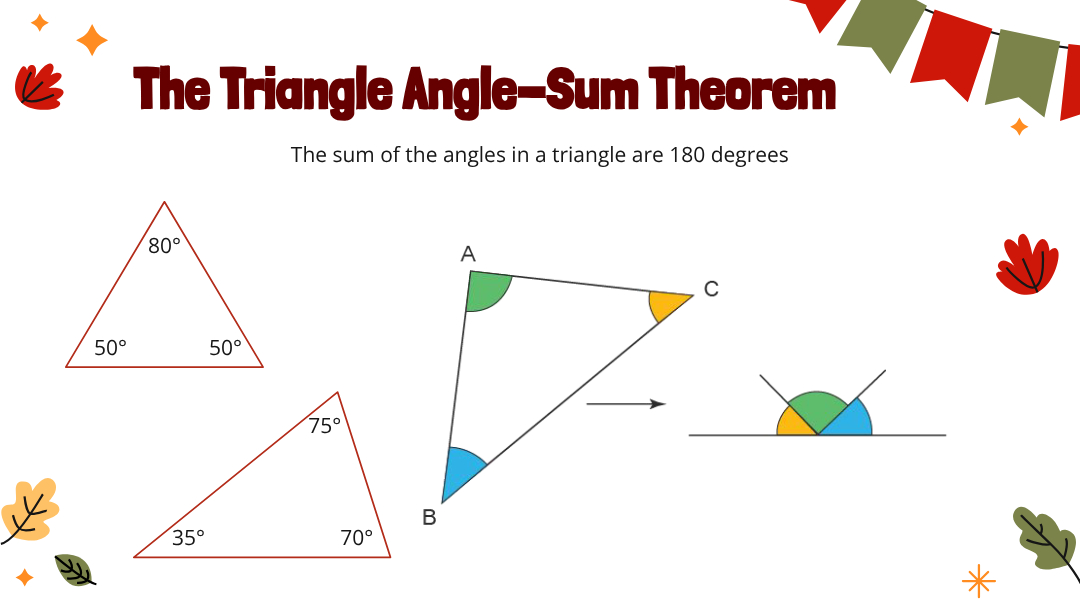
According to the Triangle Angle-Sum Theorem, what is the sum of the interior angles of a triangle?
180 degrees
90 degrees
360 degrees
270 degrees
7
8
Dropdown
9
10
11
Math Response
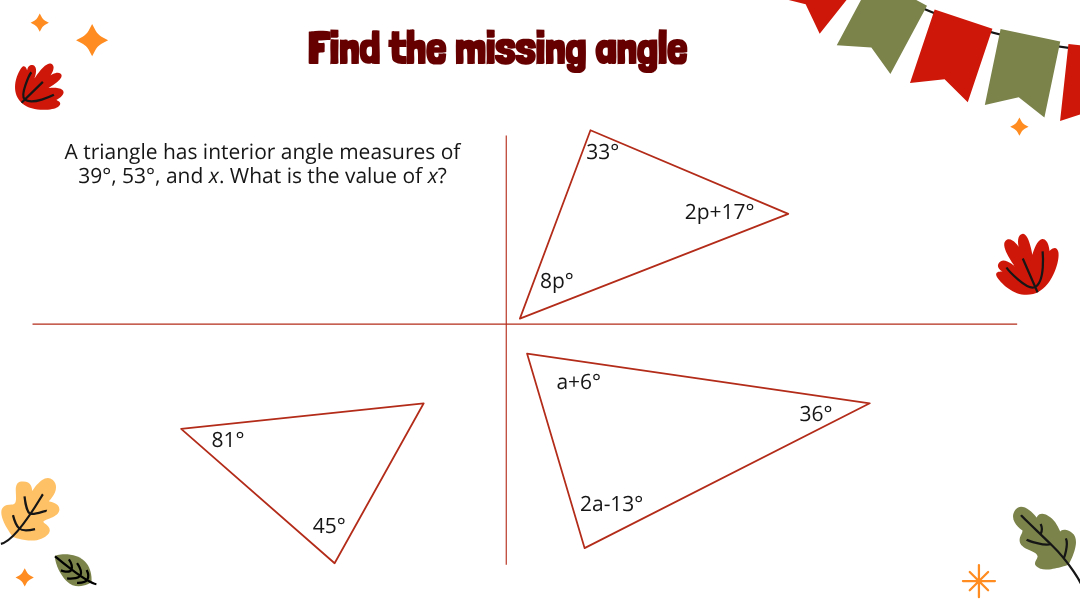
A triangle has interior angle measures of
39°, 53°, and x. What is the value of x?
12
Math Response
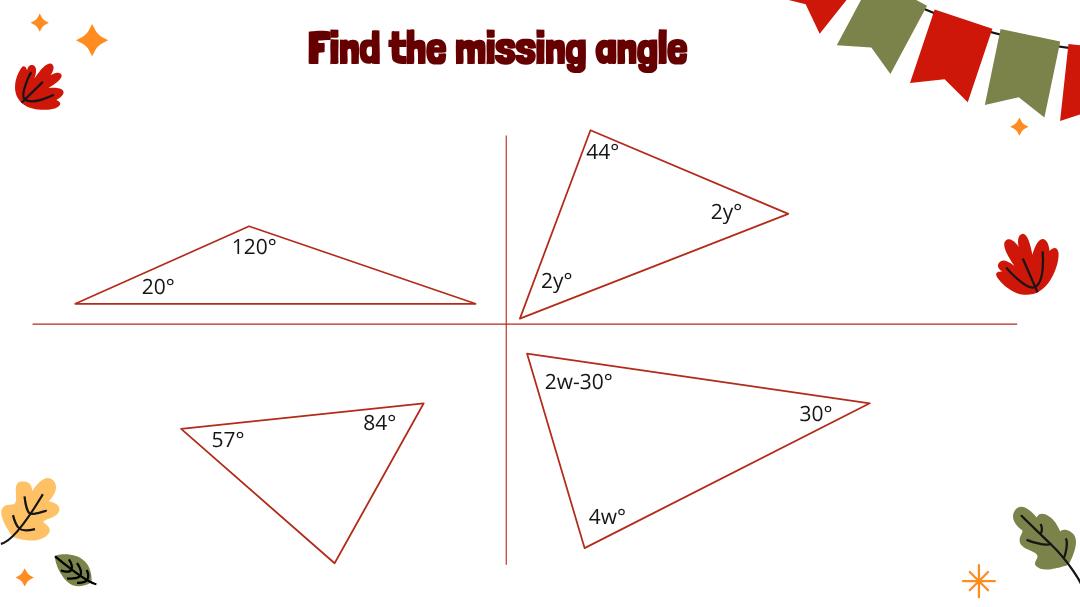
What is the measure of the missing angle?
13
Math Response
What is the value of p?
14
Math Response
What is the value of a?
15

16
Multiple Choice
Can you have a triangle with the following angles?
20°, 130°, 40°
Yes, they equal 180°
No, they equal 190°
No, they equal 180°
Yes, they equal 190°
17
Multiple Choice
Can you have a triangle with the following angles?
120°, 30°, 30°
Yes, they equal 180°
No, they equal 170°
No, they equal 180°
Yes, they equal 170°
18
Multiple Choice
Can you have a triangle with the following angles?
1°, 90°, 90°
Yes, they equal 180°
No, they equal 181°
No, they equal 180°
Yes, they equal 181°
19
Multiple Choice
Can you have a triangle with the following angles?
15°, 160°, 5°
Yes, they equal 180°
No, they equal 80°
No, they equal 180°
Yes, they equal 80°
Theorem- a general proposition not self-evident but proved by a chain of reasoning; a truth established by means of accepted truths.
Show answer
Auto Play
Slide 1 / 19
SLIDE
Similar Resources on Wayground

18 questions
Reflections
Presentation
•
8th Grade
13 questions
Comparing Functions
Presentation
•
8th Grade
13 questions
Surface Area of Prisms
Presentation
•
8th Grade
16 questions
Perfect Squares and Cubes Review
Presentation
•
8th Grade
15 questions
Proportional Relationships
Presentation
•
7th - 8th Grade
14 questions
Unit 0B Test Review 23-24
Presentation
•
8th Grade
12 questions
PORCENTAJES
Presentation
•
7th - 8th Grade
14 questions
Applying Pythagorean Theorem
Presentation
•
8th Grade
Popular Resources on Wayground
10 questions
How much do you know about our Portrait of an Eagle?

Quiz
•
10th Grade
10 questions
Fast Food Slogans
Quiz
•
6th - 8th Grade
21 questions
Continents and Oceans
Quiz
•
6th Grade
20 questions
Parts of Speech
Quiz
•
5th Grade
16 questions
Subject & Predicate
Quiz
•
5th Grade
25 questions
Multiplication Facts
Quiz
•
5th Grade
12 questions
Map Skills
Quiz
•
3rd Grade
22 questions
Continents and Oceans
Quiz
•
5th Grade
Discover more resources for Mathematics
20 questions
Rational and Irrational Numbers
Quiz
•
8th Grade
10 questions
Exploring Angles Formed by Lines Intersected by a Transversal
Quiz
•
8th Grade
20 questions
Add and Subtract Integers
Quiz
•
6th - 8th Grade
20 questions
Graphing Inequalities on a Number Line
Quiz
•
6th - 9th Grade
20 questions
Slope from a Graph
Quiz
•
8th Grade
22 questions
Adding Integers
Quiz
•
7th - 8th Grade
20 questions
Proportional vs. Non-Proportional
Quiz
•
8th Grade
20 questions
Exponent Rules
Quiz
•
8th - 9th Grade