Search Header Logo
Ecological Relationships

Ecological Relationships

Assessment

Presentation

•

Biology

•

10th Grade

•

Practice Problem

•

Medium

•
NGSS
MS-LS2-4, MS-LS2-3, MS-LS2-2

+3

Standards-aligned

Created by

Shanice Smith

Used 2+ times

FREE Resource

15 Slides • 18 Questions

1

media

2

Multiple Choice

Question image

If a disease strikes the snake population in the food chain shown, what will be the initial effect on the populations of hawks and rabbits?

1

The populations of hawks and rabbits will decrease.

2

The populations of hawks and rabbits will increase.

3

The population of hawks will increase. The population of rabbits will decrease.

4

The population of hawks will decrease. The population of rabbits will increase.

3

Multiple Choice

Question image

In the food chain Carrots--->Rabbit--->Fox. The fox is a

1

Producer

2

First level consumer

3

Second level consumer

4

Decomposer

4

Multiple Choice

Question image

What is the first organism in a food chain?

1

Herbivore

2

Carnivore

3

Producer

5

Multiple Choice

Question image

Which of the following is an omnivore in the web?

1

owls

2

foxes

3

mice

4

birds

6

Multiple Choice

Question image

9. If 50 kcal of energy are present in the tomato plants, approximately how much energy would be expected in the spider population?

1

50 kcal

2

5 kcal

3

0.5 kcal

4

0.05 kcal

7

Multiple Choice

Which list correctly shows the flow of energy in a food chain?

1

plants-> Sun-> animals-> decomposers

2

Sun-> plants-> animals-> decomposers

3

decomposers-> Sun-> plants-> animals

4

animals-> Sun-> decomposers-> plants

8

Multiple Choice

What percentage of energy is passed on at each trophic level?

1
10%
2
25%
3
15%
4
5%

9

Multiple Choice

Which of the following are reasons why 90% of energy is loss from each trophic level?

1

Metabolic processes, heat production, movement, and uneaten parts.

2
Photosynthesis efficiency, nutrient cycling, and water absorption.
3
Chemical reactions, soil quality, and atmospheric conditions.
4
Predation rates, habitat destruction, and seasonal changes.

10

media

11

media

12

Open Ended

What is an ecological niche of bees in our ecosystem?

13

media

14

media

15

Multiple Choice

Based on the predator-prey population graph, what typically happens to the predator population when the prey population decreases?

1

Predator population increases

2

Predator population decreases

3

Predator population stays the same

4

Predator population becomes extinct

16

Multiple Choice

Question image
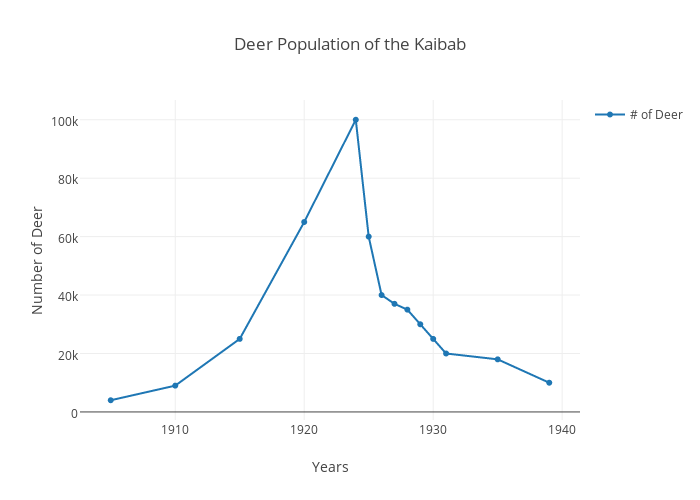
The graph above shows the variation in the deer population in the Kaibab Plateau from 1905 to 1939. Between 1907 and 1923, the natural predators of deer were eliminated from the area by hunters. What was the most likely reason for the decline in the deer population after 1924?
1
The deer stopped competing for resources because they had no predators.
2
The increased number of deer led to increased competition for resources.
3
A large number of deer left the region in search of new predators.
4
The removal of predators caused fewer resources to be available to the deer.

17

media

18

Multiple Select

Which of the following statements about herbivore-plant relationships is/are correct?

1

Herbivores affect the size of plant populations.

2

Herbivores affect the distribution of plant populations.

3

Plants can move to escape herbivores.

4

Herbivore-plant relationships are identical to predator-prey relationships.

19

media

20

media

21

Multiple Choice

Which of the following is an example of a keystone species and its impact on the ecosystem?

1

Mountain lion prevents overpopulation of herbivores.

2

Deer enrich the soil by grazing.

3

Bear supports small mammals by eating plants.

4

Wolf increases plant diversity by eating fish.

22

media

23

Multiple Choice

Which of the following best describes an invasive species in an ecosystem?

1

A species that is native to the ecosystem and has many predators.

2

A species that is introduced into an ecosystem where it does not naturally occur and has few or no predators.

3

A species that only uses a small portion of the ecosystem's resources.

4

A species that helps increase the population of other species.

24

media

25

Multiple Choice

Which of the following is NOT a characteristic of competition in an ecosystem?

1

It occurs between organisms fighting for the same limited resource.

2

It can be interspecific or intraspecific.

3

It always results in the extinction of one species.

4

It involves two or more organisms.

26

media

27

media

28

media

29

media

30

Multiple Choice

Which of the following relationships is an example of mutualism?

1

Tick and dog

2

Barnacles and whales

3

Bees and flowers

4

Hookworms and humans

31

media

32

Multiple Choice

Which of the following is an example of mutualism in an ecosystem?

1

A bee pollinating a flower

2

A tick feeding on a cat's blood

3

Barnacles finding food on a whale

4

A whale being unaffected by barnacles

33

Multiple Choice

Question image

What event within the food chain might lead to the graph shown below?

1

A disease in the population of rabbits.

2

A disease in the population of snakes.

3

A disease in the population of hawks.

4

It is impossible to tell which of the above occurred.

media

Show answer

Auto Play

Slide 1 / 33

SLIDE