
Athens in the Golden Age of Pericles- part 2

Presentation
•
Social Studies
•
9th Grade
•
Medium

Allison Bair
Used 2+ times
FREE Resource
34 Slides • 24 Questions
1
2
Multiple Choice
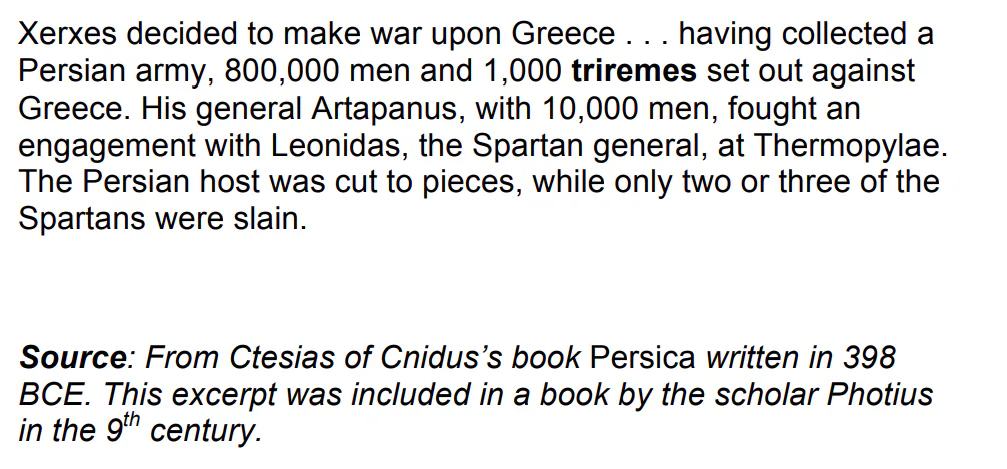
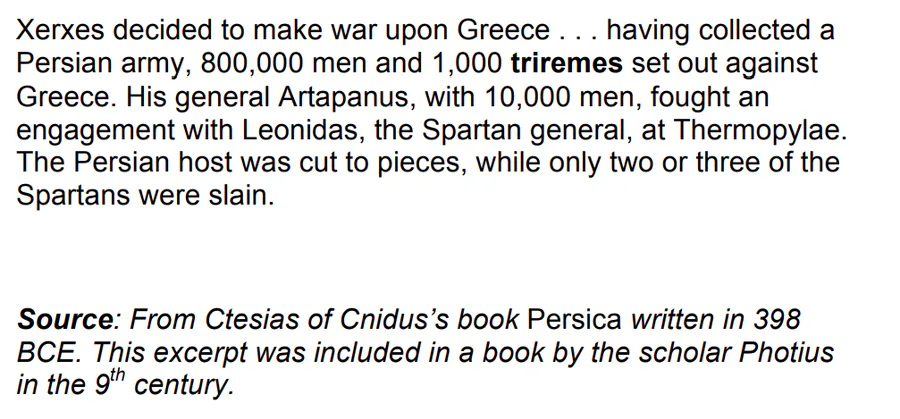
Who is the historian? And when was the account
written?
Ernle Bradford, 1980 CE
Herodotus, 450 - 420 BCE
Rupert Matthews, 2006 CE
Ctesias, 389 BCE
3
Multiple Select
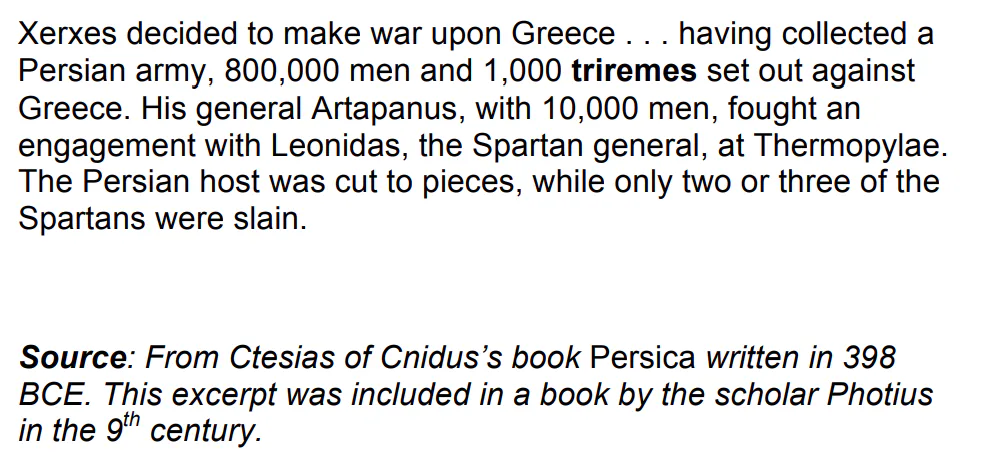
Based on this source, how many Persians do you think there were at the
Battle of Thermopylae?
10,000
350.000
200,000
800,000
4
Poll
Do you find this evidence reliable and
convincing?
Yes
No
5
6
7
8
Multiple Choice
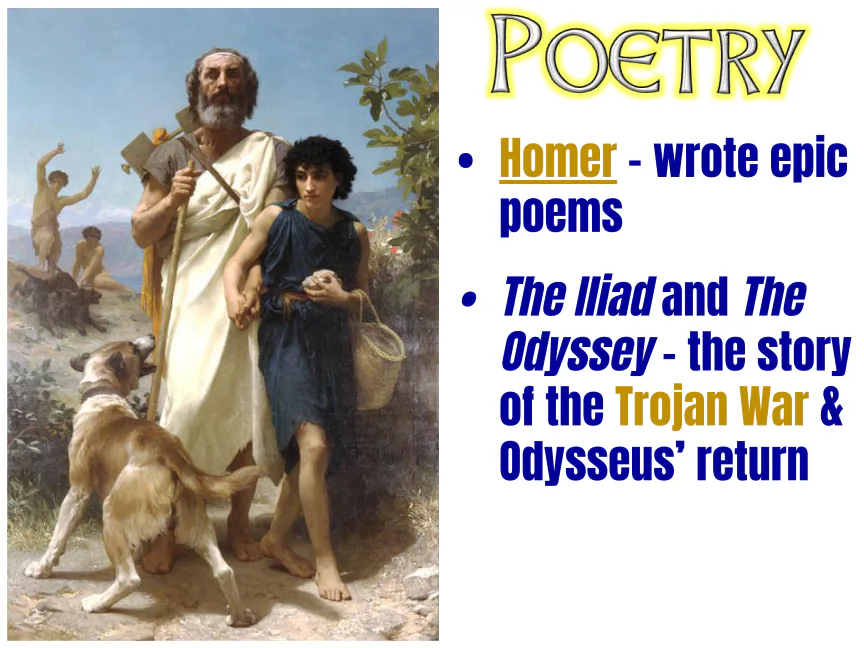
Who is the author of the epic poems?
Homer
Virgil
Ovid
Sappho
9
Multiple Choice
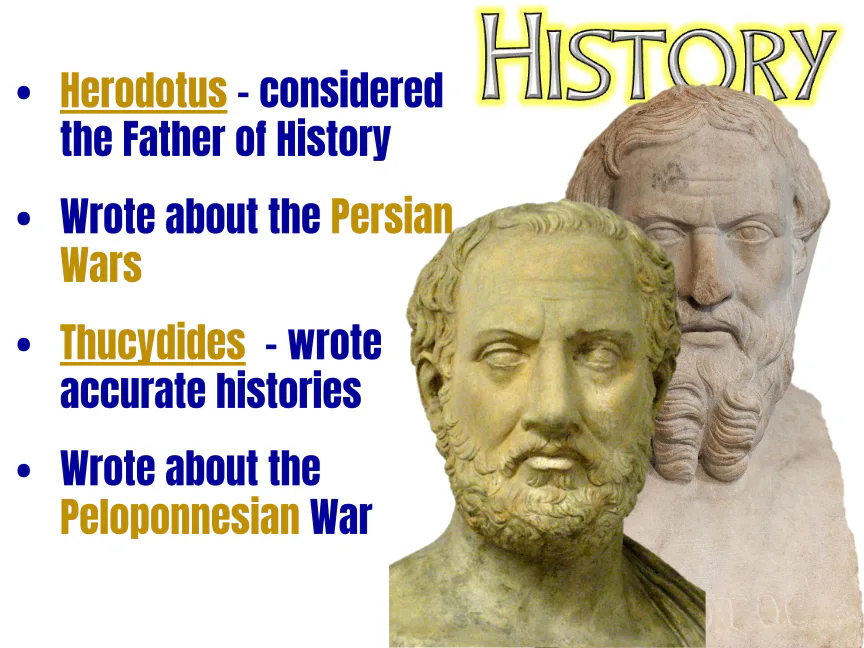
Who wrote about the Persian Wars?
Homer
Virgil
Herodotus
Thuycidides
10
Multiple Choice
Who wrote about the Peloponessian War?
Homer
Virgil
Herodotus
Thuycidides
11
12
13
Multiple Choice
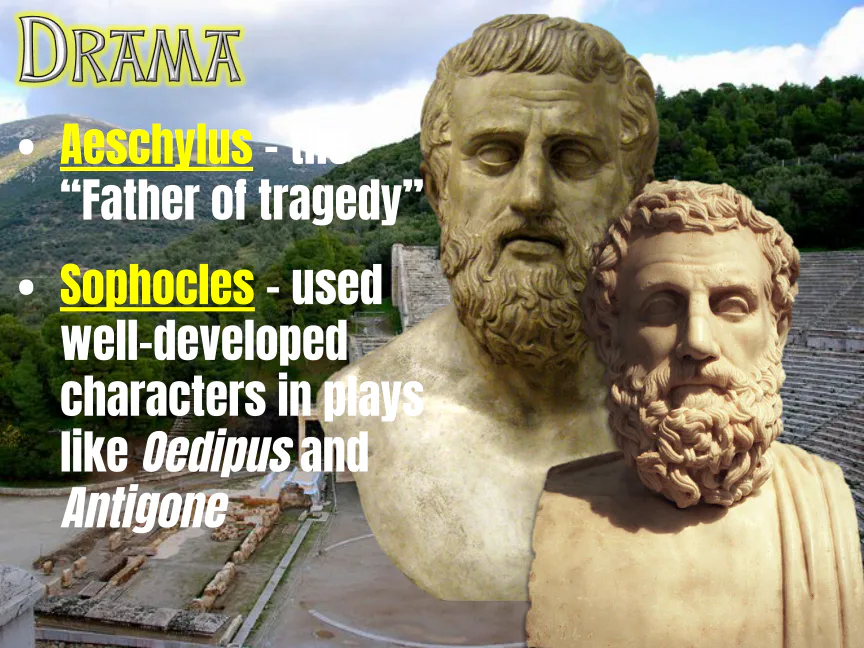
Who is considered the Father of Tragedy?
Sophocles
Philocles
Aeschylus
Thespis
14
Multiple Choice
Who wrote Antigone?
Sophocles
Philocles
Aeschylus
Thespis
15
16
17
Multiple Choice
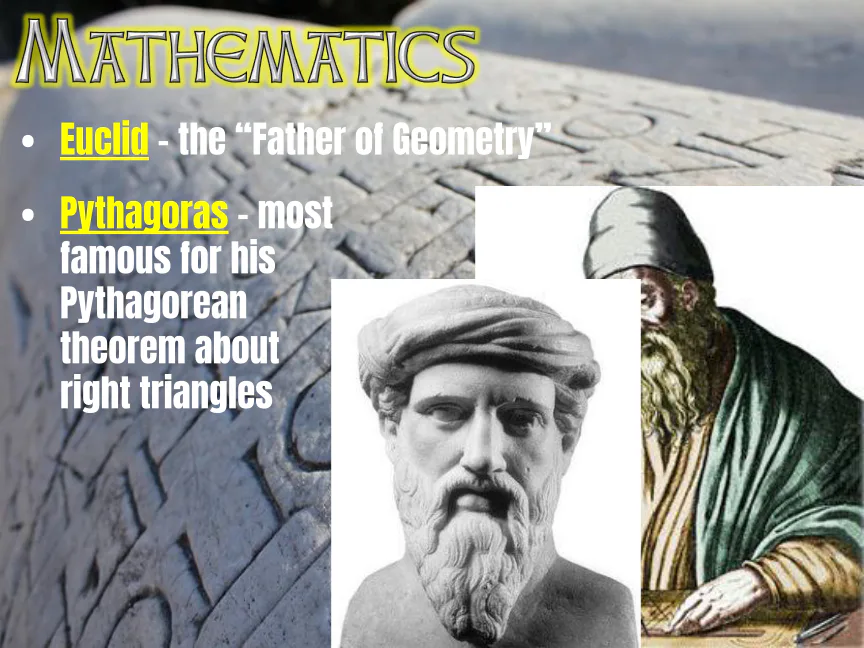
What is Pythagoras most famous for?
Calculus
Pythagorean theorem
Algebra
Geometry
18
Multiple Choice
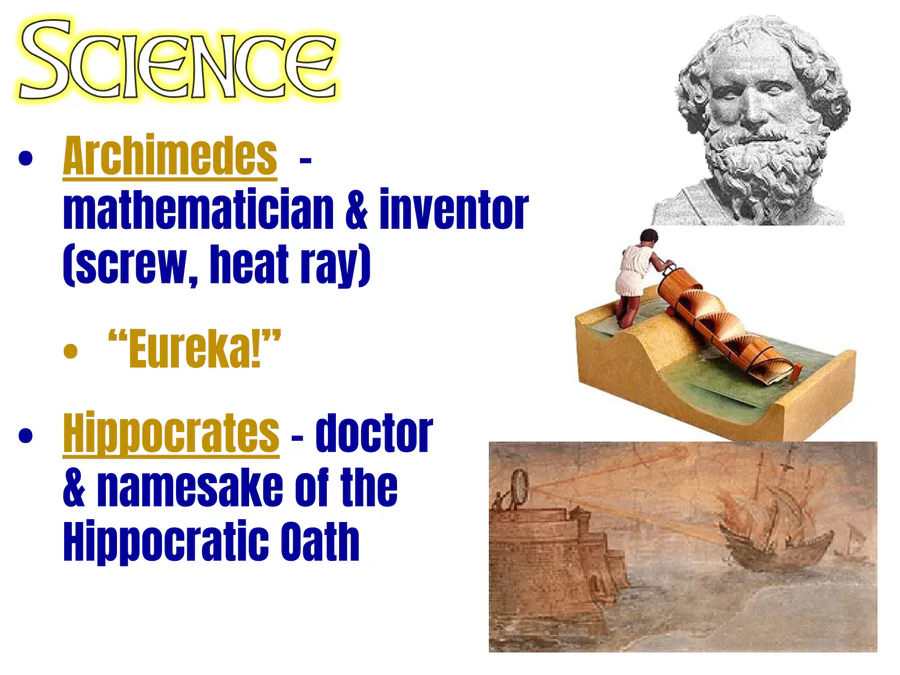
Who was the inventor and mathematician?
Archimedes
Hippocrates
Euclid
Pythagorus
19
Multiple Choice
Who was the Father of Geometery?
Archimedes
Hippocrates
Euclid
Pythagorus
20
Multiple Choice
Who is famous for his work in medicine?
Archimedes
Hippocrates
Euclid
Pythagorus
21
22
Multiple Choice
What did Socrates believe in that led to the development of the Socratic method?
Artistic expression
Lifelong learning and questioning
Military strategy
Economic trade
23
Multiple Choice
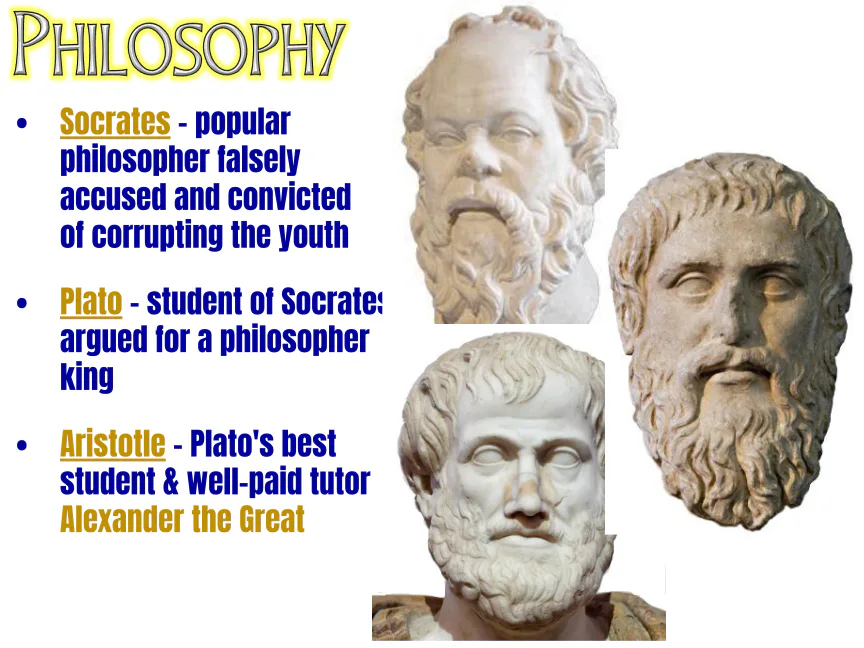
Who argued for a philosopher as king?
Socrates
Plato
Aristotle
24
Multiple Choice
Who was accused and convicted
of corrupting the youth?
Socrates
Plato
Aristotle
25
Multiple Choice
Who was the well-paid tutor of Alexander the Great?
Socrates
Plato
Aristotle
26
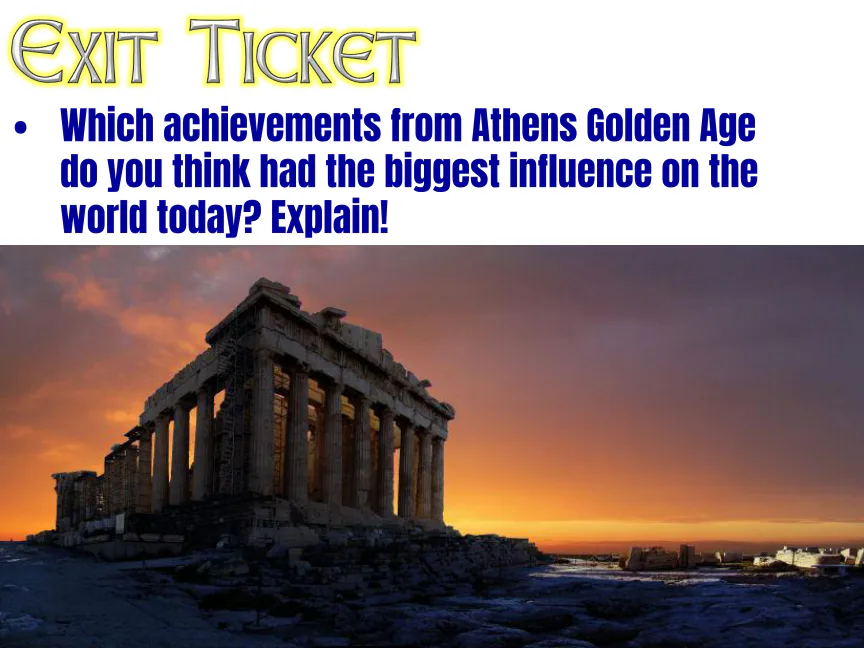
27
Poll
Which achievements from Athens Golden Age do you think had the biggest influence on the world today?
architecture/ sculpture
science/ medicine / mathematics
recording history
philosophy
drama/theatre/ poetry
28
Multiple Choice
The Greeks excelled in philosophy, sculpture, architecture, and ___________________.
theater
painting
electronics
transportation
29
Multiple Choice
During this time, the __________________, a temple dedicated to the goddess Athena, was rebuilt.
Parthenon
Pantheon
Oracle of Delphi
Erechtheion
30
Multiple Choice
The Greeks created ________________ or the search for wisdom and truth.
psychology
sociology
philosophy
the Scientific Method
31
Multiple Choice
____________ taught his students how to think by asking them questions.
Plato
Socrates
Crito
Aristotle
32
Multiple Choice
__________________ another lover of knowledge and wisdom was the tutor of Alexander the Great. He wrote and edited more than 200 books on various subjects including science and government.
Socrates
Plato
Aristotle
Crito
33
Multiple Choice

What type of Greek column is shown above?
Doric
Ionic
Corinthian
Tuscan
34
Multiple Choice
35
At the center of most city-states was an acropolis, a fortified hilltop where temples and important buildings were located. Athens became known for its direct democracy, a system in which citizens voted on laws and policies themselves rather than electing representatives. However, not everyone could vote—only free male citizens could participate.
Other Greek city-states had different forms of government. An oligarchy was ruled by a small group of powerful people, while an aristocracy was led by noble families who claimed their right to rule through birth. Sometimes power was taken by force in a tyranny, where one person seized control. Two early Athenian leaders, Draco and Solon, tried to reform laws and reduce social conflict. Draco created a harsh legal code, while Solon made fairer laws that gave citizens more rights.
36
At the center of most city-states was an acropolis, a fortified hilltop where temples and important buildings were located. Athens became known for its direct democracy, a system in which citizens voted on laws and policies themselves rather than electing representatives. However, not everyone could vote—only free male citizens could participate.
Other Greek city-states had different forms of government. An oligarchy was ruled by a small group of powerful people, while an aristocracy was led by noble families who claimed their right to rule through birth. Sometimes power was taken by force in a tyranny, where one person seized control. Two early Athenian leaders, Draco and Solon, tried to reform laws and reduce social conflict. Draco created a harsh legal code, while Solon made fairer laws that gave citizens more rights.
37
At the center of most city-states was an acropolis, a fortified hilltop where temples and important buildings were located. Athens became known for its direct democracy, a system in which citizens voted on laws and policies themselves rather than electing representatives. However, not everyone could vote—only free male citizens could participate.
Other Greek city-states had different forms of government. An oligarchy was ruled by a small group of powerful people, while an aristocracy was led by noble families who claimed their right to rule through birth. Sometimes power was taken by force in a tyranny, where one person seized control. Two early Athenian leaders, Draco and Solon, tried to reform laws and reduce social conflict. Draco created a harsh legal code, while Solon made fairer laws that gave citizens more rights.
38
At the center of most city-states was an acropolis, a fortified hilltop where temples and important buildings were located. Athens became known for its direct democracy, a system in which citizens voted on laws and policies themselves rather than electing representatives. However, not everyone could vote—only free male citizens could participate.
Other Greek city-states had different forms of government. An oligarchy was ruled by a small group of powerful people, while an aristocracy was led by noble families who claimed their right to rule through birth. Sometimes power was taken by force in a tyranny, where one person seized control. Two early Athenian leaders, Draco and Solon, tried to reform laws and reduce social conflict. Draco created a harsh legal code, while Solon made fairer laws that gave citizens more rights.
39
Greek religion centered on mythology, a collection of stories explaining natural events and human behavior through gods and heroes. The Greeks believed their gods lived on Mount Olympus. Zeus, the king of the gods, ruled the sky and thunder. Aphrodite, the goddess of love and beauty, was one of the most admired deities. Myths helped explain the world and gave lessons about virtue, courage, and fate.
40
Greek thinkers sought to understand the world through philosophy, which means “love of wisdom.” The philosopher Socrates encouraged students to question everything to seek truth. His student Plato founded the Academy in Athens and wrote about justice and government. Aristotle, Plato’s student, used logic and observation to study nature and human behavior—ideas that shaped Western science and education.
41
Greek thinkers sought to understand the world through philosophy, which means “love of wisdom.” The philosopher Socrates encouraged students to question everything to seek truth. His student Plato founded the Academy in Athens and wrote about justice and government. Aristotle, Plato’s student, used logic and observation to study nature and human behavior—ideas that shaped Western science and education.
42
Greek thinkers sought to understand the world through philosophy, which means “love of wisdom.” The philosopher Socrates encouraged students to question everything to seek truth. His student Plato founded the Academy in Athens and wrote about justice and government. Aristotle, Plato’s student, used logic and observation to study nature and human behavior—ideas that shaped Western science and education.
43
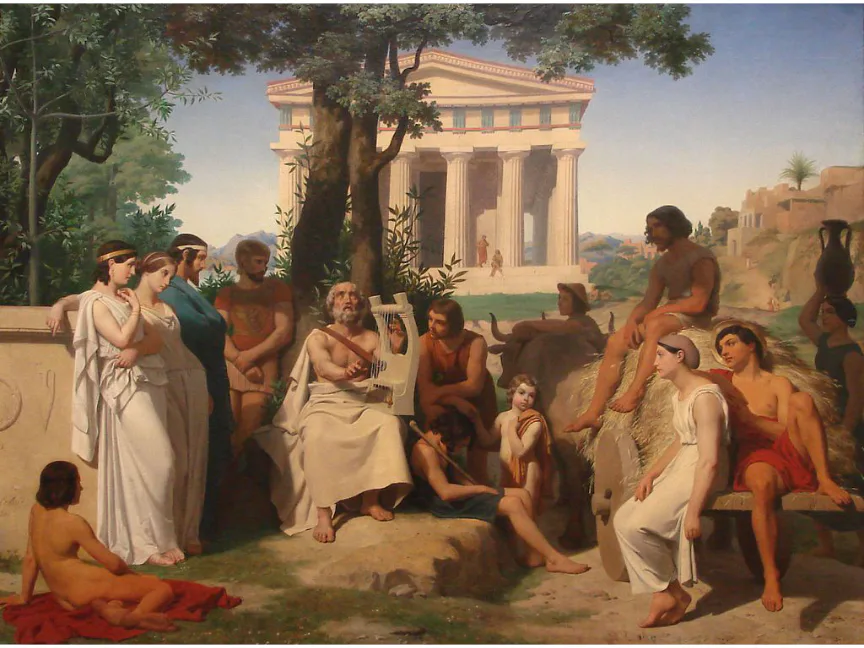
The Greeks loved stories. Homer, one of the greatest poets, wrote epic poems—long, heroic tales that celebrated bravery and adventure. His two masterpieces, the Iliad and the Odyssey, tell the stories of the Trojan War and the hero Odysseus’s journey home. Greek theater also flourished. Playwrights such as Aeschylus and Sophocles wrote tragedies—serious plays about human suffering and moral choices.
44
The Greeks loved stories. Homer, one of the greatest poets, wrote epic poems—long, heroic tales that celebrated bravery and adventure. His two masterpieces, the Iliad and the Odyssey, tell the stories of the Trojan War and the hero Odysseus’s journey home. Greek theater also flourished. Playwrights such as Aeschylus and Sophocles wrote tragedies—serious plays about human suffering and moral choices.
45
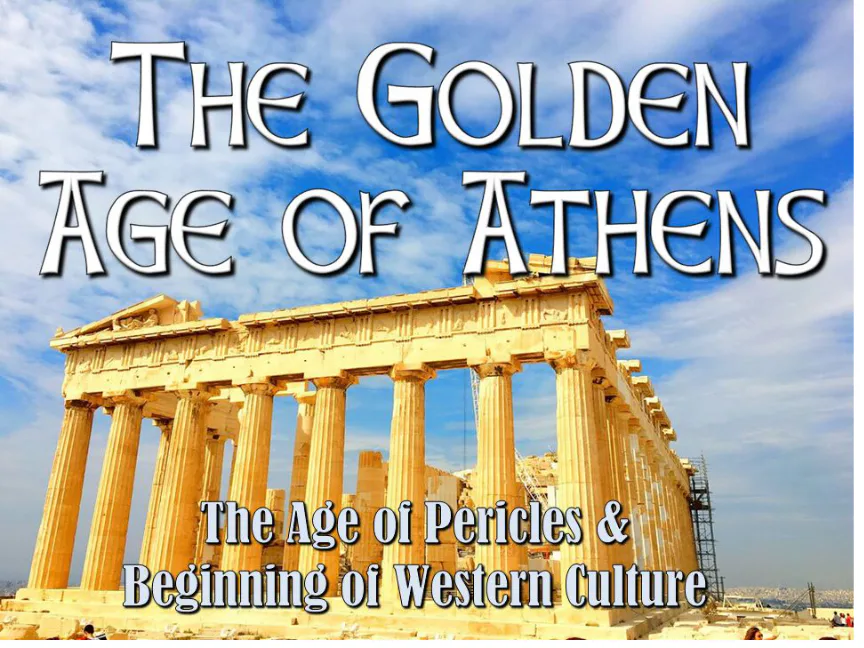
During the Golden Age of Pericles, Athens reached its height of power and culture. Pericles, a strong and democratic leader, encouraged art, philosophy, and architecture. The most famous building from this period is the Parthenon, a temple on the Athenian acropolis dedicated to Athena, the city’s patron goddess.
46
Greek architects developed three main styles of columns: Doric, Ionic, and Corinthian. Doric columns were simple and sturdy; Ionic columns were elegant with scroll-shaped tops; and Corinthian columns were the most decorative, with leaves and intricate designs. The sculptor Phidias created some of the most famous statues of the gods, including the great statue of Zeus at Olympia.
47
Greek architects developed three main styles of columns: Doric, Ionic, and Corinthian. Doric columns were simple and sturdy; Ionic columns were elegant with scroll-shaped tops; and Corinthian columns were the most decorative, with leaves and intricate designs. The sculptor Phidias created some of the most famous statues of the gods, including the great statue of Zeus at Olympia.
48
Greek architects developed three main styles of columns: Doric, Ionic, and Corinthian. Doric columns were simple and sturdy; Ionic columns were elegant with scroll-shaped tops; and Corinthian columns were the most decorative, with leaves and intricate designs. The sculptor Phidias created some of the most famous statues of the gods, including the great statue of Zeus at Olympia.
49
Greek architects developed three main styles of columns: Doric, Ionic, and Corinthian. Doric columns were simple and sturdy; Ionic columns were elegant with scroll-shaped tops; and Corinthian columns were the most decorative, with leaves and intricate designs. The sculptor Phidias created some of the most famous statues of the gods, including the great statue of Zeus at Olympia.
50
Greek scientists also made important discoveries. Pythagoras developed the Pythagorean Theorem, which is still used in geometry today. Euclid, known as the “Father of Geometry,” organized mathematical knowledge into a system still taught today. Archimedes studied physics and invented tools like the water screw and compound pulley. Hippocrates, often called the “Father of Medicine,” believed that diseases had natural causes and established an ethical code for doctors.
51
Greek scientists also made important discoveries. Pythagoras developed the Pythagorean Theorem, which is still used in geometry today. Euclid, known as the “Father of Geometry,” organized mathematical knowledge into a system still taught today. Archimedes studied physics and invented tools like the water screw and compound pulley. Hippocrates, often called the “Father of Medicine,” believed that diseases had natural causes and established an ethical code for doctors.
52
Greek scientists also made important discoveries. Pythagoras developed the Pythagorean Theorem, which is still used in geometry today. Euclid, known as the “Father of Geometry,” organized mathematical knowledge into a system still taught today. Archimedes studied physics and invented tools like the water screw and compound pulley. Hippocrates, often called the “Father of Medicine,” believed that diseases had natural causes and established an ethical code for doctors.
53
Greek scientists also made important discoveries. Pythagoras developed the Pythagorean Theorem, which is still used in geometry today. Euclid, known as the “Father of Geometry,” organized mathematical knowledge into a system still taught today. Archimedes studied physics and invented tools like the water screw and compound pulley. Hippocrates, often called the “Father of Medicine,” believed that diseases had natural causes and established an ethical code for doctors.
54
In the 5th century BCE, Greece faced a powerful enemy—the Persian Empire. The Persian Wars united the city-states against a common foe. Victories at battles such as Marathon and Salamis gave Greece confidence and pride. Afterward, Athens formed the Delian League, an alliance of city-states meant to defend against future attacks.
55
However, growing power created jealousy. Sparta and its allies formed the Peloponnesian League, which eventually fought Athens in the long and devastating Peloponnesian War. Historian Herodotus, often called the “Father of History,” wrote about the Persian Wars, while Thucydides documented the Peloponnesian War with a focus on human nature and politics.
56
The period of classical Greek civilization is called Hellenic, meaning purely Greek. After years of internal fighting, the Greek city-states became weak. In the north, Philip of Macedon saw an opportunity. He conquered Greece and united it under his rule. His son, Alexander the Great, went on to build one of the largest empires in history. As Alexander conquered Egypt, Persia, and parts of India, Greek culture mixed with Eastern traditions. This blending of cultures is known as the Hellenistic period.
Cities like Byzantium (later known as Constantinople) became centers of trade and learning during this era. Greek art, science, and philosophy spread across the known world, influencing cultures for centuries to come.
57
The period of classical Greek civilization is called Hellenic, meaning purely Greek. After years of internal fighting, the Greek city-states became weak. In the north, Philip of Macedon saw an opportunity. He conquered Greece and united it under his rule. His son, Alexander the Great, went on to build one of the largest empires in history. As Alexander conquered Egypt, Persia, and parts of India, Greek culture mixed with Eastern traditions. This blending of cultures is known as the Hellenistic period.
Cities like Byzantium (later known as Constantinople) became centers of trade and learning during this era. Greek art, science, and philosophy spread across the known world, influencing cultures for centuries to come.
58
The period of classical Greek civilization is called Hellenic, meaning purely Greek. After years of internal fighting, the Greek city-states became weak. In the north, Philip of Macedon saw an opportunity. He conquered Greece and united it under his rule. His son, Alexander the Great, went on to build one of the largest empires in history. As Alexander conquered Egypt, Persia, and parts of India, Greek culture mixed with Eastern traditions. This blending of cultures is known as the Hellenistic period.
Cities like Byzantium (later known as Constantinople) became centers of trade and learning during this era. Greek art, science, and philosophy spread across the known world, influencing cultures for centuries to come.
Show answer
Auto Play
Slide 1 / 58
SLIDE
Similar Resources on Wayground

53 questions
SSA Earth Review All Topics
Presentation
•
9th Grade
58 questions
Africa Map 1
Presentation
•
9th Grade
50 questions
3A Vocab Lesson
Presentation
•
9th Grade
55 questions
Earth Science Review Lesson
Presentation
•
8th Grade
55 questions
Science TCAP Practice
Presentation
•
8th Grade
52 questions
Protein & Enzymes DT 22-23 ADV
Presentation
•
9th Grade
53 questions
French Foods and Dining Customs
Presentation
•
8th Grade
58 questions
Executive Branch part 1
Presentation
•
9th Grade
Popular Resources on Wayground
21 questions
Continents and Oceans

Quiz
•
6th Grade
20 questions
Parts of Speech
Quiz
•
5th Grade
16 questions
Subject & Predicate
Quiz
•
5th Grade
25 questions
Multiplication Facts
Quiz
•
5th Grade
12 questions
Map Skills
Quiz
•
3rd Grade
22 questions
Continents and Oceans
Quiz
•
5th Grade
15 questions
Rounding Decimals
Quiz
•
5th Grade
20 questions
Brand Labels
Quiz
•
5th - 12th Grade
Discover more resources for Social Studies
10 questions
Exploring the Age of Exploration: Key Events and Figures

Interactive video
•
6th - 10th Grade
10 questions
Exploring Ancient Mesopotamia Through Song
Interactive video
•
6th - 10th Grade
18 questions
Understanding Population Pyramids Quiz
Quiz
•
9th Grade
25 questions
World Geo Unit 3 Review
Quiz
•
9th Grade
33 questions
Unit 3 Western Classical Civilizations Review
Quiz
•
9th Grade
23 questions
Unit 2 Review
Quiz
•
9th Grade
19 questions
Spanish American War
Presentation
•
8th - 12th Grade
44 questions
Q1 Civics Review
Quiz
•
7th - 9th Grade