

Bài thuyết trình chưa có tiêu đề

Presentation
•
Science
•
University
•
Practice Problem
•
Medium

Quốc Nhựt
Used 1+ times
FREE Resource
61 Slides • 28 Questions
1

2

3
Multiple Choice
Which of the following is a genetic disorder that affects blood clotting?
Thrombocytopenia
Hemophilia
Anemia
Leukemia
4
Open Ended
Why is understanding molecular biology important in the study of hematological diseases such as thrombocytopenia, hemophilia, and coagulation disorders?
5

6
Multiple Choice
What is the main cause of thrombocytopenic purpura according to its definition?
Destruction of platelets in peripheral blood
Increased platelet production in bone marrow
Decreased destruction of platelets
Increased red blood cell count
7

8
Open Ended
Describe the appearance of platelets under a microscope and explain their significance in diagnosing thrombocytopenic purpura.
9

10
Multiple Choice
Which of the following is NOT a cause of decreased platelet production?
Congenital conditions
Bone marrow suppression due to disease
Immune-mediated destruction in peripheral blood
Radiation exposure
11

12
Multiple Select
Select all the causes of increased platelet destruction in peripheral blood.
Immune-mediated thrombocytopenia
Congenital platelet structure disorders
Bone marrow failure
Disseminated intravascular coagulation (DIC)
13

14
Fill in the Blanks
Type answer...
15

16
Open Ended
What are the main clinical manifestations of thrombocytopenic purpura, and how do they differ between age groups and genders?
17

18

19

20
Multiple Choice
Which of the following is NOT a common symptom of immune thrombocytopenic purpura (ITP) as shown in the images?
Petechiae on lower limbs
Unexplained nosebleeds
Multiple bruises on the skin
High fever
21

22
23
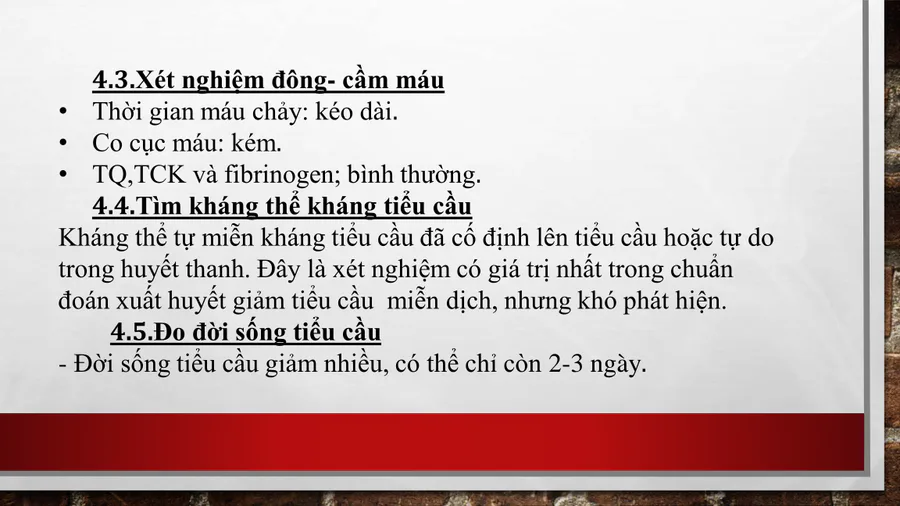
Multiple Choice
What is the most valuable laboratory test for diagnosing immune thrombocytopenic purpura (ITP) according to the slides?
Platelet count
Bone marrow biopsy
Detection of antiplatelet antibodies
White blood cell count
24
Multiple Select
Which laboratory findings are typically observed in patients with immune thrombocytopenic purpura (ITP)?
Decreased platelet count
Increased white blood cell count
Normal coagulation tests
Decreased platelet lifespan
25
Open Ended
Explain how laboratory findings help differentiate immune thrombocytopenic purpura (ITP) from other bleeding disorders.
26

27
Open Ended
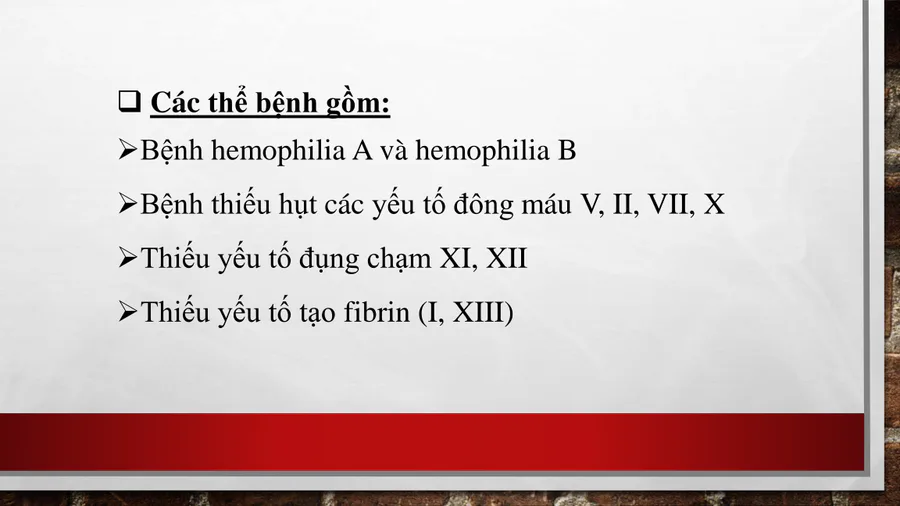
Describe the difference between hemophilia A and hemophilia B based on the clotting factors involved.
28
Fill in the Blanks
Type answer...
29

30
Multiple Choice
Which protein is responsible for normal blood clotting in healthy individuals, as shown in the diagram?
Hemoglobin
Protein đông máu
Albumin
Insulin
31

32
Open Ended
Describe the clinical symptoms that differentiate joint bleeds from a healthy joint in hemophilia patients.
33

34
Multiple Select
Which of the following are common symptoms observed in hemophilia patients based on the images?
Bruising
Swelling of joints
Fever
Joint bleeds
35

36
Fill in the Blanks
Type answer...
37

38
Multiple Choice
What is the prevalence rate of hemophilia A among hemophilia cases worldwide?
10% - 15%
20% - 25%
80% - 85%
50% - 60%
39

40
Open Ended
Explain the role of factor VIII and its genetic location in the process of blood clotting.
41

42
Multiple Choice
Which chromosome contains the gene for coagulation factor IX, and what is its significance in hemophilia B?
Chromosome X; it causes hemophilia B when mutated.
Chromosome Y; it causes hemophilia A when mutated.
Chromosome 22; it is unrelated to hemophilia.
Chromosome 8; it causes hemophilia C when mutated.
43

44
Open Ended
Describe the types of genetic mutations commonly found in hemophilia and how they differ between factor VIII and factor IX.
45

46
Fill in the Blanks
Type answer...
47

48
Multiple Choice
What is the principle behind using PCR-RFLP to detect hemophilia carriers?
It identifies specific polymorphisms in the gene of interest.
It amplifies all genes in the genome.
It sequences the entire genome.
It detects protein levels in blood samples.
49

50
Multiple Choice
Which requirements must be met to perform PCR-RFLP for hemophilia carrier detection?
Mother must be a confirmed carrier and both parents' polymorphisms must be tested.
Only the father's polymorphism needs to be tested.
No family history is required.
Only the patient's DNA is needed.
51

52
Multiple Choice
Who is indicated for hemophilia carrier testing according to the guidelines?
Any woman with a family history of hemophilia who wants to determine carrier status.
Any man with hemophilia.
Any child with bleeding disorders.
Any person with no family history of hemophilia.
53

54

55

56

57

58

59

60

61

62

63

64

65

66

67

68

69

70

71

72

73

74

75

76
77

78

79

80

81

82

83

84

85
86

87

88
Multiple Choice
Which of the following is a bleeding disorder characterized by a deficiency of clotting factors?
Thrombocytopenia
Hemophilia
Leukemia
Anemia
89
Open Ended
Reflecting on today's lesson about molecular biology in hematological diseases, which topic did you find most interesting and why?
Show answer
Auto Play
Slide 1 / 89
SLIDE
Similar Resources on Wayground

81 questions
Unidad 5 llevel 1 2021-2
Presentation
•
University
83 questions
Order Operation Exponents
Presentation
•
KG - University
84 questions
Rotational Dynamics
Presentation
•
12th Grade
81 questions
Math 1111 - College Algebra - Test 1 Review
Presentation
•
University
81 questions
Nuclear Chemistry
Presentation
•
University
83 questions
NU CVS drugs (HT) 2568
Presentation
•
University
83 questions
Microbiology Chapter 8
Presentation
•
University
85 questions
Bahasa Inggris 1 - Meeting 1 and 2
Presentation
•
University
Popular Resources on Wayground
28 questions
US History Regents Review

Quiz
•
11th Grade
36 questions
Biology Regents Review
Quiz
•
9th - 10th Grade
20 questions
Math Review
Quiz
•
3rd Grade
38 questions
Regents Life Science General Review
Quiz
•
9th Grade
20 questions
Math Review
Quiz
•
6th Grade
21 questions
EOY Grade 6 Benchmark Assessment - Content Skills
Quiz
•
6th Grade
20 questions
Inferences
Quiz
•
4th Grade
20 questions
Figurative Language Review
Quiz
•
6th Grade