Search Header Logo
Unit 1 Review

Unit 1 Review

Assessment

Presentation

Science

6th Grade

Medium

NGSS
MS-PS1-2, MS-PS1-1, MS-PS1-4

+2

Standards-aligned

Created by

Tanisha Ruff

Used 6+ times

FREE Resource

21 Slides • 43 Questions

1

media

2

media

3

media

4

media
media

5

Multiple Choice

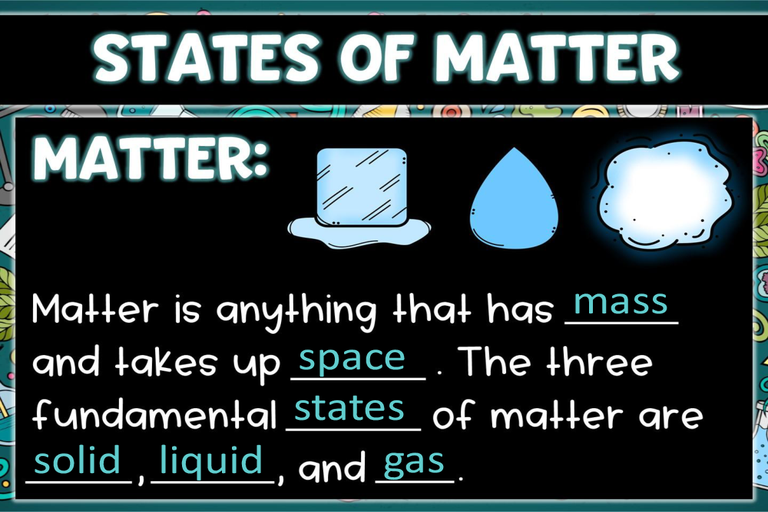
T/F. Particles in a solid VIBRATE in place.

1

True

2

False

6

Multiple Choice

WHICH OF THE FOLLOWING BEST APPLIES TO SOLIDS?

1

SOLIDS HAVE A DEFINITE SHAPE AND DEFINITE VOLUME.

2

SOLIDS HAVE NO DEFINITE SHAPE AND DEFINITE VOLUME.

3

SOLIDS HAVE A DEFINITE SHAPE BUT NO DEFINITE VOLUME.

7

media
media

8

Multiple Choice

WHICH OF THE FOLLOWING BEST APPLIES TO LIQUIDS?

1

LIQUIDS HAVE A DEFINITE SHAPE AND DEFINITE VOLUME.

2

LIQUIDS HAVE NO DEFINITE SHAPE AND DEFINITE VOLUME.

3

LIQUIDS HAVE A DEFINITE SHAPE BUT NO DEFINITE VOLUME.

9

media
media

10

Multiple Choice

WHICH OF THE FOLLOWING BEST APPLIES TO GASES?

1

GASES HAVE NO DEFINITE SHAPE AND NO DEFINITE VOLUME.

2

GASES HAVE NO DEFINITE SHAPE AND DEFINITE VOLUME.

3

GASES HAVE A DEFINITE SHAPE BUT NO DEFINITE VOLUME.

11

media

12

Fill in the Blank

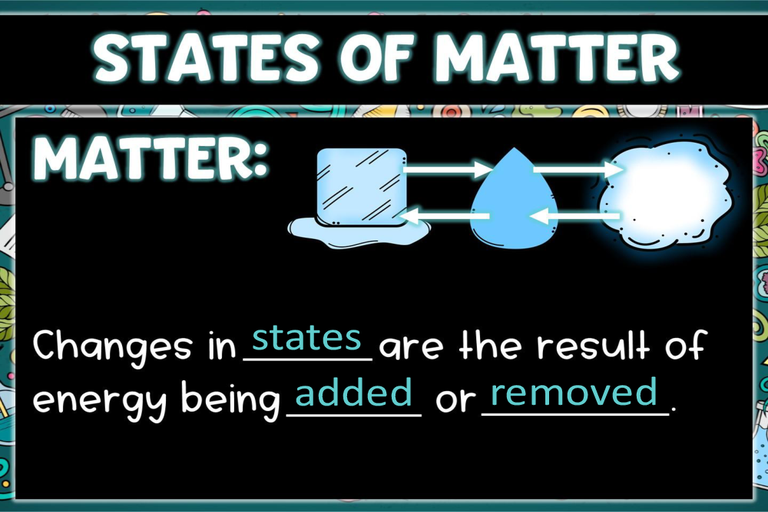
CHANGES IN STATE OF MATTER ARE CAUSED BY CHANGES IN ____________ OF THE SUBSTANCE.

13

Multiple Choice

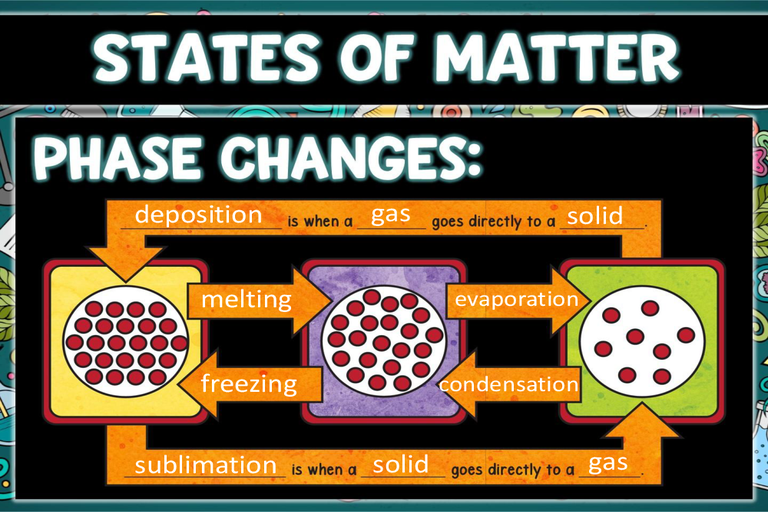
What is the temperature at which a liquid changes to a gas?

1

liquid point

2

gas point

3

melting point

4

boiling point

14

Multiple Choice

What is the temperature at which a solid changes to a liquid?

1

liquid point

2

solid point

3

melting point

4

boiling point

15

media

16

Multiple Choice

Question image

Use the image to help you. What is the process of a gas changing to liquid?

1

condensation

2

evaporation

3

sublimation

4

deposition

17

Multiple Choice

Question image

Use the image to help you. What is the process of a gas changing to solid?

1

condensation

2

evaporation

3

sublimation

4

deposition

18

media

Density

media

19

Key Vocabulary

media

Density

Density is the amount of matter in a given space, or the ratio of mass to volume.

media

Mass

Mass is a measure of the amount of matter an object contains and is not affected by gravity.

media

Volume

Volume is the amount of three-dimensional space that an object or substance occupies or contains within.

media

Water Displacement

A method for measuring the volume of an irregularly shaped object by submerging it in water.

20

The Formula for Density

media
media
media
media

21

Finding Mass and Volume

media

Finding Mass

  • The mass of an object is measured with a triple beam balance.

  • Mass is the amount of matter present in any given object.

  • The standard unit for mass is grams (g) or kilograms (kg).

media

Volume of Regular Shapes

media

Volume of Irregular Shapes

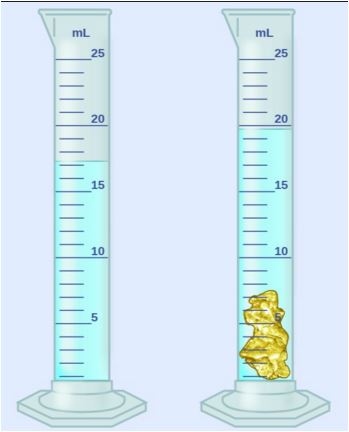
  • Use the water displacement method to find the volume of irregular objects.

  • Place the object in a graduated cylinder that is filled with water.

  • The volume is the difference in final and initial water levels.

media
media
media

22

How to Measure Volume

23

Will It Float or Sink?

Why It Floats

  • An object will float if it is less dense than the liquid it is placed in.

  • The density of pure water is a benchmark, which is about 1 gram per cubic centimeter (1 g/cm3).

  • For example, ice has a density of 0.93 g/cm3, which is why it floats in water.

media

Why It Sinks

media
  • An object will sink if it is more dense than the liquid it is placed in.

  • This means its density is greater than water's density of 1 gram per cubic centimeter (1 g/cm3).

  • For example, aluminum has a density of 2.7 g/cm3, which causes it to sink in water.

media
media
media

24

Multiple Choice

An object has a density of 1.4 g/mL. What will happen when it is placed in a container of pure water (density 1.0 g/mL)?

1

It will hover in the middle of the water.

2

It will dissolve in the water.

3

It will float on the surface.

4

It will sink to the bottom.

25

Multiple Choice

Question image
An irregularly shaped piece of gold was lowered into a graduated cylinder holding a volume of water equal to 17 ml. The height of the water rose to 20 ml. If the mass of the gold was 27 g, what was its density?
1
9 g/mL
2
10.5 g/mL
3
6.5 g/mL
4
8 g/mL

26

Multiple Choice

Question image
An irregularly shaped rock was lowered into a graduated cylinder holding a volume of water equal to 50 ml. The height of the water rose to 75 ml. If the mass of the stone was 250 g, what was its density?
1
15 g/mL
2
5 g/mL
3
10 g/mL
4
20 g/mL

27

Multiple Choice

Question image
An irregularly shaped stone was lowered into a graduated cylinder holding a volume of water equal to 200 ml. The height of the water rose to 280 ml. If the mass of the stone was 240 g, what was its density?
1
3 g/mL
2
4 g/mL
3
2 g/mL
4
5 g/mL

28

Multiple Choice

Question image
How much water has been displaced in the image shown?
1
40 mL
2
65 mL
3
20 mL
4
25 mL

29

Multiple Choice

Question image
How much water has been displaced in the image shown?
1
80 mL
2
100 mL
3
20 mL
4
60 mL

30

Multiple Choice

A lead cylinder has a mass of 540 grams and a volume of 2.70 mL.  Calculate the density of the lead cylinder. Remember to move the decimal on both sides of the problem.
1

150 g/mL

2

190 g/mL

3

200 g/mL

4

120 g/mL

31

Multiple Choice

An irregular shaped object was lowered into a graduated cylinder holding a volume of water equal to 50 ml. The height of the water rose to 57 ml. If the mass of the stone was 140 g, what was its density?
1
57 g/mL
2
50 g/mL
3
20 g/mL
4
107 g/mL

32

Multiple Choice

Question image
What is the volume of Spongebob Squarepants based on the displacement of the water in the graduated cylinder. 
1
50mL
2
52mL
3
102mL
4
2mL

33

Multiple Choice

Question image
What is the volume of the jade based on the displacement of the water in the graduated cylinder.
1
50.0mL
2
10.5mL
3
60.5mL
4
110.5mL

34

Multiple Choice

Question image
What is the volume of the yellow object based on the displacement of the water in the graduated cylinder.
1
10mL
2
50mL
3
60mL
4
110mL

35

Multiple Choice

A block of aluminum occupies a volume of 15.0 mL and weighs 40.5 g. What is its density?
1
2.8g/mL
2
2.7g/mL
3
2.66.g/mL
4
2.5g/mL

36

media

Metals, Nonmetals, and Metalloids

Middle School

media

37

media

38

Key Vocabulary

media

Luster

The metallic shine of a substance that tells us how it reflects light from its surface.

media

Malleability

The ability of a substance to be hammered or shaped into thin sheets without breaking or cracking.

media

Ductility

The ability of a substance to be stretched or pulled into a thin wire without breaking.

media

Conductivity

The measure of a substance's ability to conduct heat or an electrical current.

media

Brittle

A characteristic of a substance that is hard but is likely to break or shatter easily.

media

Semiconductors

Substances that conduct electricity and heat better than nonmetals but not as well as metals.

39

media

40

media

Some text here about the topic of discussion.

  • ​Shiny luster

  • Malleable

  • ​Good conductors

  • ​Ductile

  • ​High density

Metal Physical Properties

41

media
  • Dull

  • ​Brittle

  • Not malleable

  • Insulator

  • Not ductile​

Some text here about the topic of discussion.

Nonmetal Physical Properties

42

media
  • ​Typically solids

  • Can be shiny or dull

  • Can be malleable

  • Can be ductile

  • Can be brittle

  • Good semiconductor​

Metalloid Physical Properties

43

Multiple Choice

Which of the following is a key characteristic of metalloids?

1

Used as semiconductors

2

Ductile

3

Insulator

4

Malleable

44

Multiple Choice

Which of these is a property of metals?

1

It's malleable

2

It's an insulator

3

It's very brittle

45

Multiple Choice

Which element category could have the characteristic of brittle? Choose the best answer.

1

Metal

2

Nonmetal

3

Metalloid

4

Metalloid and Nonmetal

46

Multiple Choice

Silicon is a semiconductor and has properties of both metals and nonmetals. What type of element is Silicon?

1

Metal

2

Nonmetal

3

Metalloid

47

Multiple Choice

All of these properties describe metals except...

1

malleable

2

conductors

3

brittle

4

shiny

48

Multiple Choice

One property of a nonmetals is that it is a good conductor of electricity?
1
true
2
false

49

Multiple Choice

All of the following would classify an element as a metal except?

1

Dull

2

Lustrous

3

Malleable

4

Conductor

50

Multiple Choice

Question image
1

Metal

2

Nonmetal

3

Metalloid

51

Multiple Choice

Question image
1

Metal

2

Nonmetal

3

Metalloid

52

Multiple Choice

Question image
1

Metal

2

Nonmetal

3

Metalloid

53

Multiple Choice

Question image
1

Metal

2

Nonmetal

3

Metalloid

54

Multiple Choice

Question image
1

Metal

2

Nonmetal

3

Metalloid

55

Multiple Choice

Question image
1

Metal

2

Nonmetal

3

Metalloid

56

Multiple Choice

Question image
1

Metal

2

Nonmetal

3

Metalloid

57

Multiple Choice

Metals are malleable and ductile.

1
TRUE
2
FALSE

58

Multiple Choice

Which elements are found on the right side of The Periodic Table?
1
Metals
2
Nonmetals
3
Metalloids
4
Water

59

Multiple Choice

Question image

Which element is a nonmetal?

1
Titanium
2
Selenium
3
Potassium
4
Polonium

60

Multiple Choice

Question image
Which element is a metalloid?
1
Titanium
2
Selenium
3
Potassium
4
Polonium

61

Multiple Choice

Anytime you see the word SEMICONDUCTOR - what substance do you have?
1
Metal
2
Nonmetal
3
Metalloid

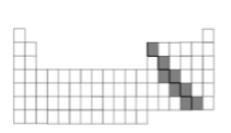
62

Multiple Choice

Question image

What category of elements is shaded in the periodic table?

1

Metals

2

Nonmetals

3

Metalloids

63

Multiple Choice

Question image

What category of elements is shaded in the periodic table?

1

Metalloids

2

Metals

3

Nonmetals

64

Multiple Choice

Question image
Look at the periodic table that is provided. Where would nonmetals be located? 
1
to the left of the table 
2
to the right of the table 
3
in the zigzag line 
media

Show answer

Auto Play

Slide 1 / 64

SLIDE