Ch 11 - Cell Reproduction and Cancer (Abrev.)
Presentation
•
Science
•
9th - 12th Grade
•
Practice Problem
•
Medium
+4
Standards-aligned
Gabriella Dalton
Used 3+ times
FREE Resource
25 Slides • 24 Questions
1
2
Word Cloud
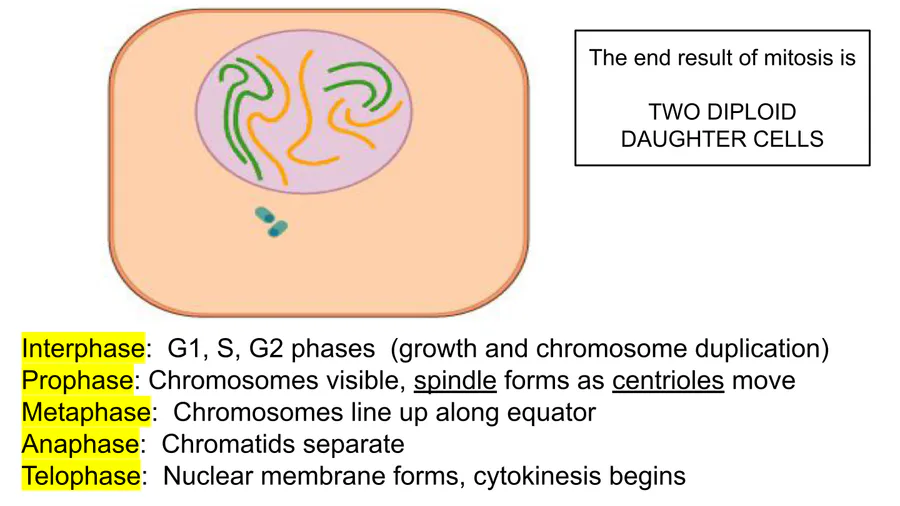
What do you know about the process shown in this image?
3
4
Poll
Why is cell reproduction important for living organisms?
It allows organisms to grow and repair tissues.
It helps organisms to breathe.
It enables organisms to digest food.
It allows organisms to move.
5
6
7
Multiple Choice
Which of the following statements correctly describes the difference between prokaryotic and eukaryotic DNA?
Prokaryotic DNA is enclosed in a nucleus, eukaryotic DNA is not.
Eukaryotic DNA is found in a loop, prokaryotic DNA is linear.
Prokaryotic DNA is single and circular, eukaryotic DNA is enclosed in a nucleus.
Both prokaryotic and eukaryotic DNA are always found in plasmids.
8
9
Multiple Choice
The Endosymbiosis Theory explains the origin of which type of cell?
Prokaryotic cells
Eukaryotic cells
Both prokaryotic and eukaryotic cells
Virus cells
10
11
Fill in the Blanks
12
13
Multiple Select
Which of the following statements are true about diploid and haploid cells?
Diploid cells have two sets of chromosomes.
Haploid cells have only one set of chromosomes.
Body cells are usually haploid
Sex cells are usually haploid.
14
15
Multiple Choice
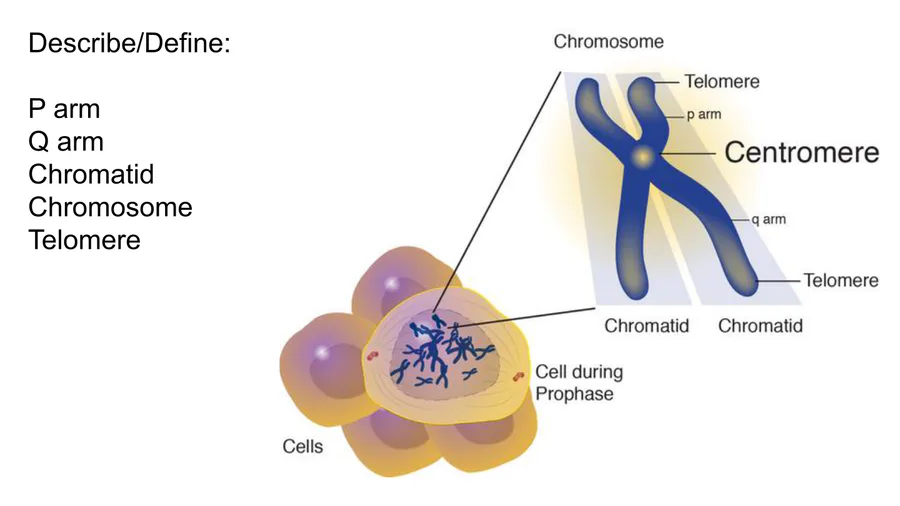
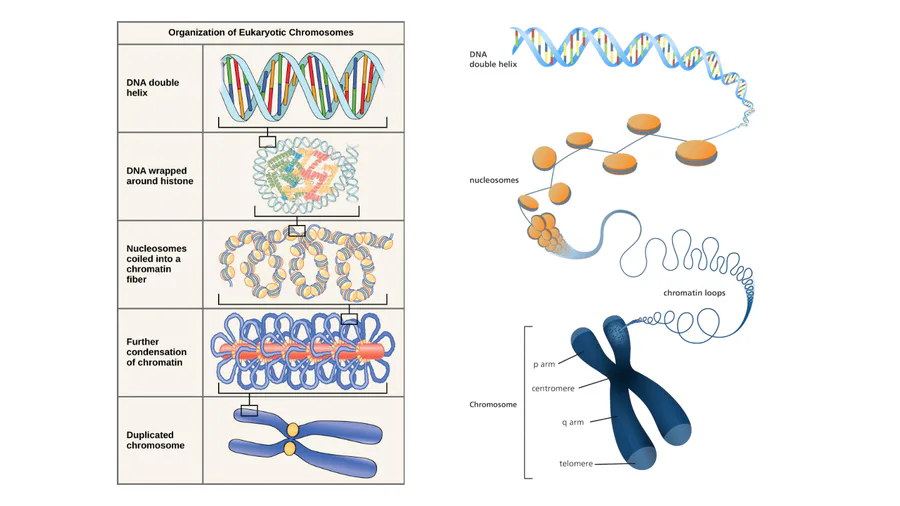
Which of the following correctly matches the chromosome structure with its description?
P arm: the longer arm of the chromosome
Q arm: the shorter arm of the chromosome
Centromere: the region joining two chromatids
Telomere: the end region of a chromosome
16
17
18
Multiple Select
Which of the following are events that occur during the M-phase (Mitotic Phase) of the cell cycle?
DNA synthesis
Nuclear division
Cytoplasmic division
Cell growth
19
Multiple Choice
The cell cycle consists of interphase and the mitotic phase. Fill in the blank: The phase where DNA synthesis occurs is called the ___ phase.
G1
G2
M
20
21
Multiple Choice
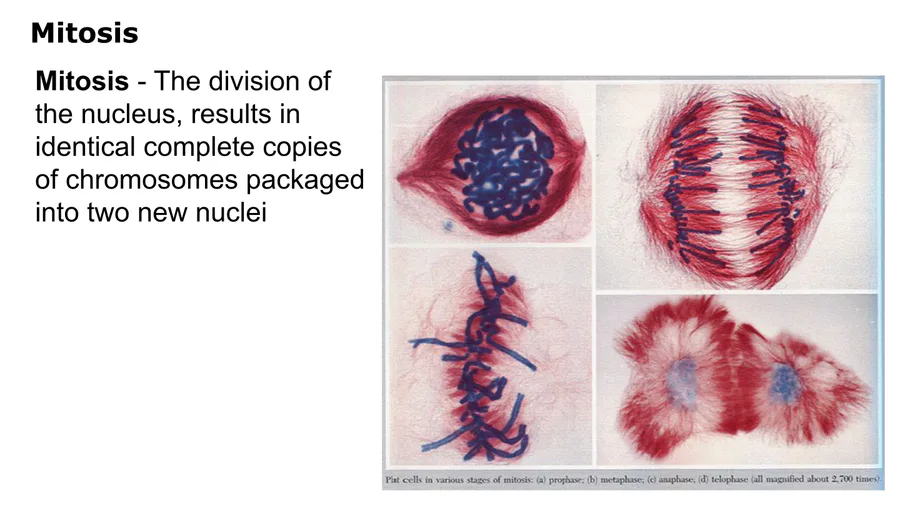
What is the main outcome of mitosis in eukaryotic cells?
Production of four daughter cells with half the chromosome number
Formation of two identical nuclei containing complete copies of chromosomes
Replication of DNA without cell division
Synthesis of proteins for cell growth
22
23
24
25
Multiple Choice
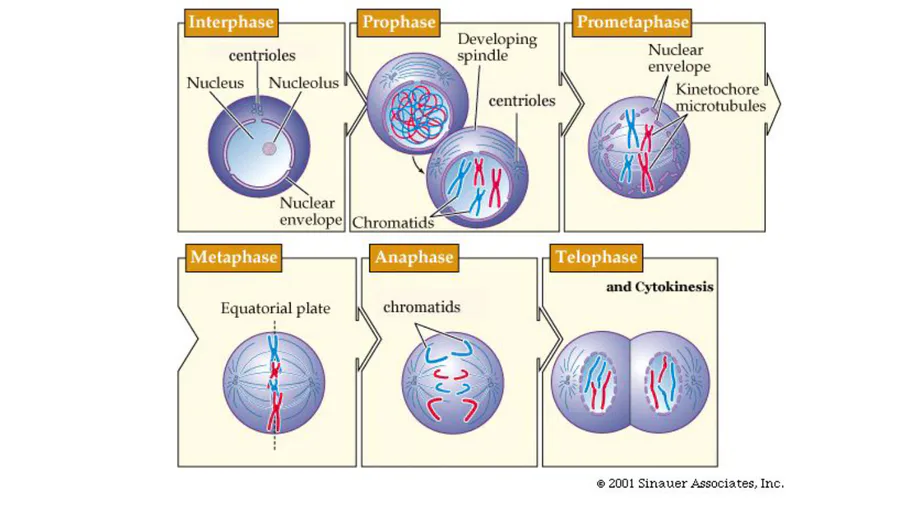
Which phase of mitosis is characterized by the alignment of chromosomes along the metaphase plate?
Prophase
Metaphase
Anaphase
Telophase
26
27
Fill in the Blanks
28
29
Labelling
Label the picture
Interphase
Prophase
Metaphase
Anaphase
Telophase
Cytokinesis
30
Open Ended
Describe the main events that occur during the process of cytokinesis in both animal and plant cells.
31
32
Hotspot
Which cell is in Anaphase?
33
34
Multiple Choice
Which of the following best describes the difference between benign and malignant neoplasms?
Benign neoplasms are cancerous, malignant neoplasms are not
Benign neoplasms do not spread, malignant neoplasms can metastasize
Benign neoplasms have abnormal nuclei, malignant neoplasms do not
Benign neoplasms form tumors, malignant neoplasms do not
35
Multiple Select
Which of the following are characteristics of cancerous cells?
Lack differentiation
Have abnormal nuclei
Form tumors
Undergo apoptosis
36
37
Open Ended
What is the role of checkpoints in the cell cycle, and what happens if a cell fails a checkpoint?
38
39
40
Multiple Choice
Which of the following best describes the mitotic index?
The ratio of cells undergoing mitosis to the total number of cells
The ratio of cells not undergoing mitosis to the total number of cells
The ratio of cells undergoing mitosis to cells not undergoing mitosis
The ratio of cells in interphase to cells in mitosis
41
Open Ended
Explain how mutations in the p53 gene can contribute to the development of cancer.
42
43
Open Ended
What did you notice between the two samples of blood (leukemia vs normal)?
44
Multiple Choice
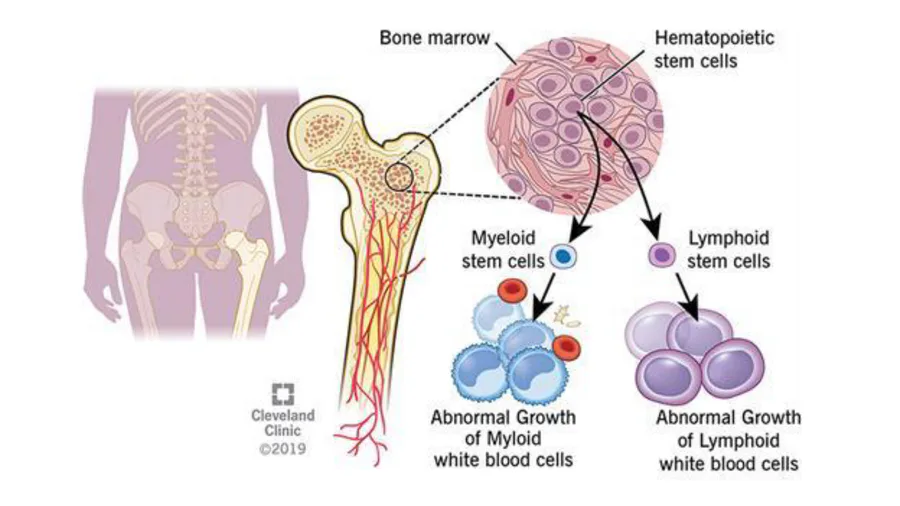
Which of the following statements about leukemia is correct?
Leukemia is cancer of the red blood cells.
Leukemia is cancer of the white blood cells.
Leukemia is caused by abnormal growth of platelets.
Leukemia only affects healthy blood cells.
45
46
47
48
Multiple Choice
Which of the following is NOT a way chemotherapy works to treat cancer?
Stopping DNA replication/synthesis
Inhibiting spindle fiber formation
Promoting metastasis
Preventing DNA from unwinding properly
49
Open Ended
Summarize what you have learned about cell reproduction and mitosis:
Show answer
Auto Play
Slide 1 / 49
SLIDE

Similar Resources on Wayground
43 questions
Is Burning a Chemical Reaction Lesson
Presentation
•
9th - 12th Grade
43 questions
Burning a Chemical Reaction Lesson
Presentation
•
9th - 12th Grade
46 questions
AR Verb Conjugations
Presentation
•
9th - 12th Grade
43 questions
Waves Lesson 1
Presentation
•
9th - 12th Grade
43 questions
Atoms Lesson
Presentation
•
KG
45 questions
Present Subjunctive
Presentation
•
9th - 12th Grade
42 questions
Animal Science Careers
Presentation
•
9th - 12th Grade
44 questions
Distance & Midpoint Formulas
Presentation
•
8th - 12th Grade
Popular Resources on Wayground
20 questions
"What is the question asking??" Grades 3-5
Quiz
•
1st - 5th Grade
20 questions
“What is the question asking??” Grades 6-8
Quiz
•
6th - 8th Grade
10 questions
Fire Safety Quiz
Quiz
•
12th Grade
20 questions
Equivalent Fractions
Quiz
•
3rd Grade
34 questions
STAAR Review 6th - 8th grade Reading Part 1
Quiz
•
6th - 8th Grade
20 questions
“What is the question asking??” English I-II
Quiz
•
9th - 12th Grade
20 questions
Main Idea and Details
Quiz
•
5th Grade
47 questions
8th Grade Reading STAAR Ultimate Review!
Quiz
•
8th Grade
Discover more resources for Science
20 questions
Cell Biology and Biochemistry Quiz
Quiz
•
9th Grade
20 questions
Human Impact on the Environment Review #2
Quiz
•
9th Grade
20 questions
Balancing Chemical Equations
Quiz
•
9th Grade
26 questions
Cell Cycle and Cancer Retest
Quiz
•
9th Grade
20 questions
Mendelian Genetics Review
Quiz
•
9th Grade
10 questions
Exploring Light and Waves Concepts
Interactive video
•
6th - 10th Grade
10 questions
Evolution Review
Presentation
•
10th Grade
10 questions
Exploring Plant Structures and Adaptations
Interactive video
•
6th - 10th Grade