
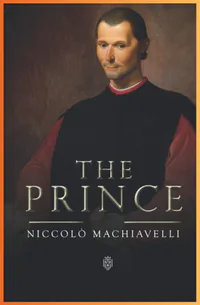
Machiavelli's arguments

Presentation
•
History
•
9th - 12th Grade
•
Practice Problem
•
Medium

Isiah Jones
Used 4+ times
FREE Resource
10 Slides • 18 Questions
1
By Isiah Jones
2
Introduction
➡ Directions: Read the prompt below and respond to the questions.
Think about the principal of your school. His/her job is to make decisions that are best for keeping the school safe for students and staff, and making sure that every student has the opportunity to get a quality education that will prepare them for the world after high school.
For a principal to do their job the best, is it better for them to be loved than to be feared or is it better to be feared than to be loved?
In the chart below write down the reasons you can think of that support both sides, then turn to a partner in class and share your ideas. If they have ideas you haven’t thought of, record them in your chart. It is better to be LOVED than to be feared. It is better to be FEARED than to be loved.
3
Poll
For a principal to do their job the best, is it better for them to be loved than to be feared or is it better to be feared than to be loved?
better for them to be loved than to be feared
better to be feared than to be loved
4
Exit Ticket: Machiavelli's advice is more about political survival than moral leadership." Defend or challenge this statement using at least two pieces of evidence from The Prince.
Objective: Students Will Be Able To analyze Machiavelli's arguments about gaining, maintaining, and consolidating power by evaluating his advice and supporting claims with textual evidence.
5
Exile: To be forced to leave one's home country or region and live somewhere else
Cynical: Believing that people are generally selfish and dishonest
Consolidate: to make something stronger or more secure. (In history: to unite or combine power).
Diplomacy: The skill of managing relationships and negotiations between different countries through talking, rather than through force or war.
Pragmatic: Dealing with problems in a practical and realistic way rather than based on theories or ideals.
6
Multiple Choice
1. After being forced into exile, a leader would...
a) be celebrated with a parade in their home city.
b) be given a higher position in the government.
c) have to live in a foreign country, away from home.
d) take a vacation to relax and see the world.
7
Multiple Choice
2. A cynical person watching a politician promise to give everyone money would most likely think...
8
Multiple Choice
3. A pragmatic leader facing a food shortage would...
9
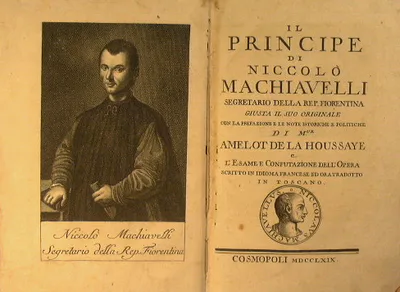
Contextualize: Who Was Machiavelli?
Our Goal: To understand the man behind the infamous book.
Directions:
Listen as we read the background information together.
Watch as I model how to "source" (contextualize) a document by looking for the author's motive and experience.
Help me answer: How did his life experiences shape his cynical view of power?
10
Multiple Choice
Who is the author of The Prince?
11
Multiple Choice
Where was The Prince written?
12
Multiple Choice
When was The Prince written?
13
Multiple Choice
Who was the intended audience for The Prince?
The Medici family, specifically Lorenzo
14
Multiple Choice
What type of source is The Prince?
Primary Source
Secondary Source
15
Multiple Choice
What is the best description of the genre of The Prince?
Diary entry
memoir
speech
biography
16
Contextualize: Who Was Machiavelli?
Second Read: Digging Deeper (5-Minute Independent/Silent Read)
Directions: Now, silently re-read the introduction. Use the text to answer the following questions about the source's nature and potential bias.
Why was The Prince written? What was Machiavelli's goal?
How might The Prince be useful evidence in understanding how Machiavelli believed power is gained, maintained, and consolidated?
What bias might Machiavelli have about how power is gained, maintained, and consolidated? Explain.
17
Open Ended
Why was The Prince written? What was Machiavelli's goal?
18
Open Ended
How might The Prince be useful evidence in understanding how Machiavelli believed power is gained, maintained, and consolidated?
19
Our Goal: To learn how to analyze Machiavelli's rules for power.
Annotation Key:
(G) = Gaining Power
(M) = Maintaining Power
(C) = Consolidating Power (Making your power solid and secure)
Section 1: That Which Concerns a Prince on the Subject of the Art of War
Read & Annotate: I will find the most powerful words.
Categorize: Is this advice for Gaining (G), Maintaining (M), or Consolidating (C) power?
Paraphrase: I will state Machiavelli's rule in my own words.
20
Fill in the Blanks
1a. According to Machiavelli, what should be the two aims of a prince?
21
Open Ended
When Machiavelli writes that a prince who has “thought more of ease than of arms” may lose their states, what is he warning princes to avoid?
22
Open Ended
Based on Section 1: That Which Concerns a Prince on the Subject of the Art of War, how should power be gained, maintained, or consolidated according to Machiavelli?
23
Jigsaw: Machiavelli's Power Playbook
Step 1: Find Your Expert Group (2 minutes)
You'll be assigned number (1, 2, or 3).
Number 1s: Go to the SECTION 2 expert area.
Number 2s: Go to the SECTION 3 expert area.
Number 3s: Go to the SECTION 4 expert area.
Step 2: Expert Huddle (10 minutes)
In your expert group, read your assigned section.
Highlight and annotate! Mark where Machiavelli talks about Gaining (G), Maintaining (M), or Consolidating (C) power.
Answer the questions for your section on the handout.
Agree on the #1 most important rule from your section.
24
Jigsaw: Machiavelli's Power Playbook
Step 3: Teaching Triads (12 minutes)
Return to your original table. You should have a 1, a 2, and a 3.
Each expert has 3 minutes to teach their rule.
Teammates: Listen and fill in your guided notes for all three sections!
25
Multiple Choice
Machiavelli argues that a prince must sometimes "know how to do wrong." According to his reasoning, when is it acceptable for a leader to do this?
26
Multiple Choice
Based on the advice from all four sections, which of the following is the most complete summary of Machiavelli's view of power?
Power requires constant military focus, a realistic view of human nature, and the practical willingness to be feared.
27
Open Ended
Machiavelli states that men are "ungrateful, fickle, false, cowardly, [and] covetous." How does this specific view of human nature directly support his argument that it is "safer to be feared than loved"?
28
Prompt: A historian states: "Machiavelli's advice is more about political survival than moral leadership." Defend or challenge this statement using at least two pieces of evidence from The Prince.
Success Criteria (for Quizizz Description or Student Instructions)
3 (Proficient): Clear claim + 2 accurate text quotes + explanation connecting evidence to claim
2 (Developing): Claim + 1 text quote + basic explanation
1 (Beginning): Unclear claim + no text evidence
By Isiah Jones
Show answer
Auto Play
Slide 1 / 28
SLIDE
Similar Resources on Wayground

21 questions
Main Idea
Presentation
•
9th - 12th Grade
21 questions
Medical Terminology
Presentation
•
9th - 12th Grade
22 questions
Interpersonal and Intrapersonal Communication
Presentation
•
9th - 12th Grade
22 questions
Where do electrons live?
Presentation
•
9th - 12th Grade
20 questions
American Enters the War
Presentation
•
9th - 12th Grade
22 questions
Atlantic Slave Trade/Global Contact
Presentation
•
9th - 12th Grade
21 questions
Spanish Clothing
Presentation
•
9th - 12th Grade
21 questions
Naming Ionic Compounds
Presentation
•
9th - 12th Grade
Popular Resources on Wayground
10 questions
Safety Day 2026 – Student Review

Quiz
•
9th Grade
21 questions
Continents and Oceans
Quiz
•
6th Grade
20 questions
Parts of Speech
Quiz
•
5th Grade
16 questions
Subject & Predicate
Quiz
•
5th Grade
25 questions
Multiplication Facts
Quiz
•
5th Grade
12 questions
Map Skills
Quiz
•
3rd Grade
22 questions
Continents and Oceans
Quiz
•
5th Grade
15 questions
Rounding Decimals
Quiz
•
5th Grade
Discover more resources for History
25 questions
The American Revolution
Quiz
•
7th - 10th Grade
15 questions
The Bill of Rights
Quiz
•
8th - 12th Grade
15 questions
Ancient Rome
Quiz
•
7th - 10th Grade
16 questions
Students of Civics Unit 2: The Constitution
Quiz
•
7th - 11th Grade
10 questions
Exploring the 7 Principles of the Constitution

Interactive video
•
6th - 10th Grade
10 questions
Significance of the Declaration of Independence
Interactive video
•
6th - 10th Grade
22 questions
Beginning of WW2 Quiz
Quiz
•
9th Grade
10 questions
Exploring the Age of Exploration
Interactive video
•
6th - 10th Grade