Search Header Logo
  1. Resource Library
  2. Math
  3. Calculus
  4. Calculus Higher Derivatives
Calculus Higher Derivatives

Calculus Higher Derivatives

Assessment

Presentation

Mathematics

9th Grade

Medium

CCSS
HSF.LE.B.5, HSF.IF.B.4, HSA.REI.D.10

+8

Standards-aligned

Created by

John Lawhon

Used 2+ times

FREE Resource

7 Slides • 47 Questions

1

​Higher order derivatives and Motion

By John Lawhon

2

Multiple Choice

Question image

At which point(s) will the slopes of the tangent line be zero?

1

at C only

2

at points A, C and E only

3

at point B and D only

4

at points A and E only

3

Multiple Choice

Question image

Where on this graph would you find a HORIZONTAL tangent line?

1

x = -3

2

x = 0

3

x = 3

4

There are no horizontal tangent lines on this graph

4

Multiple Choice

The percentage grade a student receives on a test, is modeled by G(t) where t is the number of hours spent studying for the test. Interpret G'(1) = 3

1

At 1 hour of studying, the grade will improve at a rate of 3% per hour.

2

At 3 hours of studying, the grade will improve at a rate of 1% per hour.

3

The student gains 3 percentage point per hour of study.

4

The student loses 3 percentage point per hour of study.

5

Multiple Choice

The number of gallons of water in a storage tank at time t, in minutes, is modeled by w(t).

Interpret w'(10) = -8

1

The tank loses 8 gallons per minute at 10 minutes.

2

The tank gains 8 gallons per minute at 10 minutes.

3

The rate of the tanks water loss is decreasing by 8 gallons per minute per minute at 10 minutes.

4

The tank gains 10 gallons per minute at 8 minutes.

6

Multiple Choice

What is the derivative of f(x) = 2x3 - 4x + 5?

1

f'(x) = 6x2 - 4x

2

f'(x) = 2/3x2 - 4x

3

f'(x) = 3x2 - 4

4

f'(x) = 6x2 - 4

7

Higher Order Derivatives

When we just keep taking DERIVATIVES!

media

8

What are higher order derivatives?

  • When you continue to take the derivative of a function!

  • Each iteration uses the power rule

  • You can take derivatives infinitely!

media

9

Multiple Choice

Question image
How many derivatives can you take of a function?
1
only 3
2
only 2
3
only 1
4
until you can no longer derive it

10

Multiple Choice

The first derivative of y=f(x)y=f\left(x\right) is represented as

1

f'(x)

2

y'

3

dy/dx

4

none of these

11

Multiple Choice

The 2nd derivative of y=f(x)y=f\left(x\right) also known as the derivative of the 1st derivative is represented as

1

f''(x)

2

y''

3

d2ydx2\frac{d^2y}{dx^2}

4

none of these

12

Poll

Find the second derivative of the following functions with respect to x.
y=3x2+5x-1
6x+5
3x+5
5
6

13

Poll

Find the second derivative of f(x) = x+ e - cosx
f"(x) = 2 + ex + cosx
f"(x) = 2x + ex + cosx
f"(x) = 2x + xex - cosx
f"(x) = 2x + ex + sinx

14

Multiple Choice

Find y'' for y = 3x2 + 5x + cos x

1

f''(x) = 6x + cos x

2

f''(x) = 3x + 5 - sin x

3

f''(x) = 6x + 5 + sin x

4

f''(x) = 6 - cos x

15

media

16

media

17

media

18

media

19

Multiple Choice

If the position of a particle is represented by x(t) = -t2 + 1, what is its instantaneous velocity at t = 1?  
1
v = 0
2
v = 1
3
v = -1
4
v = -2

20

Multiple Select

Acceleration is

1

integral of velocity

2

derivative of position

3

derivative of velocity

4

second derivative of poisiton

21

Multiple Select

Which of the following indicated that t=0?

1

to start

2

begins

3

finishes

4

initially

22

Multiple Choice

On the right means

1

position is positive

2

velocity is positive

3

position is negative

4

velocity is negative

23

Multiple Choice

On the left means

1

position is positive

2

velocity is positive

3

position is negative

4

velocity is negative

24

Multiple Choice

Above the ground means

1

position is negative

2

velocity is positive

3

position is positive

4

velocity is negative

25

Multiple Choice

Below the ground means

1

position is negative

2

velocity is positive

3

position is positive

4

velocity is negative

26

Multiple Choice

Moving to the right means

1

acceleration is positive

2

velocity is positive

3

position is positive

4

velocity is negative

27

Multiple Choice

Moving to the left means

1

acceleration is negative

2

velocity is positive

3

position is negative

4

velocity is negative

28

Multiple Choice

Moving up means

1

acceleration is positive

2

position is positive

3

velocity is positive

4

velocity is negative

29

Multiple Choice

Moving down means

1

velocity is negative

2

velocity is positive

3

position is negative

4

acceleration is negative

30

Multiple Choice

Dropped or at rest means

1

Acceleration is equal to 0

2

Position is equal to 0

3

Velocity is equal to zero

4

Acceleration is positive

31

Multiple Choice

Farthest to the right means

1

Find the maximum of position

2

Find the maximum of velocity

3

Find the maximum of acceleration

4

Set velocity equal to 0

32

Multiple Choice

Farthest to the left means

1

Find the minimum of acceleration

2

Find the minimum of position

3

Find the minimum of velocity

4

Set velocity equal to 0

33

Multiple Choice

Higest means

1

Find the maximum of acceleration

2

Find the maximum of velocity

3

Find the maximum of position

4

Set velocity equal to 0

34

Multiple Choice

Lowest means

1

Find the minimum of position

2

Find the minimum of acceleration

3

Find the minimum of velocity

4

Set velocity equal to 0

35

Multiple Choice

An object moves towards the origin when

1

position and velocity are the same sign

2

position and velocity are opposite signs

3

velocity and acceleration are the same sign

4

velocity and acceleration are opposite signs

36

Multiple Choice

An object moves away from the origin when

1

position and velocity are the same sign

2

position and velocity are opposite signs

3

velocity and acceleration are the same sign

4

velocity and acceleration are opposite signs

37

Multiple Choice

Speed is increasing when

1

position and velocity are the same sign

2

position and velocity are opposite signs

3

velocity and acceleration are the same sign

4

velocity and acceleration are opposite signs

38

Multiple Choice

Speed is decreasing when

1

position and velocity are the same sign

2

position and velocity are opposite signs

3

velocity and acceleration are the same sign

4

velocity and acceleration are opposite signs

39

Poll

Question image

Given the graph of f'(x), what's the interval of the graph of f(x) is increasing, select all the answers

(-4,-3)

(-1,1)

(2,infinity)

(-2,0)

40

Multiple Choice

If a function's FIRST derivative is negative at a certain point, what does that tell you?
1
The function is increasing at that point
2
The function is decreasing at that point
3
The concavity of the function is up at that point
4
The concavity of the function is down at that point

41

Multiple Choice

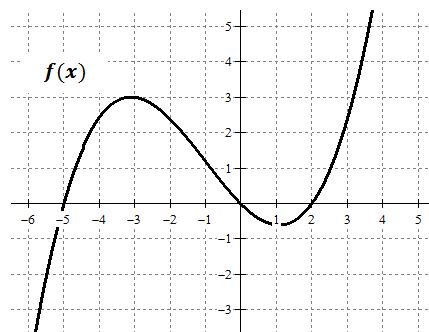
Question image
Over what interval(s) is f(x) decreasing?
1
(-3, 1)
2
(-∞, -5) ∪ (0, 2)
3
(-∞, -3) ∪ (1, ∞)
4
(-5, 0) ∪ (2, ∞)

42

Multiple Choice

If  f(x)=0f'\left(x\right)=0  and  f(a)=0f'\left(a\right)=0  changes from negative to positive at f(x)f'\left(x\right)  , then  x=ax=a  has

1

a relative maximum at x=a

2

a relative minimum at x=a

3

no relative extrema at x=a

4

a vertical tangent line at x=a

43

Multiple Choice

If  f(x)f'\left(x\right)  and  f(x)f'\left(x\right)  changes from positive to negative at  x=ax=a  , then  f(x)f\left(x\right)  has 

1

A relative maximum at x=a

2

A relative minimum at x=a

3

No relative extrema at x=a

4

A vertical tangent line at x=a

44

Multiple Choice

The function  f(x)=x3+3x25f\left(x\right)=-x^3+3x^2-5  has a relative maximum value of _____________ at x=_____________.

1

0; -5

2

-5; 0

3

2; -1

4

-1; 2

45

Multiple Choice

If   f(a)=0\ f'\left(a\right)=0  , then you are guaranteed a relative extreme value at x=a. 


1

True

2

False

46

Multiple Choice

Question image

Which of the following could be the graph of f ' , the derivative of f ?

1
2
3
4
5

47

Match

Match the following notation:

position
acceleration

velocity

speed

displacement

s(t)s\left(t\right)

v(t)v'\left(t\right)

s(t)s'\left(t\right)

v(t)\left|v\left(t\right)\right|

s(b)s(a)s\left(b\right)-s\left(a\right)

48

Multiple Choice

Question image

A bug begins to crawl up a vertical wire at time t=0t=0 .  The velocity vv of the bug at time tt , 0<t<80<t<8 , is given by the function whose graph is shown behind this text.

At what value of tt does the bug change direction

1
2
2
4
3
6.5
4
7

49

Dropdown

A particle moves along the x-axis so that at time t0t\ge0 , its velocity is given by v(t)=2t+8v(t)=−2t+8 .

The particle is ​
at t=7t=7 ​ .

50

Multiple Choice

Question image

Suppose that the functions f and g and their derivatives with respect to x have the following values at the given values of x. Find the derivative with respect to x of f(x)+g(x)\sqrt[]{f\left(x\right)+g\left(x\right)}   at x = 3.

1

1210\frac{1}{2\sqrt[]{10}}  

2

9210\frac{9}{2\sqrt[]{10}}  

3

910\frac{9}{\sqrt[]{10}}  

4

1210-\frac{1}{2\sqrt[]{10}}  

51

Multiple Choice

The position of a particle moving along a coordinate line is s=2+2ts=\sqrt[]{2+2t}   with s in meters in t in seconds. Find the particle's acceleration at t = 1 second.

1

-1/16 m/sec^2

2

1/2 m/sec^2

3

1/8 m/sec^2

4

-1/8 m/sec^2

52

Multiple Choice

Find y'' if y = 6x sinx

1

y=12cosx+6xsinxy''=-12\cos x+6x\sin x  

2

y=6cosx12xsinxy''=6\cos x-12x\sin x  

3

y=12cosx6xsinxy''=12\cos x-6x\sin x  

4

y=6xsinxy''=-6x\sin x  

53

Multiple Choice

The number of gallons of water in a swimming pool t minutes after the pool has started to drain is Q(t)=50(20x)2Q\left(t\right)=50\left(20-x\right)^2  . How fast is the water running out after 15 minutes?

1

1250 gal/min

2

625 gal/min

3

500 gal/min

4

250 gal/min

54

Multiple Choice

Find the instantaneous velocity when x = 2.

f(x)=x3 x21f\left(x\right)=x^3\ \sqrt[]{x^2-1}  

1

43+123\frac{4}{\sqrt[]{3}}+12\sqrt[]{3}  

2

28328\sqrt[]{3}  

3

434\sqrt[]{3}  

4

163+123\frac{16}{\sqrt[]{3}}+12\sqrt[]{3}  

​Higher order derivatives and Motion

By John Lawhon

Show answer

Auto Play

Slide 1 / 54

SLIDE