Search Header Logo
Ionic Compound Naming & Formula Writing

Ionic Compound Naming & Formula Writing

Assessment

Presentation

Chemistry

9th - 12th Grade

Practice Problem

Medium

NGSS
HS-PS1-1, MS-PS1-1, HS-PS1-4

+3

Standards-aligned

Created by

Genia Harris

Used 1+ times

FREE Resource

26 Slides • 28 Questions

1

media

2

media

3

media

4

Multiple Choice

Which type of chemical bond is formed by the electrical attraction between positive ions from metals and negative ions from nonmetals?

1

Ionic bonding

2

Covalent bonding

3

Metallic bonding

4

Hydrogen bonding

5

media

6

media

7

Open Ended

Compare and contrast ionic, covalent, and metallic bonds in terms of the types of elements involved and the way electrons are transferred or shared.

8

media

9

Fill in the Blank

Ions are created when an atom or molecule gains or loses one or more ___, resulting in a net positive or negative electrical charge.

10

Multiple Choice

Which of the following statements about ion formation is correct?

1

Cations are formed by gaining electrons.

2

Anions are formed by losing electrons.

3

Cations are formed by losing electrons.

4

Anions are formed by losing protons.

11

media

12

Multiple Choice

What is the simplest collection of atoms from which an ionic compound’s formula can be established called?

1

Molecule

2

Formula unit

3

Ion pair

4

Element

13

media

14

Open Ended

Explain how chemical symbols are used to represent elements and why capitalization matters.

15

media

16

Multiple Choice

Which of the following chemical formulas represents a compound with six carbon atoms and six hydrogen atoms?

1

NaHCO3

2

C6H6

3

C2H6

4

HC2H3O2

17

media

18

Fill in the Blank

Given the formula BaCl2, how many barium atoms and chlorine atoms are present in the compound?

19

media

20

Open Ended

Explain the law of definite proportions and provide an example using water (H2O).

21

media

22

Multiple Choice

Which of the following compounds is a binary compound?

1

NaCl

2

NaNO3

3

C6H6

4

HC2H3O2

23

media

24

Multiple Choice

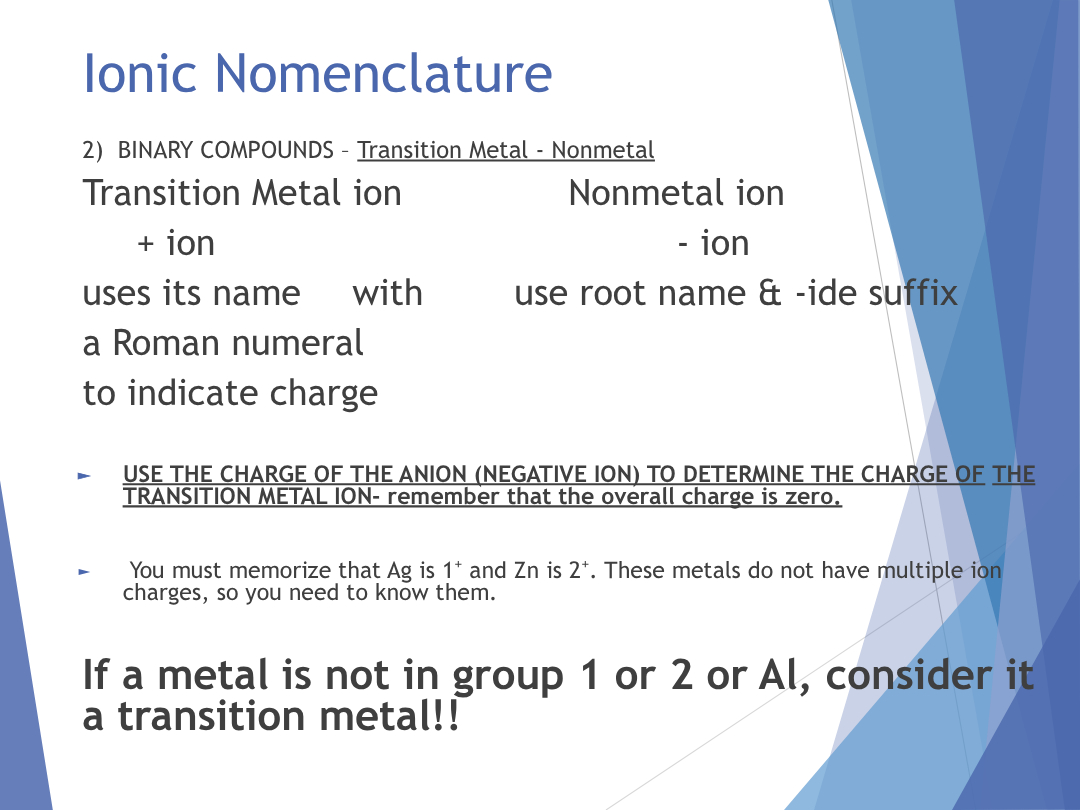
In naming binary ionic compounds, what suffix is added to the root name of the nonmetal ion?

1

-ate

2

-ide

3

-ite

4

-ous

25

media

26

Multiple Choice

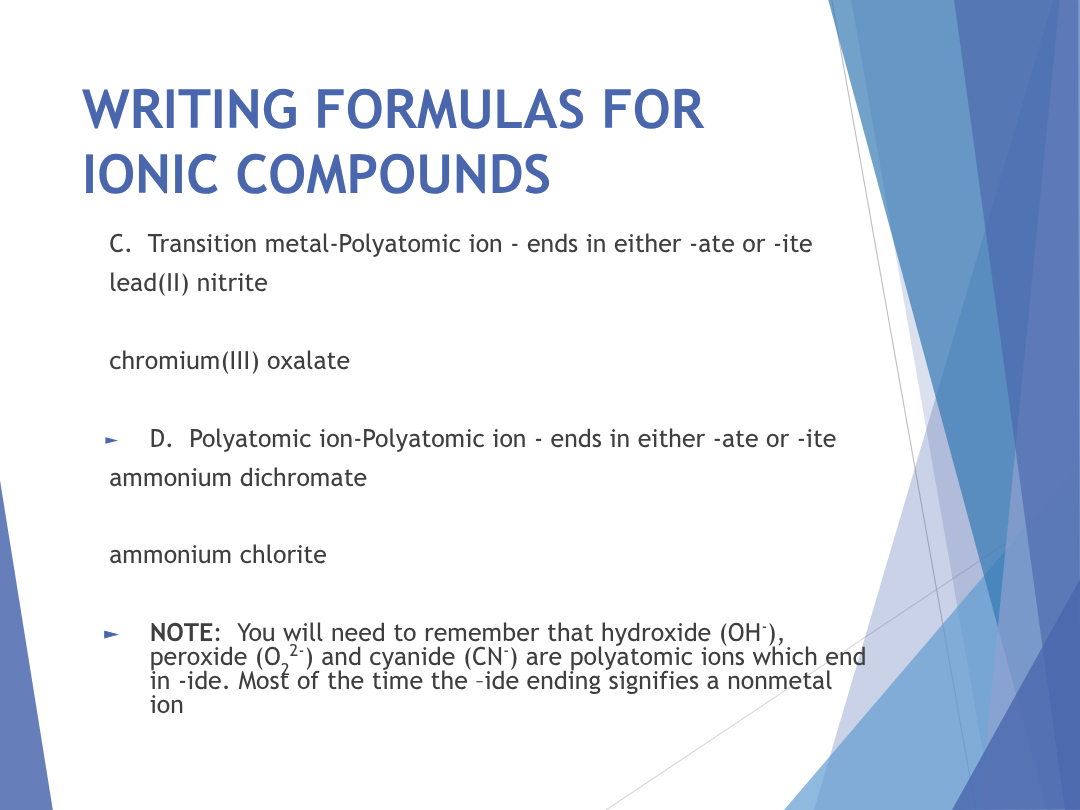
Which of the following is a polyatomic ion-polyatomic ion compound?

1

NH4NO3

2

Na2SO4

3

NH4Cl

4

(NH4)2SO4

27

Open Ended

What is the purpose of using a Roman numeral when naming transition metal ions in ionic compounds?

28

media

29

Multiple Select

Select all the compounds that are examples of metal-polyatomic ion compounds.

1

Mg(NO3)2

2

NH4Cl

3

Na2SO4

4

NH4NO3

30

media

31

Multiple Choice

Which of the following compounds contains a polyatomic ion?

1

PbCl2

2

Sn3N2

3

Mg(NO3)2

4

Na2SO4

32

media

33

media

34

Open Ended

What is the significance of a Roman numeral in the name of an ionic compound?

35

Fill in the Blank

The suffix ___ is used for binary compounds containing only two elements.

36

media

37

media

38

Open Ended

Explain how the naming conventions differ for binary and polyatomic ionic compounds.

39

media

40

Multiple Choice

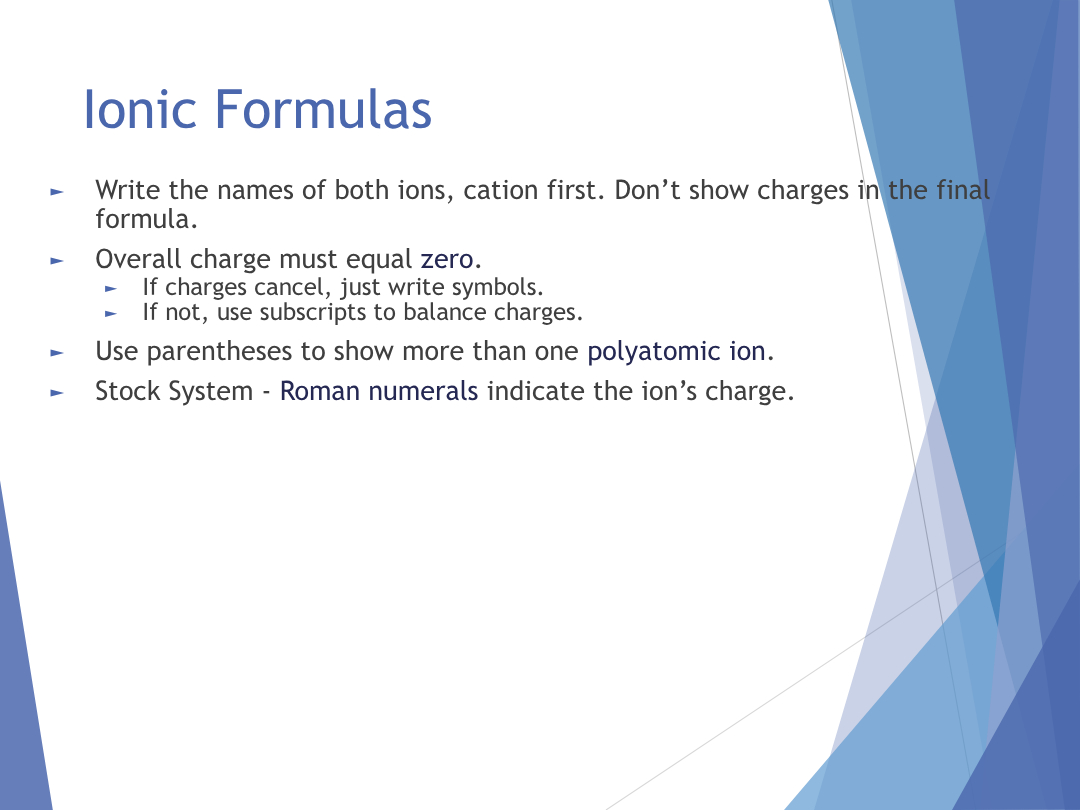
Which of the following is NOT a rule for writing ionic formulas?

1

Write the names of both ions, cation first.

2

Show charges in the final formula.

3

Overall charge must equal zero.

4

Use parentheses to show more than one polyatomic ion.

41

media

42

media

43

Open Ended

Explain how you determine whether a compound contains an ionic bond and if polyatomic ions are present.

44

media

45

media

46

Fill in the Blank

The formula FeCl3 represents iron(___) chloride.

47

Multiple Select

Select all compounds that contain polyatomic ions.

1

KCl

2

Mg(NO3)2

3

CuCl2

4

Na2CO3

48

media

49

Open Ended

Why is it important to use Roman numerals when naming compounds containing transition metals?

50

Multiple Choice

Name the following compound: SnO2
1
tin(II) oxide
2
tin(IV)oxide
3
tin(II)oxygen 
4
tin oxide

51

Multiple Choice

Zn3P2
1
Zinc Phosphide
2
Zinc (II) Phosphide
3
Trizinc Diphosphide
4
Zinc Phosphate

52

Multiple Choice

An ionic compound made of copper (Cu2+) and oxygen would be named
1
copper oxygen.
2
copper oxide.
3
dicopper oxide.
4
copper(II) oxide.

53

Multiple Choice

Titanium(IV) oxide has the formula

1

Ti4O

2

TiO4

3

Ti(IV)O

4

TiO2

5

Ti4O2

54

Multiple Choice

Why do elements form chemical bonds?

1

To increase their energy

2

To achieve a lower energy arrangement

3

To become unstable

4

To lose electrons

media

Show answer

Auto Play

Slide 1 / 54

SLIDE