


cycles of matter
Presentation
•
Science
•
9th Grade
•
Practice Problem
•
Hard
+13
Standards-aligned

Julie King
Used 1+ times
FREE Resource
20 Slides • 28 Questions
1
2
Open Ended
What are some of the reservoirs (holding places) for carbon?
Try to think of examples from each global system: hydrosphere, atmosphere, biosphere, geosphere
3
Multiple Choice
4
Match
Match the following
moves carbon from the biosphere to the geosphere
moves carbon from atmosphere to biosphere
moves carbon from biosphere to atmosphere
Decomposition
Photosynthesis
Respiration
Decomposition
Photosynthesis
Respiration
5
6
Labelling
Label the energy pyramid
primary consumer
secondary consumer
tertiary consumer
producer
7
Labelling
Listed in the Item Bank are some important labels for sections of the image below. Drag and drop each label to the corresponding area it identifies in the image
Consumer
Producer
10%
1%
0.1%
100%
8
9
10
Labelling
Complete the diagram using the options below.
Cellular Respiration
Photosynthesis
Carbon in the Atmosphere
Decomposition
Fossil Fuels
Combustion
11
Reorder
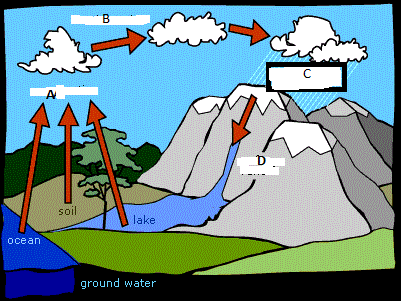
Reorder the following steps of the water cycle, starting with EVAPORATION
EVAPORATION
Condensation
Precipitation
Ground Water/Lakes/Water on Earth's surface
12
13
Fill in the Blank
Type answer...
14
15
16
Labelling
Label the Nitrogen Cycle Diagram
Ammonium
Nitrates
Plants
Decomposers
Atmospheric Nitrogen
Nitrites
17
Open Ended
What is the energy source that drives the hydrologic cycle?
18
Open Ended
Describe 2 ways in which humans can have a negative effect on the water cycle.
19
20
Drag and Drop
Point sources
Nonpoint sources
Wastewater
21
22
Multiple Choice
What are the two main processes that store carbon underground and release carbon dioxide into the atmosphere?
Biogeochemical processes
Human activities
Photosynthesis
Respiration
23
24
Multiple Select
This diagram shows the carbon cycle. Which of the following represents what is happening with the arrows labeled C.
Fossil fuels from the ground provide energy in the form of carbon to the factory.
Carbon in the form of dioxide is removed from the atmosphere, since plants perform cell respiration.
Plants and animals die and then decomposers, break down dead organisms adding carbon to the soil.
Carbon in the form of dioxide is removed from the atmosphere, since plants perform photosynthesis.
25
26
Categorize
Photosynthesis
Dissolving into ocean
Combustion of fossil fuels
cellular respiration
Decomposition
Place the following processes in the carbon cycle in their correct category
27
28
Labelling
Label the Carbon Cycle Diagram
Fossils & Fossil Fuels
Decaying Organisms
Organic Carbon
Animal Respiration
Plant Respiration
Auto/Factory Emissions
Combustion
Dead Organisms & Waste Products
Photosynthesis
29
Open Ended
Why is photosynthesis and cellular respiration considered a paired process?
30
31
Open Ended
How does combustion create more CO2 when carbon cannot be created?
32
33
Multiple Choice
34
35
Multiple Choice
Which of the following most completely describes the role of nitrogen-fixing bacteria in the nitrogen cycle? Nitrogen-fixing bacteria convert
nitrates intro nitrogen gas
ammonia into proteins
molecular nitrogen gas into ammonia into nitrites and nitrates
nitrites into nitrates
36
37
Multiple Choice
Imagine a farmer is concerned about the health of his crops and learns about the nitrogen cycle. What is the significance of denitrification in this cycle?
It helps in the formation of ammonia from nitrogen gas
It aids in the conversion of ammonia into nitrates
It releases nitrogen gas back into the atmosphere from nitrates
It increases the nitrogen content available to plants
38
39
Labelling
Label the nitrogen cycle processes
Nitrogen Fixation
Ammonification
Assimilation
Nitrification
Denitrification
40
41
Multiple Choice
Why is phosphorus essential to organisms?
It helps form important molecules like DNA and RNA
It is a source of energy
It aids in photosynthesis
It is a building block of proteins
42
43
Multiple Choice
Which of the following statements about the phosphorus cycle is true?
Moves through the food web and returns to the soil during decomposition.
Phosphorus leaches into groundwater from the soil and is locked in sediments.
Both mining and agriculture add phosphorus into the environment.
All of the above.
44
45
Multiple Choice
Discuss the role of human activities in altering the phosphorus cycle.
They have no significant impact
They decrease the amount of phosphorus in the soil
They increase the rate of phosphorus cycling
They can lead to an oversupply of phosphorus in water bodies
46
Open Ended
Why is nitrogen important to organisms?
47
Open Ended
How do plants obtain nitrogen if they can’t get it from the air?
48
Multiple Choice
Predict the environmental impact if a significant amount of phosphorus is washed into a lake.
Decrease in aquatic plant growth
Increase in aquatic plant growth leading to eutrophication
No significant change in the lake's ecosystem
Immediate toxicity to aquatic animals
Show answer
Auto Play
Slide 1 / 48
SLIDE

Similar Resources on Wayground
41 questions
The Judicial Branch/Supreme Court
Presentation
•
9th Grade
44 questions
Chemistry Basics for Biologists 2.0
Presentation
•
9th Grade
43 questions
HS ESS 2 4
Presentation
•
9th Grade
43 questions
Heat Transfer Weather
Presentation
•
9th Grade
40 questions
Grade 9 General Unit 3 Lesson 1
Presentation
•
9th Grade
39 questions
Photosynthesis and Cellular Respiration
Presentation
•
9th Grade
42 questions
AKS 9B - Electromagnetic vs. Mechanical Waves
Presentation
•
8th Grade
40 questions
Survival of the Fittest Lab Presentation
Presentation
•
9th Grade
Popular Resources on Wayground
10 questions
5.P.1.3 Distance/Time Graphs
Quiz
•
5th Grade
10 questions
Fire Drill
Quiz
•
2nd - 5th Grade
20 questions
Equivalent Fractions
Quiz
•
3rd Grade
22 questions
School Wide Vocab Group 1 Master
Quiz
•
6th - 8th Grade
20 questions
Main Idea and Details
Quiz
•
5th Grade
20 questions
Context Clues
Quiz
•
6th Grade
20 questions
Inferences
Quiz
•
4th Grade
12 questions
What makes Nebraska's government unique?
Quiz
•
4th - 5th Grade
Discover more resources for Science
10 questions
Exploring the Layers of the Earth
Interactive video
•
6th - 10th Grade
25 questions
Naming Ionic and Covalent Compounds
Quiz
•
9th Grade
20 questions
Balancing Chemical Equations
Quiz
•
9th Grade
15 questions
Protein synthesis
Quiz
•
9th Grade
20 questions
Human Impact on the Environment Review #2
Quiz
•
9th Grade
20 questions
Newton's Laws of Motion
Quiz
•
9th Grade
20 questions
Mendelian Genetics Review
Quiz
•
9th Grade
16 questions
Balancing Chemical Equations and Types of Reactions
Quiz
•
9th - 10th Grade