

Electronic brake systems

Presentation
•
Instructional Technology
•
11th Grade
•
Practice Problem
•
Hard

Jonathan Siegrist
FREE Resource
74 Slides • 22 Questions
1

2

3
Open Ended
Why is it important for brakes to be fully functional in case of an emergency?
4
Multiple Choice
How do electronic brake control (EBC) systems improve vehicle safety compared to standard hydraulic braking systems?
By increasing vehicle speed
By computer-controlled hydraulics that maximize braking in emergencies
By reducing the need for brakes
By making the vehicle lighter
5

6
Multiple Choice
Which of the following is a function of ABS in electronic brake control systems?
Prevents wheel lock up
Prevents loss of driving control
Engine braking control
Minimizes wheel slip during acceleration
7

8
Multiple Select
Which of the following are features of EBC systems?
Engine braking control
Crash avoidance braking
Trailer sway control
Minimizes wheel slip during acceleration
9

10
Fill in the Blanks
11

12
Multiple Choice
What is the primary function of the TCS system as shown in the diagram?
Enhances traction without driver input
Prevents vehicle rollover
Detects understeer
Shortens panic stop distances
13

14

15

16
Multiple Choice
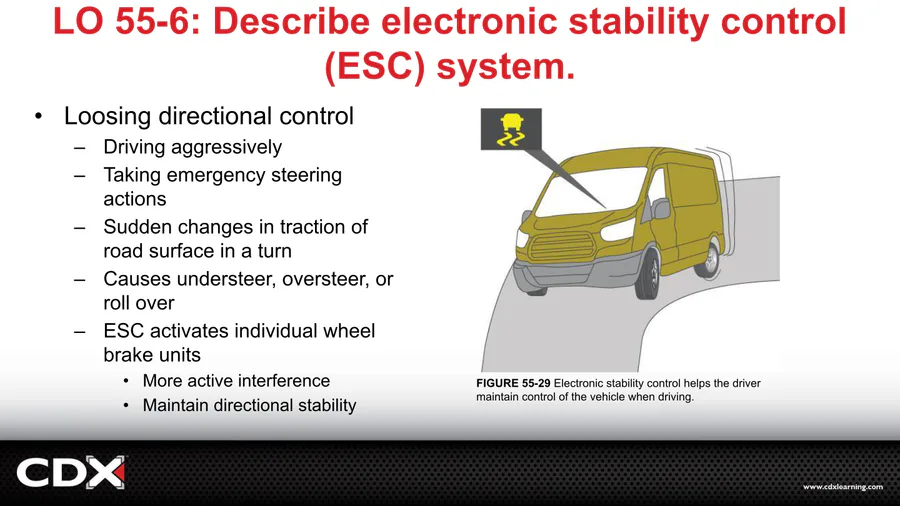
What is oversteer and what happens to the rear tires during cornering in this condition?
The vehicle’s path is straighter than the front wheels turn and rear tires gain traction
The vehicle’s path is sharper than the front wheels turn and rear tires lose traction
The vehicle’s path matches the front wheels turn and rear tires maintain traction
The vehicle’s path is unpredictable and rear tires lock up
17

18
Multiple Select
Which of the following are functions of the Electronic Brake Control Module (EBCM)?
Uses information from ESC systems and wheel speed sensors
Commands individual brake unit application and engine torque modification
Monitors stability
Requires constant driver input
19

20
Fill in the Blanks
21

22

23

24
Multiple Select
Which of the following statements about the HCU/modulator in an ABS system are correct?
It is connected in line with brake lines
It receives operating signals from EBCM
It controls brakes during ABS conditions
It directly monitors wheel speed
25

26

27

28
Open Ended
Explain how the ABS warning lamp and ABS failure are detected and managed in a vehicle.
29

30
Fill in the Blanks
31
Multiple Select
Select all factors that contribute to wheel lock up during braking.
Friction of road surface
Type and condition of each tire
Difference between vehicle speed and wheel speed
Engine temperature
32

33
Open Ended
Describe the function of the solenoid valve in the ABS hydraulic control unit.
34

35
Multiple Choice
Which component in an ABS master cylinder assembly is responsible for modifying pressure?
Solenoid valve in HCU
Brake pedal
Wheel speed sensor
Accumulator valve
36

37
Multiple Choice
Which component in a non-integral ABS master cylinder houses the solenoid valves?
Booster
Master cylinder
Hydraulic control unit (HCU)
Wheel brake unit
38

39

40
Fill in the Blanks
Type answer...
41
Open Ended
Explain the difference between non-integral ABS master cylinders and portless ABS master cylinders in terms of their design and operation.
42

43
Multiple Select
Which of the following statements about solenoid valves in ABS hydraulic control units is/are correct?
They control brake pressure.
They are always located in the master cylinder.
They allow brake fluid to flow freely to the wheel brake unit during apply mode.
There are always four valves in the hydraulic circuit.
44

45
Open Ended
Describe the sequence of actions performed by solenoid valves during the apply, hold, and release stages in ABS operation.
46

47
Multiple Choice
During non-ABS braking, what happens to the brake fluid after the brake pedal is pressed?
It is stored in the accumulator.
It travels in non-energized open isolation valves to the brake unit.
It is blocked by the solenoid valves.
It is returned to the reservoir by an electric pump.
48

49

50

51

52

53

54

55

56

57

58

59

60

61

62

63

64

65

66

67

68

69

70

71

72
73

74

75

76

77

78

79

80

81

82

83

84

85

86

87

88

89

90

91

92

93

94

95

96
Open Ended
Reflecting on what you learned about electronic brake control systems, what questions do you still have or what would you like to know more about regarding their operation or benefits?
Show answer
Auto Play
Slide 1 / 96
SLIDE
Similar Resources on Wayground

87 questions
Unit 11- Immunity
Presentation
•
12th Grade
86 questions
Miscellaneous3
Presentation
•
11th - 12th Grade
87 questions
Chapter 19 part 3
Presentation
•
12th Grade
93 questions
ENGLISH 11 Second Term Exam Review
Presentation
•
11th Grade
89 questions
Struktur dan Fungsi Jaringan Tumbuhan
Presentation
•
11th - 12th Grade
89 questions
EPF: Module 2 (25-26)
Presentation
•
12th Grade
94 questions
Imperialism
Presentation
•
12th Grade
95 questions
ℍ𝕞𝕜④ MLA & Capitalization
Presentation
•
12th Grade
Popular Resources on Wayground
10 questions
HCS SCI 03 Summer School Review 4

Quiz
•
3rd Grade
11 questions
HSMS - Standard Response Protocol
Quiz
•
6th - 8th Grade
16 questions
1.1-1.2 Quiz Review
Quiz
•
9th - 12th Grade
12 questions
Exponent Expressions
Quiz
•
6th Grade
20 questions
Adding and Subtracting Integers
Quiz
•
6th - 7th Grade
11 questions
Northeast States
Quiz
•
3rd - 4th Grade
10 questions
Characterization
Quiz
•
3rd - 7th Grade
10 questions
Common Denominators
Quiz
•
5th Grade