

IPC Review Part 1

Presentation
•
Science
•
9th Grade
•
Easy
+3
Standards-aligned

Jennifer Guillory
Used 1+ times
FREE Resource
11 Slides • 24 Questions
1
By Jennifer Guillory
IPC.5A position, velocity, acceleration, and time
IPC.5B relationship between mass and acceleration in terms of the net force
IPC.5C momentum and impulse
3 questions for each of these topics
2

Diagonal line shows CONSTANT speed
The SLOPE of the line indicates the speed
horizontal line shows NO MOTION
curves show ACCELERATION
The x-axis is the ORIGIN
IPC.5A position, velocity, acceleration, and time
3
Multiple Select

Which object(s) are accelerating?
A
B
C
D
E
4
Multiple Choice
What is the speed of a runner who runs a distance of 75 meters in 15 seconds?
0.2 m/s
0.5 m/s
5 m/s
20 m/s
5
Multiple Select

What is the speed pf the object in section A?
0 m/s
30 m/s
0.5m/s
2 m/s
6
Multiple Select

Which object(s) are NOT moving?
A
B
C
D
E
7
Multiple Choice
When analyzing a graph, how would an object with a constant acceleration appear to move on a distance-time graph?
A curved line
A diagonal line
A horizontal line
Can not be determined on a distance-time graph
8
Velocity graphs ARE NOT the same as distance time graphs!
IPC.5A position, velocity, acceleration, and time
9

IPC.5A position, velocity, acceleration, and time
10

IPC.5A position, velocity, acceleration, and time
11
Multiple Choice

What is happening to the car between 3-8 seconds?
The car is stopped
The car is traveling at a constant velocity of 0.5 m/s.
The car has an acceleration of 0.5 m/s2.
The car is going in the other direction.
12
Multiple Choice
The velocity-time graphs represent the motion of four different objects. Identify any object that is stationary or not moving. Check all that apply.
13
Multiple Choice
When the velocity of an object changes over time, this is known as –
speed
1st law of motion
acceleration
force
14
Multiple Choice
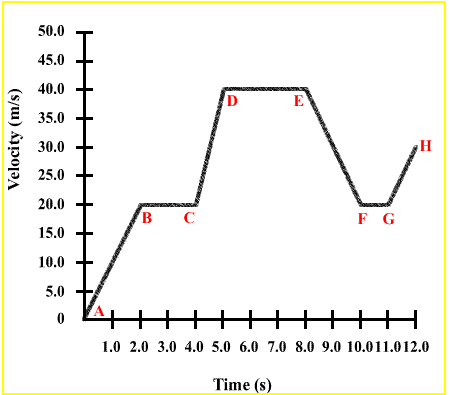
15
Multiple Choice
While examining a velocity-time graph, you observe that the graph shows a horizontal line for a certain duration.
What does this suggest about the motion of the object?
The object is accelerating at a constant rate.
The object is at rest.
The velocity is constant, and the acceleration is zero.
The object is decelerating.
16
Newton's Second Law of Motion

IPC.5B relationship between mass and acceleration in terms of the net force
17
Balanced Forces
When balanced forces act on an object, the net force is zero.
The forces are equal in size and act in opposite directions.
There is no change in motion, meaning the object has zero acceleration.

Unbalanced Forces

When unbalanced forces act on an object, the net force is not zero.
These forces cause a change in the object's motion, called acceleration.
The net force is found by combining all individual forces acting on it.

IPC.5B relationship between mass and acceleration in terms of the net force
18
Effects of Forces on Moving Objects
Zero Net Force
When the net force on an object is zero, it does not accelerate.
Its velocity stays constant, so it does not change its speed or direction.
The object keeps moving at a steady pace and in a straight line.

Force in Same Direction
A net force acts on the object in its direction of movement.
This unbalanced force causes the moving object to accelerate and speed up.
The object’s velocity increases as long as this net force is applied.

Force in Opposite Direction
A net force pushes against the object’s direction of current motion.
This causes the object to decelerate, which means that it slows down.
Its velocity decreases, and it may eventually come to a complete stop.


19
Multiple Choice
What is the key difference in the net force between balanced and unbalanced forces?
Balanced forces result in a net force of zero, while unbalanced forces result in a non-zero net force.
Balanced forces are always in the same direction, while unbalanced forces are in opposite directions.
Balanced forces only apply to objects at rest, while unbalanced forces apply to objects in motion.
Balanced forces cause an object to accelerate, while unbalanced forces do not.
20
Multiple Choice
If an object is not accelerating, what must be true about the net force acting on it?
The net force is equal to its weight.
The net force is zero.
The net force is equal to its mass.
The net force is positive.
21
Multiple Choice
According to Newton's second law of motion, force is equal to –
Mass x velocity
Velocity x time
Mass x acceleration
Acceleration x velocity
22
Multiple Choice
What happens to the force acting on an object if the acceleration stays constant but mass doubles?
it doubles
it is halved
it stays the same
there is not enough information to determine what will happen to the force
23
Multiple Choice
24
Multiple Choice
25
Multiple Choice
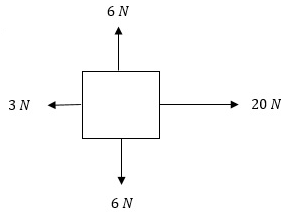
What is the NET FORCE of this diagram?
17 N, right
17 N, left
23 N, right
12 N, up
26

IPC.5C momentum and impulse
27

IPC.5C momentum and impulse
28
Multiple Choice
29
Multiple Choice
A 0.250 kg cart moving at 0.400 m/s has how much momentum?
0.1 kg-m/s
1 kg-m/s
10 kg-m/s
100 kg-m/s
30

IPC.5C momentum and impulse
31
Multiple Choice
32
Multiple Choice
Impulse describes which of the following?
How quickly a change in momentum occurs
How quickly an object falls
How quickly a change in mass occurs
How quickly an object transfers heat
33
Multiple Choice
Airbags are used in cars to minimize momentum in a collision. This is because:
This increases the time of impact so that the momentum is decreased.
This decreases the time of impact so that the momentum is decreased.
This increases the time of impact so that the momentum is increased.
None of the above
34
Multiple Choice
The Law of Conservation of Momentum states:
The total momentum before a collision is equal to the total momentum after a collision.
The total momentum before a collision is greater than the total momentum after a collision.
The total momentum before a collision is less than the total momentum after a collision.
The total momentum before a collision is not related to the total momentum after a collision.
35
Multiple Select
Which of the following are ways to minimize the impulse of a collision?
Choose TWO correct answers.
Provide more padding for the object
Shorten the time interval during which the collision occurs
Lengthen the time interval during which the collision occurs
Make the object more rigid
Increase the mass of the object
By Jennifer Guillory
IPC.5A position, velocity, acceleration, and time
IPC.5B relationship between mass and acceleration in terms of the net force
IPC.5C momentum and impulse
3 questions for each of these topics
Show answer
Auto Play
Slide 1 / 35
SLIDE
Similar Resources on Wayground

33 questions
DNA and Protein Synthesis Day 3
Presentation
•
9th Grade
27 questions
Periodic Table Build
Presentation
•
9th Grade
28 questions
Electromagnetic Spectrum
Presentation
•
8th Grade
27 questions
Types of Galaxies
Presentation
•
8th Grade
27 questions
Valence and Lewis Dot Diagrams
Presentation
•
9th Grade
29 questions
Review BIODIVERSITY
Presentation
•
9th Grade
25 questions
The CARBON CYCLE
Presentation
•
9th Grade
25 questions
Physical and Chemical Changes Review
Presentation
•
8th Grade
Popular Resources on Wayground
21 questions
Continents and Oceans

Quiz
•
6th Grade
20 questions
Parts of Speech
Quiz
•
5th Grade
16 questions
Subject & Predicate
Quiz
•
5th Grade
25 questions
Multiplication Facts
Quiz
•
5th Grade
12 questions
Map Skills
Quiz
•
3rd Grade
22 questions
Continents and Oceans
Quiz
•
5th Grade
15 questions
Rounding Decimals
Quiz
•
5th Grade
20 questions
Brand Labels
Quiz
•
5th - 12th Grade
Discover more resources for Science
10 questions
Exploring Chemical and Physical Changes

Interactive video
•
6th - 10th Grade
20 questions
Atomic Structure
Quiz
•
9th Grade
10 questions
Exploring the Periodic Table
Interactive video
•
6th - 10th Grade
10 questions
Exploring Earth's Spheres and Their Interactions
Interactive video
•
6th - 10th Grade
20 questions
The Cell Cycle and Mitosis
Quiz
•
9th Grade
15 questions
Cell Cycle
Quiz
•
9th Grade
10 questions
Exploring Chemical Changes
Interactive video
•
6th - 10th Grade
10 questions
Exploring Weathering, Erosion, and Deposition Processes
Interactive video
•
6th - 10th Grade