

Rhetorical Devices with Elie Wiesel

Presentation
•
English
•
8th Grade
•
Practice Problem
•
Hard

Natalie Waagner
FREE Resource
10 Slides • 12 Questions
1

2
Multiple Choice
Which of the following is NOT a characteristic of a formal speech?
It uses informal, everyday language.
It has a central idea supported by details, examples, and anecdotes.
It is tailored to a specific audience for a specific occasion.
It uses rhetorical devices to create emotional impact.
3
Open Ended
Why do you think formal speeches often use rhetorical devices or specific patterns of language to create an emotional impact?
4

5

6

7
Multiple Choice
What are two commonly used rhetorical devices in formal speeches, and how do they impact the audience?
Rhetorical questions and repetition; they add emphasis and stir emotions.
Metaphors and similes; they make speeches humorous.
Statistics and facts; they make speeches more scientific.
Stories and anecdotes; they make speeches longer.
8

9
Multiple Choice
Which of the following questions is rhetorical?
What time is it?
Can you help me with this problem?
Will you stand by and watch people suffer?
Where do you live?
10

11
Open Ended
Mark the important repeated word in this quotation from Dr. Martin Luther King, Jr.'s 'I Have a Dream' speech: 'With this faith, we will be able to work together, to pray together, to struggle together, to go to jail together, to stand up for freedom together, knowing that we will be free one day.' What concept or idea is emphasized by the repetition of this word?
12

13

14
Multiple Choice
How does the use of repetition in a speech help structure the speaker's argument and make it more powerful?
It confuses the audience.
It emphasizes key ideas and helps organize the speech.
It makes the speech shorter.
It distracts listeners from the main point.
15
Fill in the Blanks
In Elie Wiesel's Nobel Peace Prize acceptance speech, rhetorical devices such as
Type answer...
16
Open Ended
Explain how rhetorical questions and repetition are used to advance a speaker's claim in a speech.
17

18
Multiple Choice
How do the rhetorical devices of rhetorical questions and repetition in Wiesel's speech contribute to his call to action?
Rhetorical questions make the speech more entertaining, while repetition makes it longer.
Rhetorical questions remind listeners of the Nobel Peace Prize's origins and emphasize Wiesel's call to action; repetition extends the call to every individual and reflects his impassioned tone.
Rhetorical questions confuse the audience, and repetition makes the message unclear.
Rhetorical questions and repetition have no impact on the speech.
19
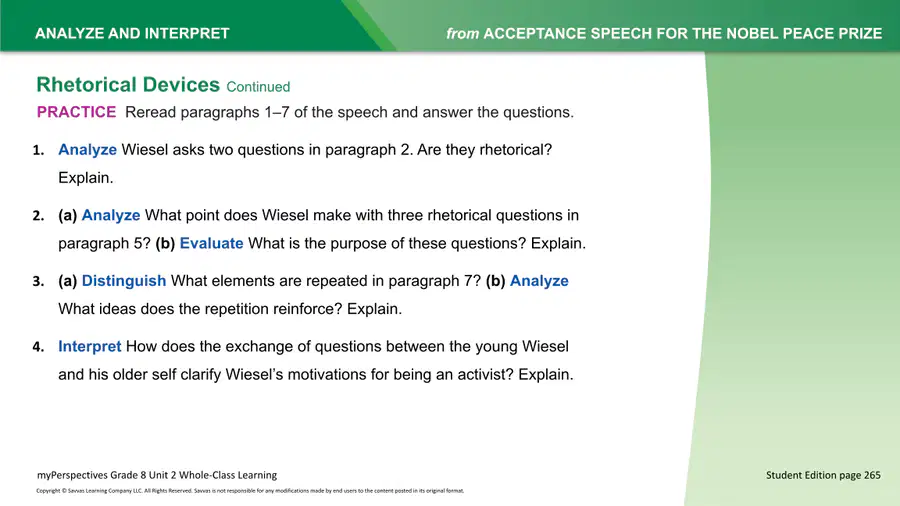
20
Open Ended
Explain how Wiesel uses rhetorical devices to motivate his audience to take action. Provide examples from the speech to support your answer.
21
Open Ended
How does the structure of a formal speech compare to that of an essay?
22
Multiple Choice
What are some key characteristics of a formal speech?
It uses informal language and jokes.
It is tailored to a specific audience and occasion, uses formal language, and includes rhetorical devices.
It is always written as a poem.
It does not have a central idea.
Show answer
Auto Play
Slide 1 / 22
SLIDE
Similar Resources on Wayground

15 questions
The Outback Survival Guide
Presentation
•
8th Grade
17 questions
Connectors of Sequence
Presentation
•
8th Grade
17 questions
A Long Walk to Water: Chapter 4
Presentation
•
8th Grade
17 questions
Allusions
Presentation
•
9th Grade
17 questions
Argument: Claims and Reasons
Presentation
•
8th Grade
19 questions
Diary of Anne Frank Act 1 Conflict & Drama Elements
Presentation
•
8th Grade
20 questions
Imagery
Presentation
•
8th Grade
16 questions
Verbals Review ~ Infinitives and Gerunds
Presentation
•
8th - 9th Grade
Popular Resources on Wayground
10 questions
How much do you know about our Portrait of an Eagle?

Quiz
•
10th Grade
10 questions
Fast Food Slogans
Quiz
•
6th - 8th Grade
21 questions
Continents and Oceans
Quiz
•
6th Grade
20 questions
Parts of Speech
Quiz
•
5th Grade
16 questions
Subject & Predicate
Quiz
•
5th Grade
25 questions
Multiplication Facts
Quiz
•
5th Grade
12 questions
Map Skills
Quiz
•
3rd Grade
22 questions
Continents and Oceans
Quiz
•
5th Grade
Discover more resources for English
25 questions
Making Inferences
Quiz
•
6th - 8th Grade
20 questions
Figurative Language Review
Quiz
•
8th Grade
30 questions
Central Idea practice Grade 7-8
Quiz
•
6th - 8th Grade
12 questions
Final Figurative Language Review
Presentation
•
6th - 8th Grade
20 questions
Sentences, Fragments, and Run-ons
Quiz
•
8th Grade
20 questions
TEXTUAL EVIDENCE & INFERENCES
Quiz
•
6th - 8th Grade
11 questions
Objective Summary Review
Quiz
•
6th - 8th Grade
17 questions
Plot
Quiz
•
8th Grade