

U.S. Government Midterm Review Slides

Presentation
•
Social Studies
•
11th Grade
•
Practice Problem
•
Medium
Standards-aligned

Leslie Johnson
Used 3+ times
FREE Resource
41 Slides • 70 Questions
1

2

3

4
Multiple Select
Select ALL correct answers
Three factors to determine is a source is credible
Author's financial interest
Author's degree & work experience
Author's arguments that use stereotypes & bias
Author's position is logical & consistent
Author's evidence is cited
5
Multiple Choice
What are the key questions to consider when determining the credibility of a source of information?
Qualifications of the writer
Supporting evidence
Consistency with other sources
Bias or unstated assumptions
6
Multiple Choice
Citizens must decide whether to build a new city auditorium or repair the old one. Supporters of the new building say their plan is more cost-effective. To judge whether this claim is trustworthy, what information should citizens focus on?
How many events the auditorium hosts each year
How much money supporters spend promoting their plan
How popular the supporters are in the community
Cost estimates from architects and financial experts
7
Multiple Choice
Who would give the most reliable description of life under a dictatorship?
A high-ranking official who works for the dictator
A political prisoner who was recently jailed by the regime
A historian who interviewed many citizens living under the dictator
A leader of a country that is a close ally of the dictator
8

9


10
Multiple Choice
What are the key points of compromise in a disagreement?
Each side wins completely
Ending the conflict is less important
Both sides give something up
The decision is one-sided
11

12
Multiple Choice
people on both sides of an issue giving up something to reach an agreement
Compromise
Preamble
consult
authority
13
Multiple Choice
Some Americans want the government to remove TV shows they believe teach harmful values to kids, while TV stations say they should choose their own programs. Which action represents a reasonable compromise?
Allow stations full freedom to air anything
Ban all programs that some viewers find inappropriate
Schedule questionable programs late at night when children are unlikely to watch
Survey children and only air shows they choose
14
Multiple Choice
When two sides each give up something to reach an agreement, what method of conflict resolution is being used — the same method that helped large and small states settle disputes during the Constitutional Convention?
Compromise
Negotiation
Consensus Building
Persuasion
15

16

17
Multiple Choice

Which part of the Declaration of Independence are listed below?
*The British quartered their troops in colonists' homes.
*The King dissolved colonial legislatures.
*The King took away the colonists' right to a trial by jury.
*British troops attacked colonial towns.
Which phrase completes the diagram?
Preamble/Introduction
Natural Rights/law
Grievances/complaints-Explaining why Indepence from Great Britain was necessary
Resolution for Independence
18

19
Multiple Choice
The concept that people have to agree to be governed. If the government fails to protect their rights, people can revolt and abolish the government.
Separation of powers
Freedom of speech
Freedom of religion
Social Contract
20
Multiple Choice
What did Enlightenment thinkers like John Locke argue?
That universal laws could not be discovered
That they should rebel against King John of France
That governments must protect the natural rights of the people
That absolute monarchies were the best form of government
21

22
Multiple Choice
What are the key differences between the Virginia Plan and the New Jersey Plan regarding representation in Congress?
Virginia Plan: Unicameral
New Jersey Plan: Bicameral
Virginia Plan: Population-based representation and the New Jersey Plan: State-based representation
23

24
Multiple Choice
How did the Connecticut (Great) Compromise resolve the conflict between large and small states about representation in Congress?
It created one house based on population and another with equal representation for each state
It created separate governments for large and small states
It required Connecticut to provide the most representatives
It kept the same representation system used under the Articles of Confederation
25
Multiple Choice
The Framers created a __________ legislature with one house based on population and one with equal representation.
Unicameral
Gerrymandered
Equal
Bicameral
26

27

28
Multiple Choice
Determine if the statement reflects a view of a Federalist or Anti-Federalist:
The Supremacy Clauses puts too much power in the national government.
Federalist
Anti-Federalist
29
Categorize
Wanted the Bill of Rights before they would agree to ratify the Constitution
Supported adding the elastic clause to the Constitution
Group supported the states having power in the government
Favored the creation of the federal bank
Wanted a strong federal government
Wanted to get rid of the Articles of Confederation & create the Constitution
Worried that the Constitution made federal laws “the supreme law of the land”
Worried the federal government would use their powers to take freedoms away from citizens
Thought a president was necessary for the federal government to help protect the country
Favored the creation of three branches of government
Alexander Hamilton, James Madison, John Jay
Supporters: Property owners, wealthy merchants in northern states
more commonly found in urban areas
Thomas Jefferson, George Mason, Patrick Henry, John Hancock
Supporters: Small farmers, shopkeepers, workers
more commonly found in rural areas
Can you identify Federalist or Anti-Federalist?
30
Multiple Choice
Determine if the statement reflects a view of a Federalist or Anti-Federalist:
Including a Bill of Rights is necessary to limit the government.
Federalist
Anti-Federalist
31
Multiple Choice
Determine if the statement reflects a view of a Federalist or Anti-Federalist:
The welfare of the country is a greater than individual state sovereignty
Federalist
Anti-Federalist
32
Multiple Choice
Determine if the statement reflects a view of a Federalist or Anti-Federalist: Strong national government is needed to address the problems under the Articles of Confederation
Federalist
Anti-Federalist
33
Multiple Choice
Determine if the statement reflects a view of a Federalist or Anti-Federalist: Powers of the national government should be limited relative to the powers of the state govenrments
Federalist
Anti-Federalist
34
Multiple Choice
What was the original Federalist position on adding a Bill of Rights?
Additional protections were necessary
Adding a Bill of Rights was risky and might delay ratification
A Bill of Rights was needed to protect national sovereignty
No Bill of Rights was needed because the Constitution already limited government power
35
Multiple Choice
What were the main arguments of the Federalists in support of the Constitution?
A strong national government was necessary
Separation of Powers would keep the government under control
Supported the Necessary and Proper Clause
36
Multiple Choice
Why did Federalists support adding the Necessary and Proper (Elastic) Clause to the Constitution?
To increase citizen participation in choosing officials
To allow the national government to operate effectively
To guarantee state sovereignty
To protect individual rights
37

38

39
Multiple Choice

"We the People”—represents the constitutional principle of:
limited government
checks and balances
popular sovereignty
separation of powers
40
Multiple Choice

What is popular sovereignty?
Where sovereignty (the power to make the decision) is left to the government to decide
Where sovereignty (the power to make the decision) is left to the people to decide by voting.
41
Multiple Choice
Alexander Hamilton's quote at the New york state ratification convention highlights which Constitutional principle?
"Here [in the U.S. House of Representatives], sir, the people govern; here they act by their imediate representatives.
Federalism
Limited Government
Popular Sovereignty
Separation of Powers
42

43
Multiple Choice
What is the correct order of the first three articles of the Constitution?
Legislative, Executive, Judicial
Judicial, Legislative, Executive
Legislative, Judicial, Executive
Judicial, Executive, Legislative
44
Multiple Choice

Which government principle is illustrated in this diagram?
Federalism
Popular Sovereignty
Republicanism
Separation of Powers
45

46
Multiple Choice
Article III establishes the Supreme Court and allows for:
Local courts created by city governments
State courts created by state governments
Lower courts created by Congress
International courts created by treaties
47
Multiple Choice
Each branch of government has specific powers. Which power belongs to the Judicial Branch?
Enforcing laws
Interpreting laws
Impeaching and removing officials
Passing laws
Nominating judges
48
Multiple Choice
Select the Branch of Government:
Determines if laws are Constitutional/Unconstitutional
Executive
Legislative
Judicial
49
Multiple Choice
Select the Branch of Government:
Can impeach the President, Vice-President, or civil officers
Executive
Legislative
Judicial
50
Multiple Choice
Select the Branch of Government: Can Enforce Laws
Executive
Legislative
Judicial
51
Multiple Choice
Select the Branch of Government: Appoints Ambassadors
Executive
Legislative
Judicial
52
Multiple Choice
Select the Branch of Government: Appoints Federal Judges
Executive
Legislative
Judicial
53
Multiple Choice
Select the Branch of Government: Writes Laws
Executive
Legislative
Judicial
54
Multiple Choice
After the Affordable Care Act was passed, which branch was responsible for enforcing it?
Legislative
Executive
Judicial
Congress
55

56
Multiple Choice
Which part of the Constitution settles conflicts when a state law and a national law disagree?
Supremacy Clause
Bill of Rights
Necessary and Proper Clause
Full Faith and Credit Clause
57

58

59
Multiple Choice
The Tenth Amendment reserves certain powers for the states. Which Constitutional principle does this best represent?
Checks and Balances
Federalism
Separation of Powers
Rule of Law/Limited Government
60

61
Multiple Choice
Identify the Principle of Government
Congress shall make no law respecting an extablisment of religion, or prohibiting the free exercise thereof; or abridging the freedom of speech, or of the press...
Limited Government
Popular Sovereignty
Separation of Powers
62
Multiple Choice
Identify the Principle of Government
Representatives shall be approptioned among the several States according to their respective numbers, counting the whole number of persons in each State.
Limited Government
Popular Sovereignty
Separation of Powers
63
Multiple Choice
Identify the Principle of Government
Congress may by law provide for the case wherein neither a President elect nor a Vice President elect shall have qualifed, declaring who shall then act as President...
Limited Government
Popular Sovereignty
Separation of Powers
64
Multiple Choice
President Clinton was impeached by the House, and the Senate held the trial. What Constitutional idea does this process illustrate?
One branch checking another
Separation of powers between legislative and executive branches
Expansion of popular sovereignty
Judicial review
65
Multiple Choice
Which match between description and Constitutional principle is incorrect?
Authority comes from the people — Popular Sovereignty
Power divided between national and state governments — Federalism
Branches can limit each other — Checks and Balances
Power divided between national and state governments — Separation of Powers
66


67

68
Multiple Choice
Which option best describes gerrymandering?
Senators speaking endlessly to block a vote
The House impeaches; the Senate holds the trial
State legislatures drawing districts to favor one party
An elector voting against the popular vote
69
Multiple Choice
This nationwide count occurs every ten years to determine population changes and whether states gain or lose House seats:
Filibuster
Census
Impeachment
Gerrymandering
70

71
Multiple Choice
What are the reasons for having a bicameral legislature?
To ensure equal representation
To make both large and small states happy
To limit the power of the President
To increase the number of laws passed
72
Multiple Choice
Which body represents the entire state rather than a single district?
House
Senate
Supreme Court
Electoral College
73

74
Multiple Choice
Which group has the Constitutional power to approve (ratify) treaties made by the President?
Supreme Court
House of Representatives
U.S. Senate
Vice President
75

76
Multiple Choice
Before Sonia Sotomayor could join the Supreme Court, her nomination needed approval from:
The U.S. Senate
The Supreme Court
The President's Cabinet
The House of Representatives
77
78
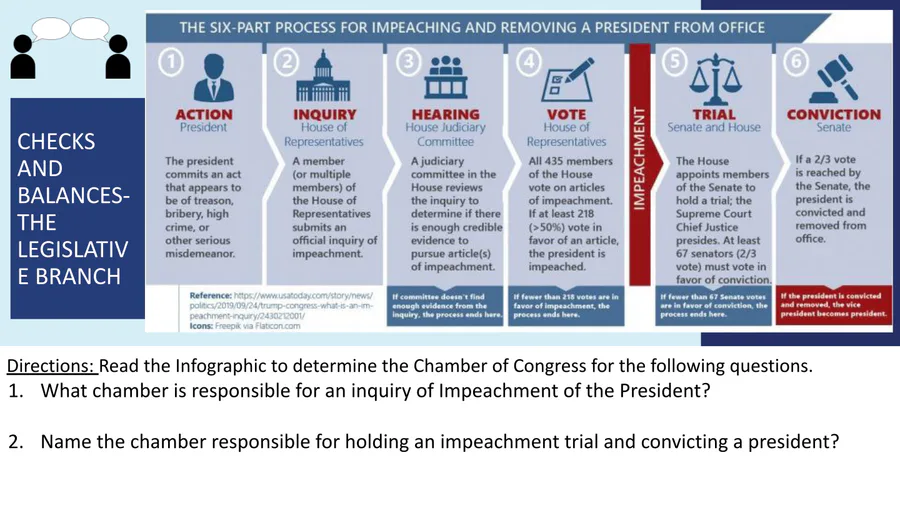
Multiple Choice
In impeachment proceedings, the House may _____, but the Senate must _____.
convict / impeach
impeach / convict and remove
remove / impeach
impeach / accuse
79

80
Multiple Choice
Congress’s expressed lawmaking powers come from
Article I
Article II
Article III
The Declaration of Independence
81
Multiple Choice
What best describes Congress’s expressed powers?
Powers not written in the Constitution but enforced through funding
Powers clearly listed in the Constitution
Powers given only to the states
Powers not listed but allowed through the Elastic Clause
82
Multiple Choice
When Congress expands its authority using the Elastic Clause, which group loses power?
Executive Branch
Judicial Branch
State Governments
House of Representatives
83
Multiple Choice
The Elastic Clause allows Congress to:
Regulate interstate trade
Override a presidential veto
Expand its powers as needed
Declare war
84
85
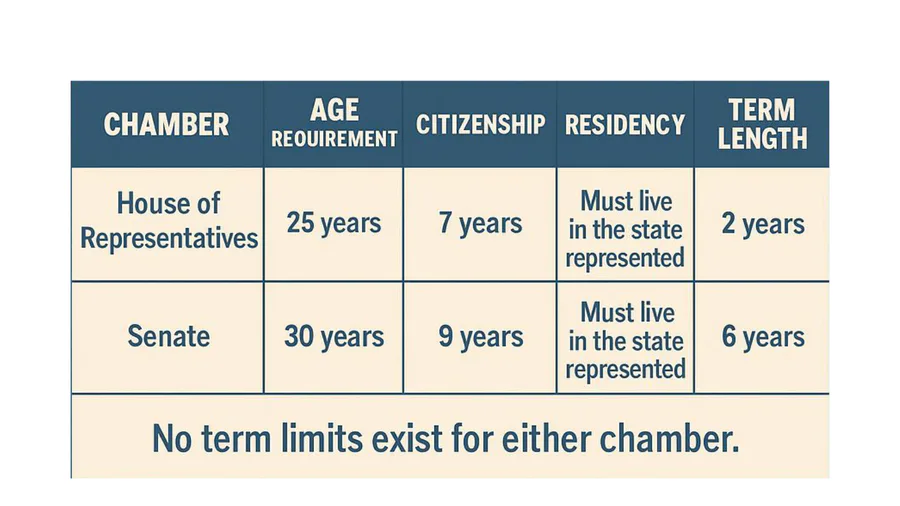
Multiple Choice
Which is NOT a qualification for serving in the House of Representatives?
At least 25 years old
Must live in the state they represent
Must have been a U.S. citizen for 9 years
Must have been a U.S. citizen for 7 years
86

87
Multiple Choice
What is the most powerful leadership position in the U.S. Senate?
Speaker of the Senate
President of the Senate
President Pro Tempore
Senate Majority Leader
88
Multiple Choice
If the Senate is split 50–50 between Democrats and Republicans, how is the majority party determined?
There is no majority party
The House majority determines it
The party of the Vice President becomes the majority as he/she is the tie-breaking vote
The previous majority remains in power
89
Multiple Choice
Which position does NOT come from the legislative branch?
Speaker of the House
House Minority Leader
President Pro Tempore
President of the Senate
90


91

92

93


94
Multiple Choice
Which is a Constitutional requirement for becoming President?
Must have held another elected office
Must be at least 35 years old
Must have been a U.S. resident for at least 35 years
Must have served in the military
95
Multiple Choice
Which item would not be found in Article II of the Constitution?
Length of the President’s term
Presidential qualifications
Presidential powers
The Powers for impeachment and removal
96

97
Multiple Choice
Candidate A wins 2,552,250 votes; Candidate B wins 2,600,000 votes in Ohio (17 electoral votes). How many electoral votes does Candidate A receive?
17
9
0
A percentage equal to their share of the popular vote
98

99
Multiple Choice
Which of the following could NOT happen in a modern presidential election?
A candidate wins the popular vote but loses the electoral vote
The House chooses the President if no one gets 270
A candidate receives 271 electoral votes and still loses
Maine or Nebraska split their electoral votes
100

101
Multiple Choice
If Candidate A has 268 electoral votes, Candidate B has 267, and Candidate C has 3, how is the President chosen?
Candidate A wins automatically
The House of Representatives chooses the President
The popular vote winner becomes President
The candidate who won the most states wins
102

103
Multiple Choice
The 23rd Amendment gave Washington D.C. electoral votes. How many did it grant?
5
4
3
2
104

105
Multiple Choice
Which statement about presidential terms is true today?
Presidents may run for more than two terms, but it is discouraged
Presidents regularly serve more than two terms
After FDR’s four terms, the Constitution was amended to limit future Presidents to two terms
Presidents are limited to one term only
106

107
Multiple Choice
Which Executive Department oversees the federal pardon process?
Health and Human Services
Defense
Justice
State
108
Multiple Choice
If wealthy individuals bribe college officials to admit their children, which Executive Department investigates and brings charges?
Defense
State
Justice
Education
109

110
Multiple Choice
Which statement about U.S. military power is the most accurate under the Constitution?
The President declares war and makes major strategic decisions
Congress serves as Commander-in-Chief
The President can deploy troops for up to 60 days before needing congressional approval
The President controls military funding
111
Multiple Choice
Which law was passed to limit the President’s military powers after the Vietnam War?
Marbury v. Madison
War Powers Act of 1973
25th Amendment
Elastic Clause
Show answer
Auto Play
Slide 1 / 111
SLIDE
Similar Resources on Wayground

101 questions
Dynamics_G11
Presentation
•
11th Grade
107 questions
Biology EOC Review 2
Presentation
•
9th - 10th Grade
107 questions
Cognitive Bias and Logical Fallacies
Presentation
•
12th Grade
104 questions
Lesson 4.5 : Common Injuries & Disorders of the Skeletal System
Presentation
•
10th Grade
108 questions
9.1 KOMUNITI DAN EKOSISTEM
Presentation
•
12th Grade
107 questions
Lesson #35 - The Impact of World War II on Americans
Presentation
•
10th Grade
106 questions
Heredity Notes - CP Bio
Presentation
•
11th Grade
102 questions
DC Civil Rights
Presentation
•
12th Grade
Popular Resources on Wayground
10 questions
Safety Day 2026 – Student Review

Quiz
•
9th Grade
21 questions
Continents and Oceans
Quiz
•
6th Grade
20 questions
Parts of Speech
Quiz
•
5th Grade
16 questions
Subject & Predicate
Quiz
•
5th Grade
25 questions
Multiplication Facts
Quiz
•
5th Grade
12 questions
Map Skills
Quiz
•
3rd Grade
22 questions
Continents and Oceans
Quiz
•
5th Grade
15 questions
Rounding Decimals
Quiz
•
5th Grade
Discover more resources for Social Studies
39 questions
Unit 7 Key Terms
Quiz
•
11th Grade - University
38 questions
Unit 6 Key Terms
Quiz
•
11th Grade - University
38 questions
The Progressive Era
Quiz
•
11th Grade
25 questions
Progressive Era
Quiz
•
11th Grade
25 questions
Gilded Age Gallery Walk
Presentation
•
9th - 12th Grade
20 questions
How The Constitution Has Changed
Quiz
•
11th Grade
25 questions
Mastery Quiz SSUSH 11-14
Quiz
•
11th Grade
30 questions
Q1 US History Check
Quiz
•
11th Grade