

Origin of Life

Presentation
•
Science
•
9th - 12th Grade
•
Hard
+1
Standards-aligned

Barbara White
Used 4+ times
FREE Resource
14 Slides • 8 Questions
1

Origin of Life
High School
2
Learning Objectives
Differentiate between a scientific law and a scientific theory.
Describe the hypothesized conditions of early Earth's atmosphere.
Explain the Miller-Urey experiment and its significance.
Summarize the endosymbiotic theory for the origin of eukaryotic cells.
Outline the proposed sequence of development for the first life forms.


3
Key Vocabulary

Abiogenesis
The theory that life can arise from nonliving matter under certain environmental conditions.

Biogenesis
The principle that living organisms can only be produced by other living organisms.

Anaerobic
Describes an organism or process that does not require oxygen to function or survive.

Prokaryotic
A simple type of cell that does not have a membrane-bound nucleus or organelles.

Eukaryotic
A complex type of cell that contains a nucleus and other membrane-bound organelles.

Endosymbiosis
The theory that eukaryotes evolved through a symbiotic relationship between different prokaryotic cells.
4
Scientific Law vs. Theory
Scientific Law
Describes what will happen in a given situation, based on repeated observations.
It predicts outcomes but does not explain the underlying reasons why they happen.
It is often expressed as an equation and is considered a universal fact.

Scientific Theory

Provides a comprehensive explanation for why a natural phenomenon occurs, based on evidence.
It is supported by a wide range of evidence from many experiments and observations.
Theories can be updated or modified if new evidence becomes available over time.
5
Solved Example 1
In a population of 100 pea plants, 75 have purple flowers (dominant) and 25 have white flowers (recessive). What are the allele frequencies for the dominant (P) and recessive (p) alleles in this population?
Step 1: Analyze and Sketch the Problem
6
Solved Example 1
In a population of 100 pea plants, 75 have purple flowers (dominant) and 25 have white flowers (recessive). What are the allele frequencies for the dominant (P) and recessive (p) alleles in this population?
Step 2: Solve for the Unknown
7
Solved Example 1
In a population of 100 pea plants, 75 have purple flowers (dominant) and 25 have white flowers (recessive). What are the allele frequencies for the dominant (P) and recessive (p) alleles in this population?
Step 3: Evaluate the Answer
8
Multiple Choice
What is the primary difference between a scientific theory and a scientific law?
A law can be revised, while a theory cannot be challenged.
A theory is a guess, while a law is a proven fact.
A law explains why something happens, while a theory predicts what will happen.
A theory explains why something happens, while a law predicts what will happen.
9
The Origin of Life: Early Earth and Abiogenesis
Early Earth's Atmosphere
The early atmosphere was formed by gases from volcanic eruptions and comets.
It likely contained methane, ammonia, water vapor, and carbon dioxide.
This early atmosphere was anaerobic, meaning that it lacked any free oxygen.

The Spark of Life

Abiogenesis is the idea that life can emerge from nonliving chemical sources.
The Miller-Urey experiment simulated early Earth's conditions to test this hypothesis.
It produced amino acids, which are the essential building blocks of proteins.
10
Multiple Choice
What was the key finding of the Miller-Urey experiment described on this slide?
That comets brought fully formed life to Earth.
That amino acids, the building blocks of proteins, could form from inorganic gases and energy.
That Earth's early atmosphere contained high levels of oxygen.
That the first living cells were created in a lab environment.
11
The First Cells and Endosymbiosis
Prokaryotic Cells
The first life forms on Earth were simple, single-celled organisms called prokaryotes.
They were anaerobic, which means they did not require oxygen to survive and produce energy.
These simple cells are very small and lack a nucleus or other complex organelles.

Endosymbiotic Theory
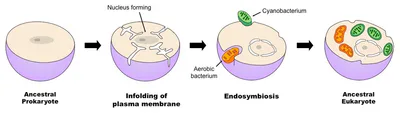
This theory explains how complex eukaryotic cells evolved from simpler prokaryotic cells.
A large ancestral cell engulfed smaller prokaryotes, forming a symbiotic relationship.
These prokaryotes evolved into organelles like mitochondria and chloroplasts over millions of years.
12
Solved Example 2
In a DNA comparison, a gorilla has 1 sequence difference from a human, while a lemur has 10. If the mutation rate is constant, how many times more recently did humans and gorillas share an ancestor than humans and lemurs?
Step 1: Analyze and Sketch the Problem
Goal: Determine the relative time since divergence.
Knowns: Gorilla differences = 1; Lemur differences = 10.
Unknown: The ratio of divergence time (Lemur vs. Gorilla).
Formula: Time is directly proportional to the number of differences.
13
Solved Example 2
In a DNA comparison, a gorilla has 1 sequence difference from a human, while a lemur has 10. If the mutation rate is constant, how many times more recently did humans and gorillas share an ancestor than humans and lemurs?
Step 2: Solve for the Unknown
14
Solved Example 2
In a DNA comparison, a gorilla has 1 sequence difference from a human, while a lemur has 10. If the mutation rate is constant, how many times more recently did humans and gorillas share an ancestor than humans and lemurs?
Step 3: Evaluate the Answer
The human-lemur common ancestor is 10 times more distant in the past than the human-gorilla one.
This means the human-gorilla ancestor is 10 times more recent.
The answer makes sense as fewer DNA differences imply a more recent common ancestor.
15
Multiple Choice
According to the Endosymbiotic Theory, how did eukaryotic cells gain organelles like mitochondria?
The organelles spontaneously formed within an ancestral prokaryotic cell.
An ancestral host cell engulfed smaller prokaryotic cells, which then became organelles.
Mitochondria were once independent eukaryotic cells that joined together.
Eukaryotic cells created their own organelles from scratch using their DNA.
16
Common Misconceptions About the Origin of Life
Misconception | Correction |
|---|---|
Spontaneous generation is the same as evolution. | Abiogenesis is how life began; evolution is how life changes over time. |
The first living cells were complex, like modern cells. | The first cells were simple prokaryotes, lacking a nucleus and complex organelles. |
The Miller-Urey experiment created a living cell. | It showed that organic molecules, like amino acids, could form from inorganic materials. |
Endosymbiosis was just a bacterial infection of a cell. | It was a mutually beneficial relationship between two cells. |
17
Multiple Choice
Based on the hypothesized sequence of development, why were the very first life forms likely anaerobic?
Because they lived deep in the oceans where there was no light.
Because Earth's early atmosphere lacked significant amounts of free oxygen.
Because they were prokaryotic and simple cells do not use oxygen.
Because oxygen was toxic to all forms of life at the time.
18
Multiple Choice
How did the development of photosynthetic organisms affect Earth's atmosphere and the evolution of subsequent life?
They depleted the atmosphere of nitrogen, preventing other life from forming.
They consumed all the carbon dioxide, which cooled the planet.
They released oxygen, which made the evolution of aerobic, more complex organisms possible.
They were the first eukaryotic cells, leading to multicellular life.
19
Multiple Choice
Analyze the relationship between the Miller-Urey experiment and the theory of abiogenesis. What is the most critical conclusion supported by the experiment's results?
The experiment proves that life must have originated on Earth and not from an extraterrestrial source.
The experiment provides evidence that a key step in abiogenesis, the formation of organic building blocks from inorganic matter, is chemically possible.
The experiment shows that the early atmosphere was identical to the mixture of gases used in the lab.
The experiment demonstrates that a bolt of lightning can create a living cell from a mixture of gases.
20
Multiple Choice
Considering the Endosymbiotic Theory, what would be the most likely consequence for eukaryotic life if an ancestral cell had never engulfed an ancient aerobic prokaryote?
All eukaryotic life would have remained anaerobic and single-celled, unable to form complex organisms.
Eukaryotic cells would not have a nucleus to protect their genetic material.
Complex cells would lack mitochondria and would be far less efficient at generating energy, likely preventing the evolution of multicellular life.
Plants would not be able to perform photosynthesis because they would lack chloroplasts.
21
Summary
Theories explain how phenomena happen, while laws predict the results of phenomena.
Earth’s early atmosphere was anaerobic, which allowed for the formation of organic molecules.
The first life forms were simple, anaerobic prokaryotes that arose from non-living matter.
Complex eukaryotic cells evolved from symbiotic relationships between different prokaryotic cells.
22
Poll
On a scale of 1-4, how confident are you about the concepts covered in today's review?
1
2
3
4
Origin of Life
High School
Show answer
Auto Play
Slide 1 / 22
SLIDE
Similar Resources on Wayground

19 questions
3.4 Behavior of Gases
Presentation
•
9th - 12th Grade
18 questions
Intro to Nucleic Acids
Presentation
•
9th - 12th Grade
20 questions
Cell Division
Presentation
•
9th - 12th Grade
14 questions
Balancing Chemical Equations Review
Presentation
•
9th - 12th Grade
16 questions
Unit 11: Forces
Presentation
•
9th - 12th Grade
17 questions
Water uses, cycle, and conservation
Presentation
•
9th - 12th Grade
16 questions
Bioaccumulation vs. Biomagnification
Presentation
•
9th - 12th Grade
16 questions
The Theory of Evolution
Presentation
•
8th Grade
Popular Resources on Wayground
6 questions
PRIDE Always and Everywhere
Presentation
•
12th Grade
20 questions
Lab Safety Quiz

Quiz
•
6th Grade
26 questions
KOR Review Kahoot Questions
Quiz
•
8th Grade
21 questions
Continents and Oceans
Quiz
•
6th Grade
12 questions
Unit Zero lesson 2 cafeteria
Presentation
•
9th - 12th Grade
20 questions
Parts of Speech
Quiz
•
5th Grade
10 questions
Riddles Riddles fun Riddles
Quiz
•
6th - 12th Grade
16 questions
Subject & Predicate
Quiz
•
5th Grade
Discover more resources for Science
10 questions
Scientific Method (The scientific method)

Interactive video
•
9th Grade
10 questions
Exploring Chemical and Physical Changes
Interactive video
•
6th - 10th Grade
10 questions
Exploring the States of Matter
Interactive video
•
6th - 10th Grade
20 questions
Atomic Structure
Quiz
•
9th Grade
30 questions
Atomic Structure and Periodic Table Review
Quiz
•
10th Grade
9 questions
Exploring the Steps of the Scientific Method
Interactive video
•
6th - 10th Grade
16 questions
Identify Key Characteristics of Living Organisms
Quiz
•
9th - 12th Grade
20 questions
Photosynthesis
Quiz
•
9th Grade