

Lesson 24 Encryption Methods 1

Presentation
•
Computers
•
11th - 12th Grade
•
Easy

Ryan Mordey
Used 4+ times
FREE Resource
10 Slides • 5 Questions
1
By Ryan Mordey
2
Discussed how network functionality is divided into layers.
Past
Explain basic encryption methods some of which pre-date
Assess the effectiveness of a range of encryption methods..
Present
Future
Careers: Network Security Specialist, Cryptographer, Cryptanalyst
3

When data is encrypted, it passed through a process that combines data with a key, which is used to encrypt data then at the receiving end it is used to decrypt the data.
This is known as symmetric key encryption, with applications such as whole disk encryption the key is kept safe by the user and applied every time the computer is booted.
Symmetric Encryption
4

Data being transmitted needs a different process, as sending the same key used to encrypt to decrypt data, could be more vulnerable to data interception.
Asymmetric keys use different keys to encrypt and decrypt the data but are mathematically related to each other. For example a encrypt key might be a calculation but the decrypt key is the matching answer.
Asymmetric Encryption
5
Comparison
Here is an comparison on the use of encryption methods:

6
Categorize
Same key is used
User keeps the key private
Used for whole disk encryption
Applied each time computer boots up
One key to encrypt
Another key to decrypt
Keys are mathematically linked
Best used for data transmission
Less Processing time needed
More processing time needed
Drag the correct characteristic to the encryption technique
7
Pre-computing Cyphers
Substitution Cypher also known as a shift cypher, involves substituting one letter of the alphabet with another.
This is an outdated method that is easy to develop but can be easily cracked, providing little security:

As a written algorithm:
1. Select Shift Value
2. Input Message
3. Loop through characters of message
a) Encrypted character = current character + shift value
b) Save encrypted character
c) Next character in message
4. Output encrypted message
8
Pre-computing Cyphers
Transposition Cypher moves around the position of the letters in a message. This is different to substitution where the letters change but the position does not.
Here is a columnar transposition where each letter is placed into a table but we choose to transpose through the column to make a new word.
As a written algorithm:
1. Create a table to hold message
2. Loop through characters of message
a) insert character in table index
b)Move to next index on row
c)Next character in the message
3. Return to first index
4. Loop through index of table
a) Save character from index to encrypted message
b)Move to next index in column
5.Output encrypted message.

9
Fill in the Blanks

The following cypher text has been created using a transposition cypher what was the original message?
ACDTKATAWATN
10
Fill in the Blanks
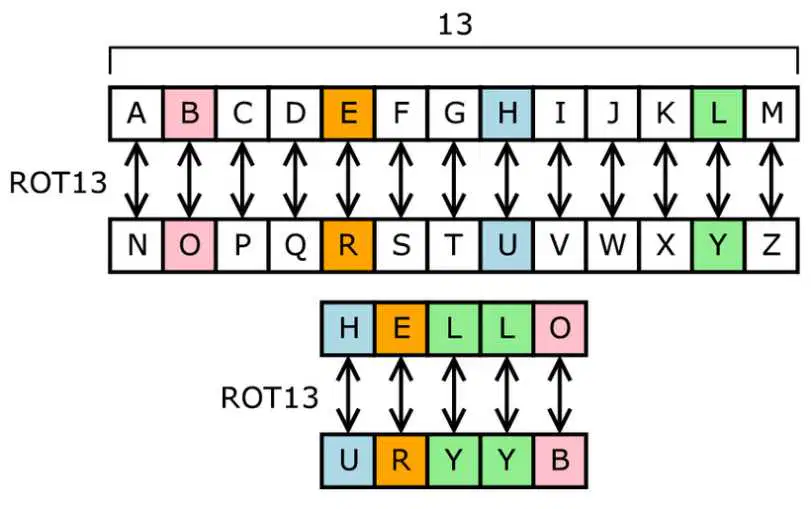
Using this method of substitution cipher, encrypt the message: MAIDEN
11
XOR Cyphers
This technique uses a binary operator called XOR. Applying an XOR operation to two binary numbers produces a new result which is the encrypted message.
To decrypt the message all you need to do is XOR the message with the same key. XOR is used in modern encryption methods
This encryption method is relatively simple and inexpensive to perform, however if you know the XOR cipher stream you can reverse engineer to decrypt the ciphertext.

12
Steganographic Cyphers
This method involves hiding a message within some other kind of data. For example binary data could be hidden in an image file, this method does not attract attention so is hard to spot.
Most hackers will see what just appears to be an image, so might not think anything of the additional binary data. Once discovered it is not difficult to crack the code.

13
Draw
Using the XOR cypher technique what would the result of comparing A and B be? Write your answer for each comparison in column C. 2 Marks.
14
Multiple Choice
How does a steganographic cypher work?
15
Computer Task:
Use the written algorithm to try and create your own substitution encryption program in Python.
You should input a message and see if the person can try and crack your encryption technique.
Complete all the questions on the work sheet.
By Ryan Mordey
Show answer
Auto Play
Slide 1 / 15
SLIDE
Similar Resources on Wayground

10 questions
Hexadecimal Number System
Presentation
•
11th - 12th Grade
10 questions
Plessy v. Ferguson
Presentation
•
12th Grade
10 questions
Algebra - Lesson Distance Between Points
Presentation
•
12th Grade
13 questions
Sound waves- Part 1
Presentation
•
11th - 12th Grade
11 questions
Linear & Quadratic Regression using Desmos
Presentation
•
10th - 12th Grade
11 questions
Half-life Review
Presentation
•
10th - 12th Grade
11 questions
Adding and Subtracting Rational Expressions
Presentation
•
10th - 12th Grade
10 questions
Coding in Kindergarten 2023
Presentation
•
KG
Popular Resources on Wayground
10 questions
Safety Day 2026 – Student Review

Quiz
•
9th Grade
21 questions
Continents and Oceans
Quiz
•
6th Grade
20 questions
Parts of Speech
Quiz
•
5th Grade
16 questions
Subject & Predicate
Quiz
•
5th Grade
25 questions
Multiplication Facts
Quiz
•
5th Grade
12 questions
Map Skills
Quiz
•
3rd Grade
22 questions
Continents and Oceans
Quiz
•
5th Grade
15 questions
Rounding Decimals
Quiz
•
5th Grade