

Module 2, Lesson 1: Describe Motion

Presentation
•
Science
•
9th - 12th Grade
•
Medium
+1
Standards-aligned

Tynisha Wilson
Used 15+ times
FREE Resource
13 Slides • 15 Questions
1
Think-Pair-Share
What is motion?
What ways can motion be described?
2
3
4
5
6
Multiple Select
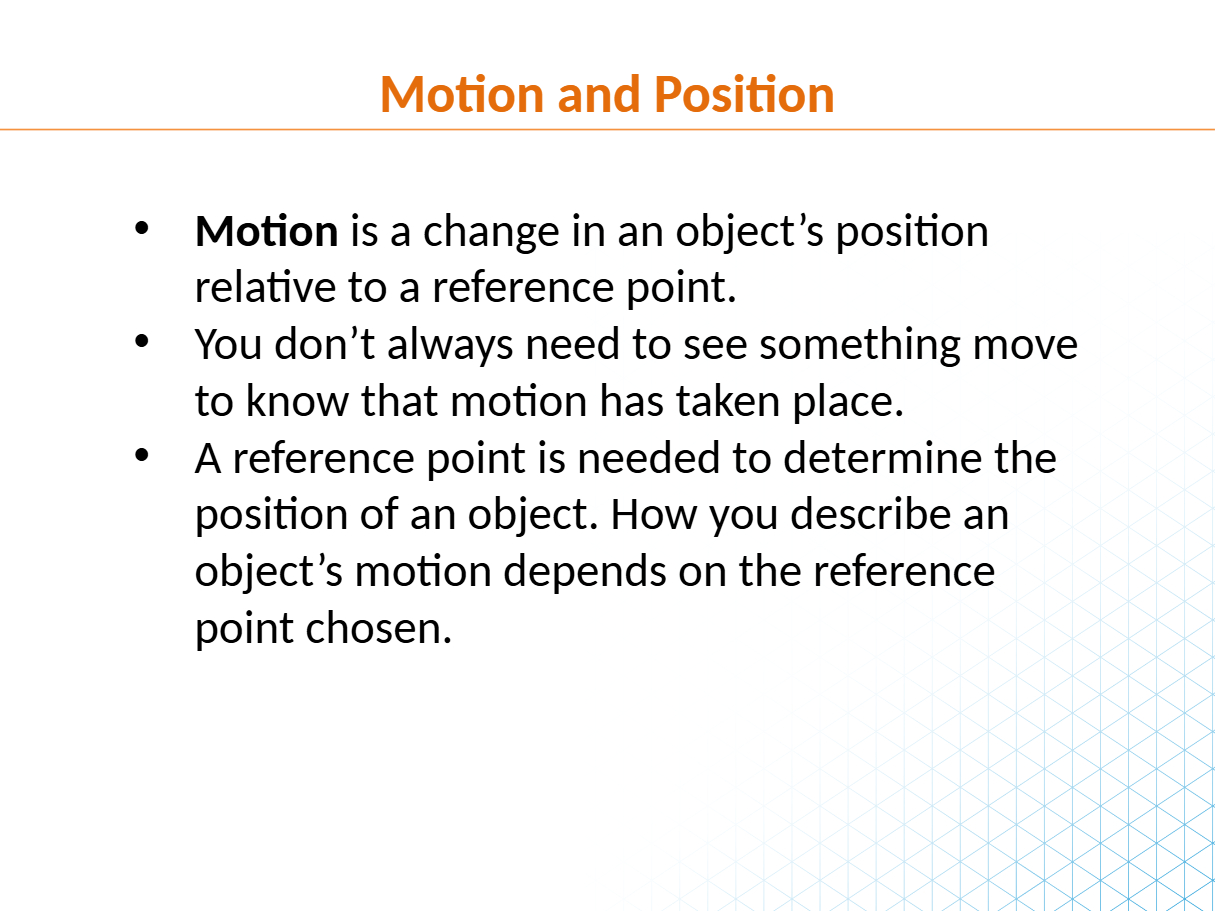
Select all statements that are true about motion and reference points.
A reference point is needed to determine the position of an object.
Motion is a change in an object's position relative to a reference point.
You always need to see something move to know that motion has taken place.
How you describe an object's motion depends on the reference point chosen.
7
8
Multiple Choice
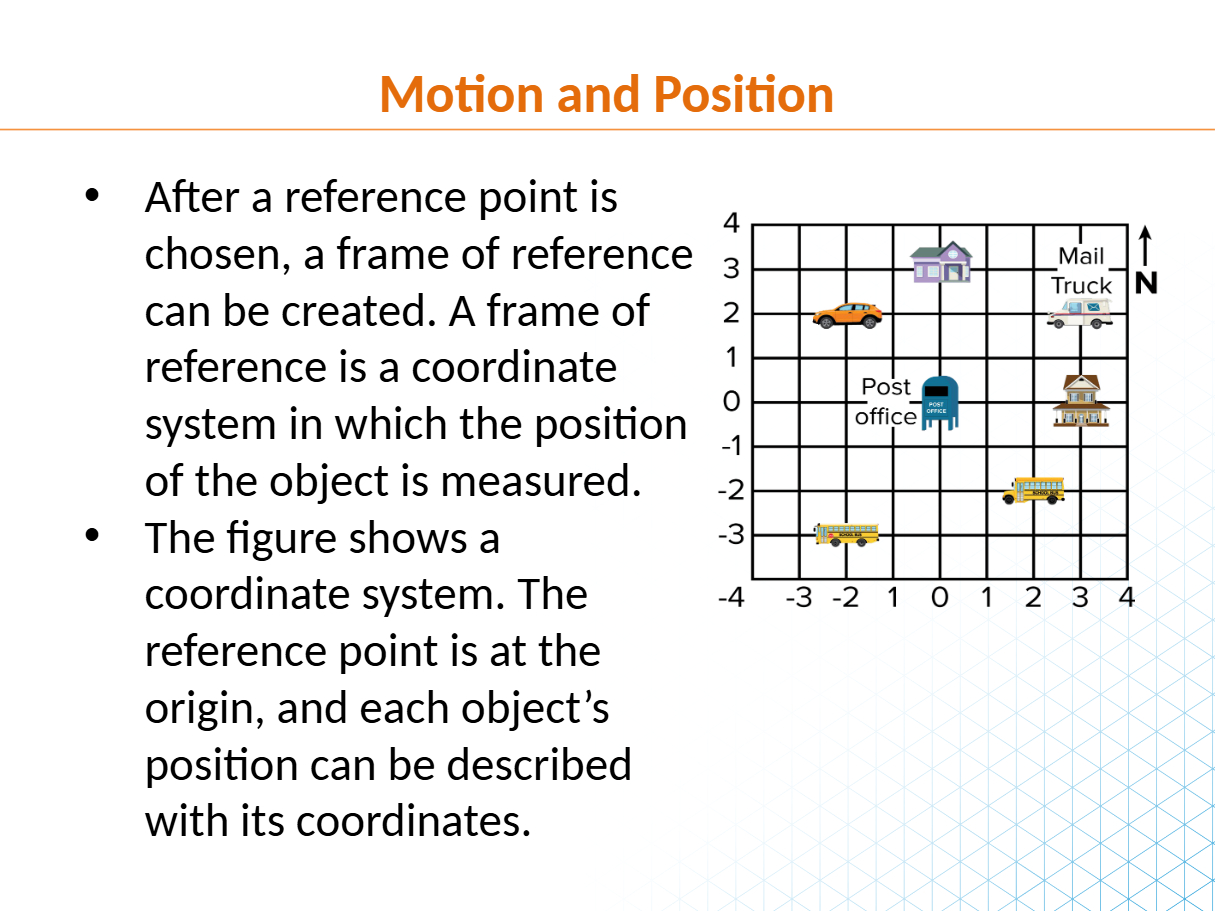
After a reference point is chosen, a frame of reference can be created. What is a frame of reference?
A system for measuring the position of objects using coordinates.
A tool for measuring speed.
A way to calculate displacement only.
A method for finding the mass of an object.
9
10
Fill in the Blanks
11
12
Multiple Choice
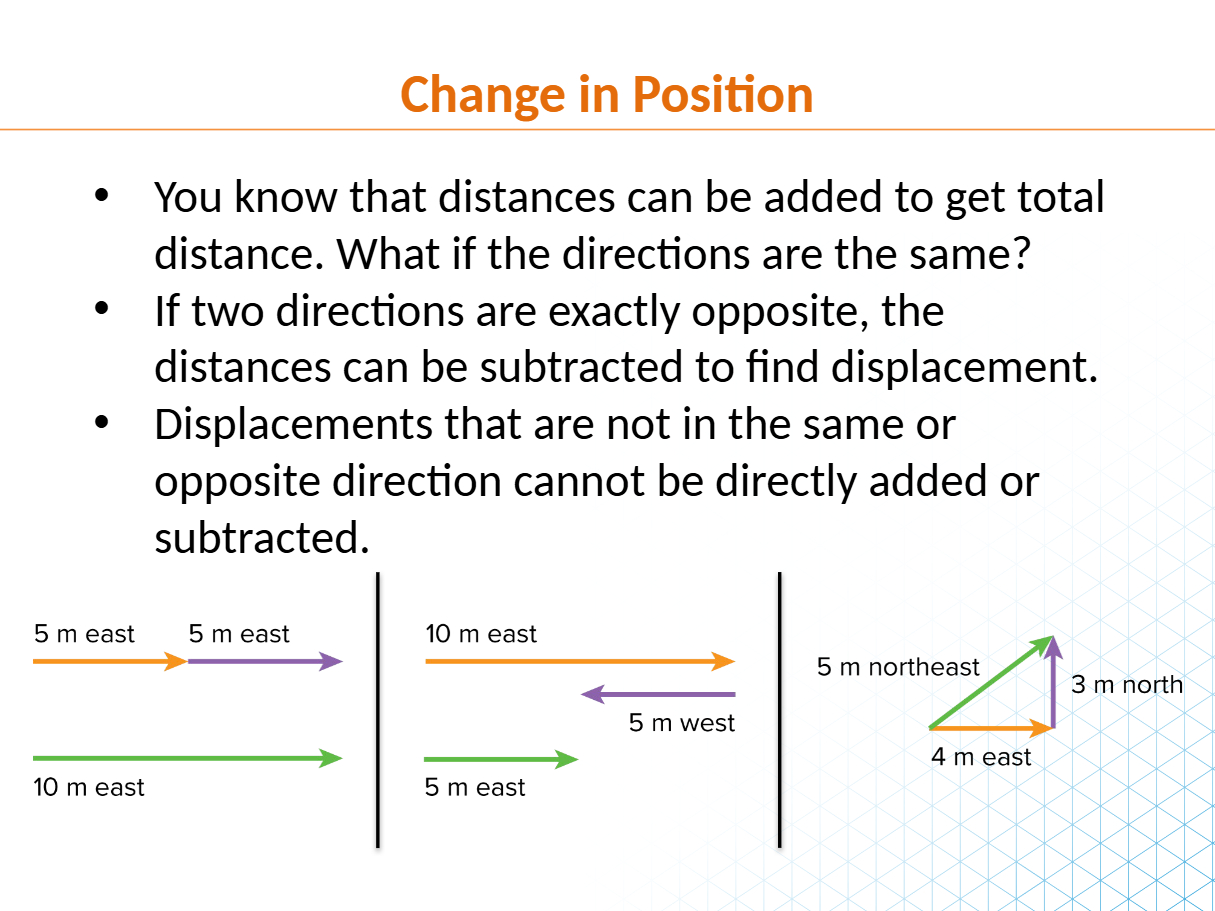
Which of the following scenarios demonstrates that displacement cannot be directly added or subtracted?
Two movements in the same direction.
Two movements in exactly opposite directions.
Two movements that are not in the same or opposite direction.
Two movements along a straight line.
13
Multiple Choice
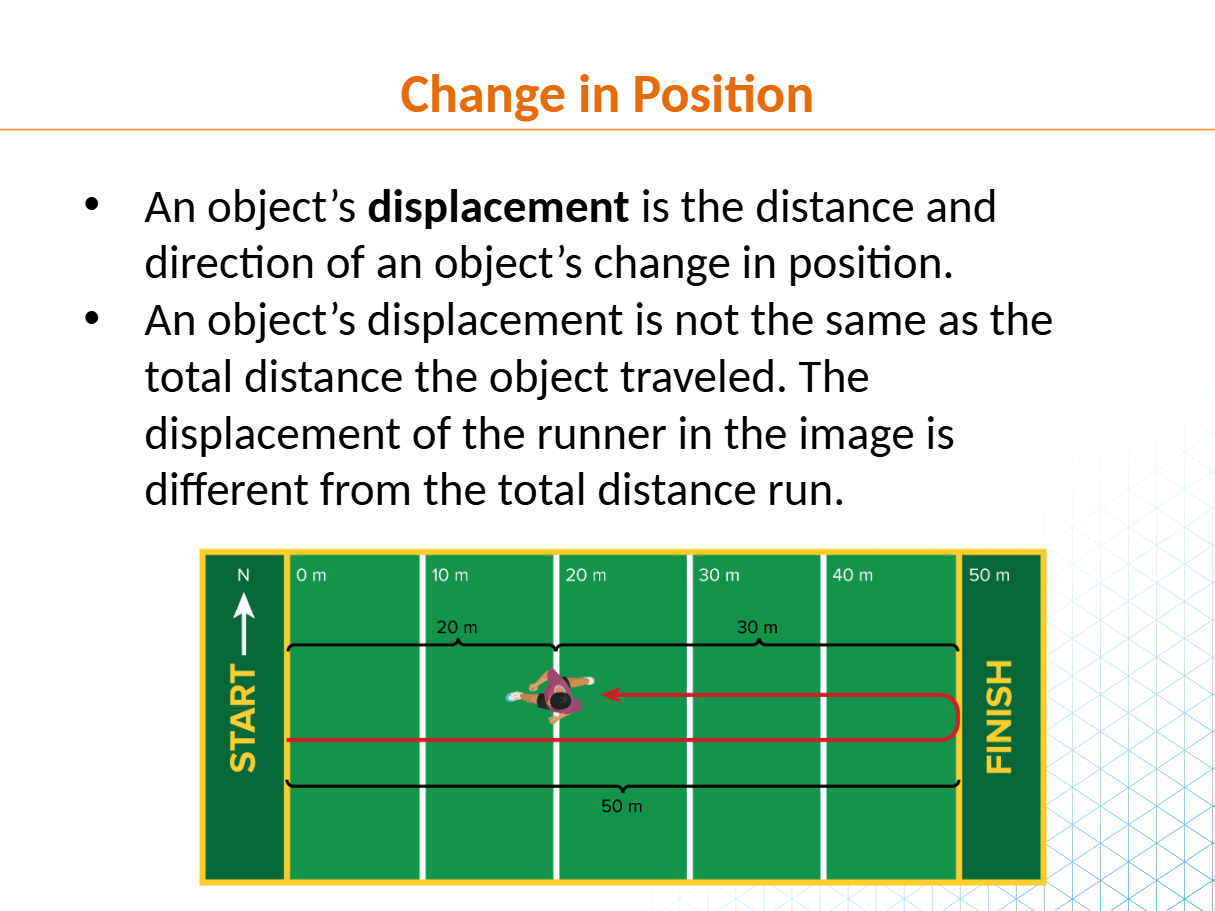
Which of the following best describes the difference between distance and displacement?
Distance is the total length traveled, while displacement is the straight-line distance from the starting point to the ending point.
Distance is always shorter than displacement.
Displacement is the total length traveled, while distance is the straight-line distance from the starting point to the ending point.
Distance and displacement are always equal.
14
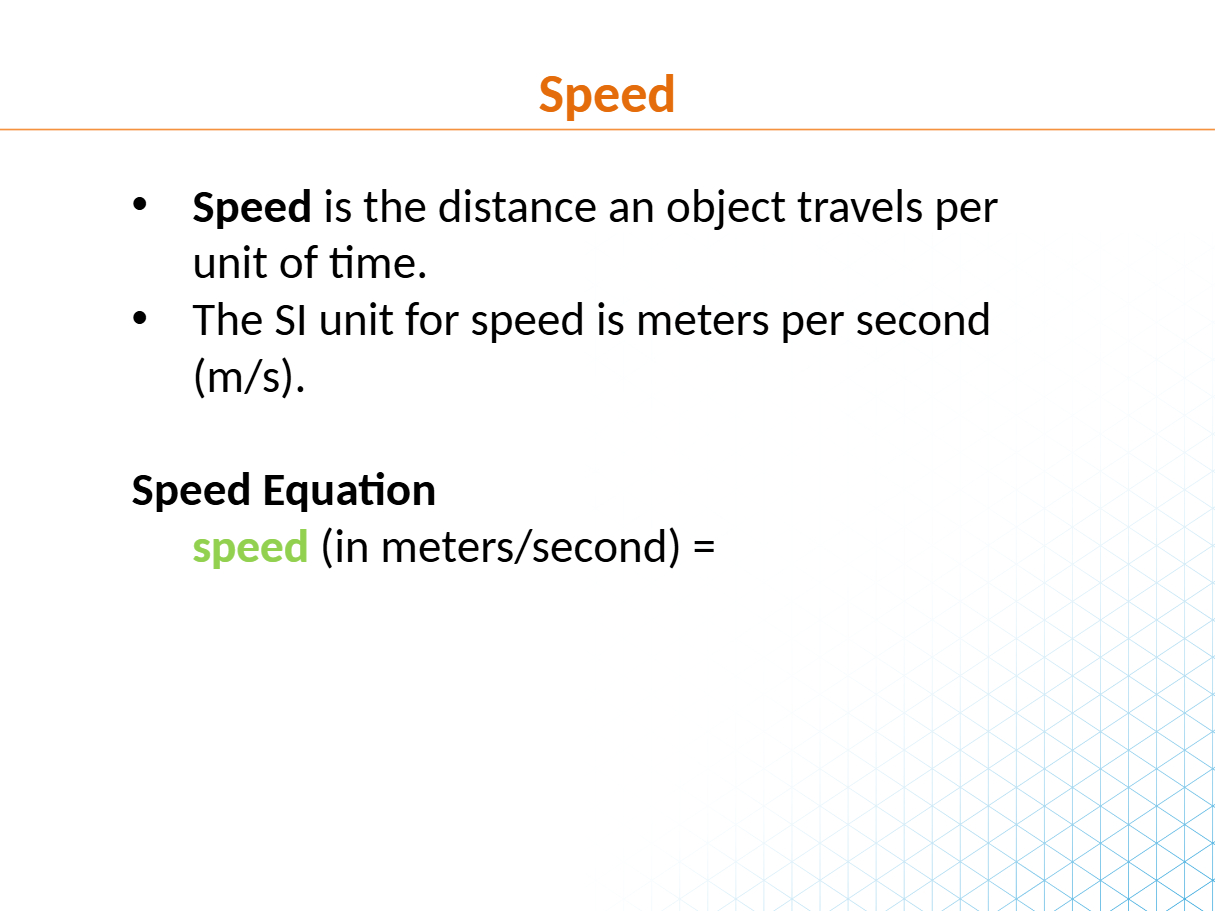
15
Fill in the Blanks
16
17
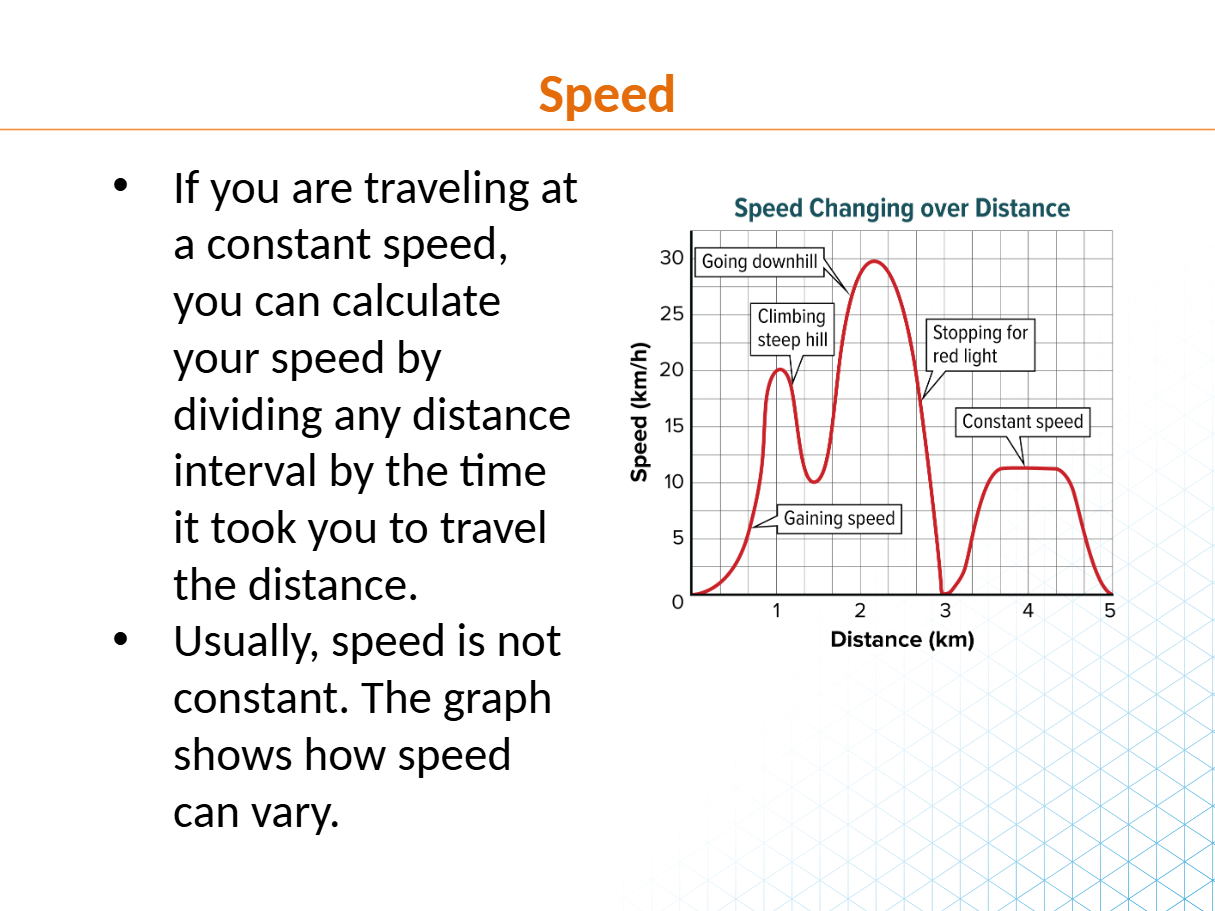
Multiple Choice
Which of the following statements best explains how speed can change over a journey, as shown in the graph?
Speed always increases over time.
Speed remains constant throughout the journey.
Speed can increase, decrease, or remain constant at different intervals.
Speed only decreases when going uphill.
18
19
20
21
Open Ended
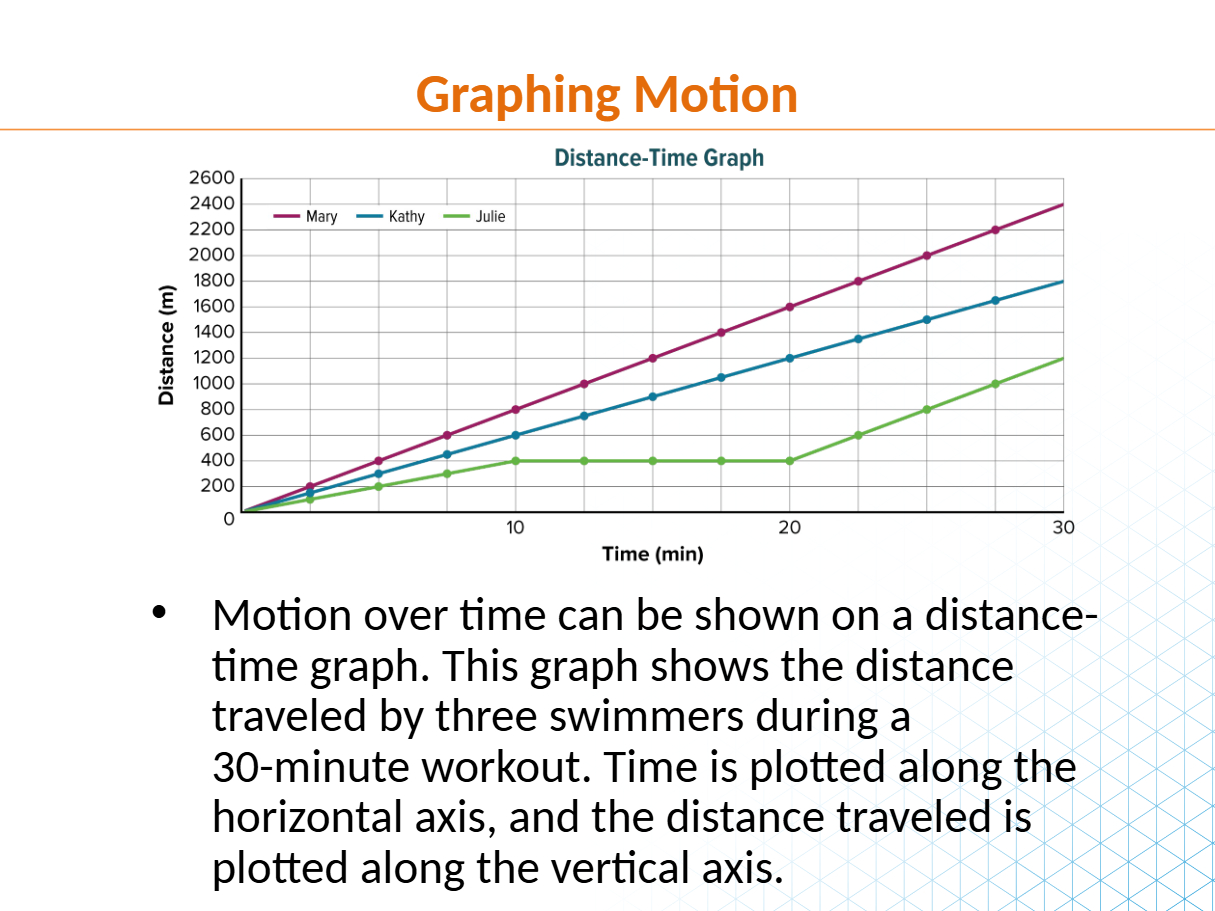
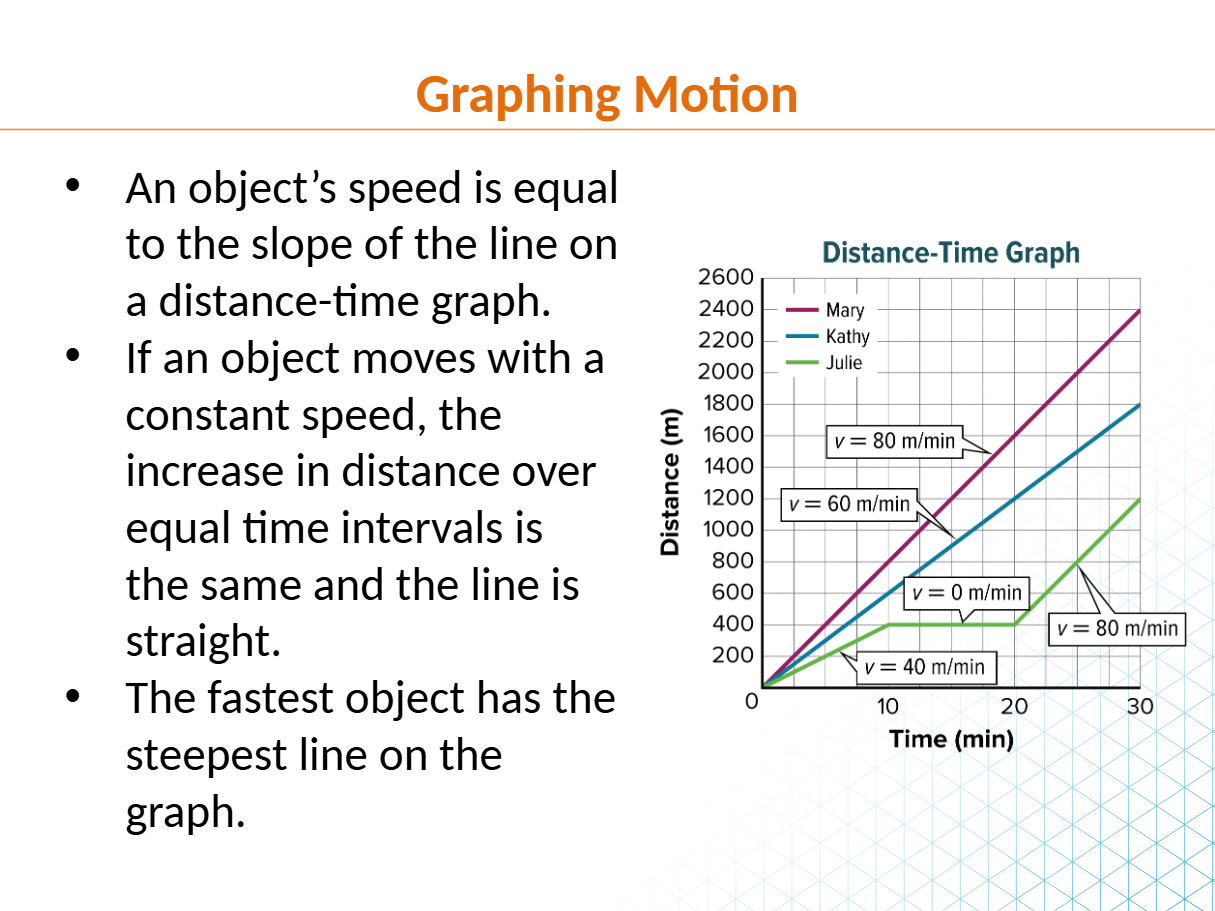
How can you determine the speed of an object from a distance-time graph?
22
Multiple Select
Select all correct statements about interpreting a distance-time graph:
The slope of the line represents speed.
A straight line indicates constant speed.
The steepest line shows the fastest speed.
A horizontal line means increasing speed.
23
Multiple Choice
How is speed defined?
acceleration/time
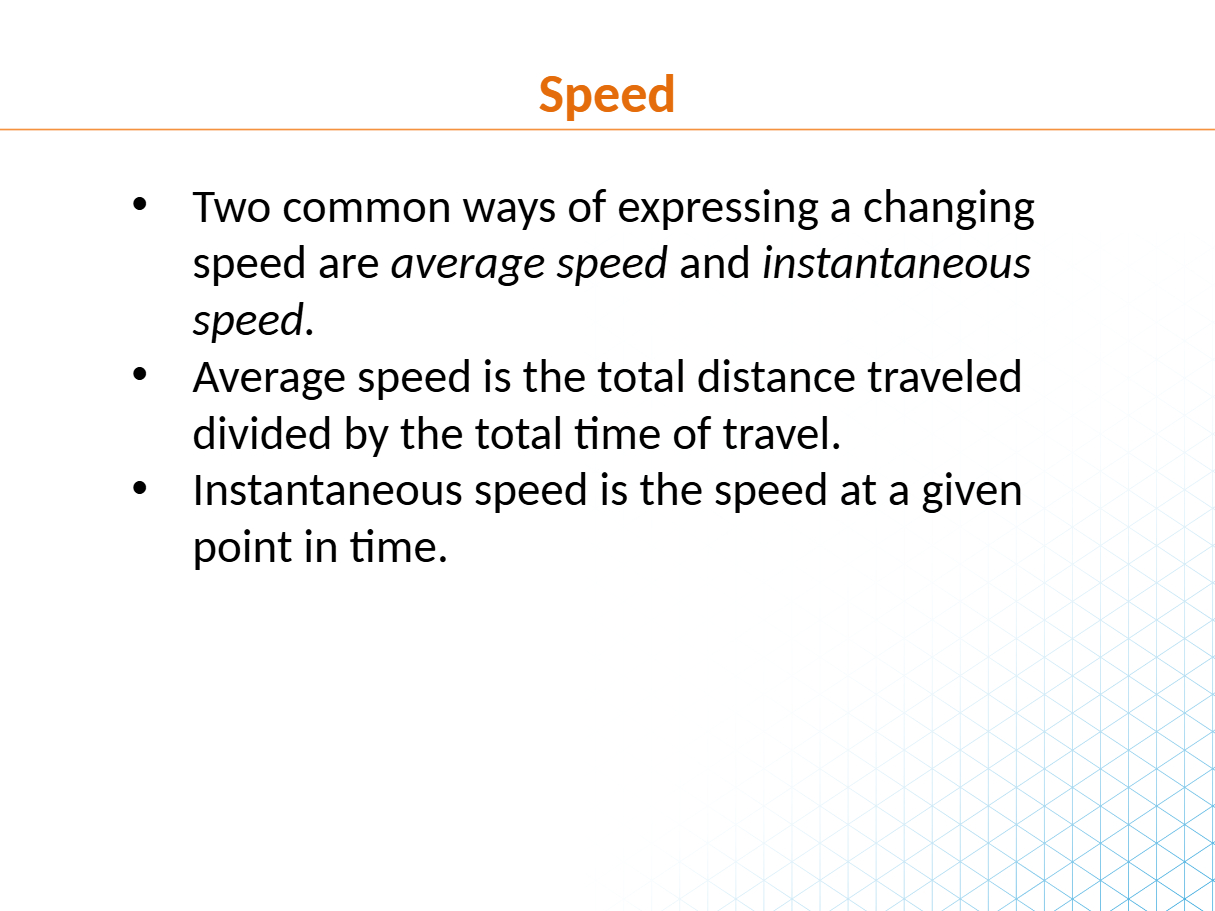
distance/time
change in velocity/time
displacement/time
24
Multiple Choice
What is the speed of a walker who covers a distance of 1000 m in 25 minutes? (25 min = 1500 s)
40 m/s
1.6 m/s
0.67 m/s
0.67 s/m
25
Multiple Choice
A wolf walks 20 km east and then turns around and walks 10 km west. What is the total displacement?
30 km east
30 km west
10 km east
10 km west
26
Multiple Choice
Which of the following is NOT true of a distance-time graph?
The slope of the graph equals the object's speed.
Distance is on the x-axis.
Time is on the x-axis.
The line is straight if speed is constant.
27
Multiple Choice
Which of the following is true?
Speed is usually constant.
Average speed is the total time of travel divided by the distance traveled.
If an object is moving with a constant speed, the instantaneous speed does not change.
The x-axis is divided into equal distance intervals on a distance-time graph.
28
Open Ended
After learning about describing motion, what is one real-life example where understanding motion is important?
Think-Pair-Share
What is motion?
What ways can motion be described?
Show answer
Auto Play
Slide 1 / 28
SLIDE
Similar Resources on Wayground

23 questions
Scientific Method
Presentation
•
9th - 12th Grade
21 questions
Biogeochemical Cycles
Presentation
•
9th - 12th Grade
21 questions
The Great Pacific Garbage Patch
Presentation
•
9th - 12th Grade
23 questions
Earths Movements
Presentation
•
9th - 12th Grade
19 questions
Structure of Atom
Presentation
•
9th - 12th Grade
20 questions
Skeletal System: Joints
Presentation
•
9th - 12th Grade
20 questions
Momentum
Presentation
•
9th - 11th Grade
20 questions
Open SciEd Biology Lesson 4 Clover Genetics and Environment
Presentation
•
9th - 12th Grade
Popular Resources on Wayground
20 questions
Math Review

Quiz
•
3rd Grade
15 questions
Fast food
Quiz
•
7th Grade
20 questions
Context Clues
Quiz
•
6th Grade
20 questions
Inferences
Quiz
•
4th Grade
19 questions
Classifying Quadrilaterals
Quiz
•
3rd Grade
20 questions
Figurative Language Review
Quiz
•
6th Grade
20 questions
Equivalent Fractions
Quiz
•
3rd Grade
10 questions
Identify Fractions, Mixed Numbers & Improper Fractions
Quiz
•
3rd - 4th Grade
Discover more resources for Science
25 questions
Naming Ionic and Covalent Compounds
Quiz
•
9th Grade
40 questions
NCFE Earth and Environmental Science Released Test
Quiz
•
9th - 12th Grade
10 questions
Exploring Weather Influences and Map Reading

Interactive video
•
6th - 10th Grade
20 questions
Human Impact on the Environment Review #2
Quiz
•
9th Grade
20 questions
Balancing Chemical Equations
Quiz
•
9th Grade
61 questions
End of the Year Trivia Fun
Quiz
•
9th Grade
15 questions
Protein synthesis
Quiz
•
9th Grade
30 questions
Environmental Science Final Exam REVIEW
Quiz
•
9th - 12th Grade