

Module 21: Immigrants and Urban Life

Presentation
•
Social Studies
•
8th Grade
•
Easy

Teresa Smith
Used 8+ times
FREE Resource
7 Slides • 8 Questions
1
By Teresa Smith

(5 minutes)
Directions: You will read and respond to the prompt: If you received a “text message” from your friend explaining to you how their life has changed since they have started being a factory worker, how would you respond to your friend “text message”? You are required to write 3 or more sentences to respond to your friend “text message."
2
Open Ended
read and respond to the prompt: If you received a “text message” from your friend explaining to you how their life has changed since they have started being a factory worker, how would you respond to your friend “text message”?
3
Standard:8.6-Interpret the causes, effects, and challenges of the Industrial
Revolution. Objective 8.6.5-Assess how geography influenced the location of factories.
I Can Statement: “I can explain how geography influenced where factories were built.”
Module 21: Immigrants and Urban Life
4

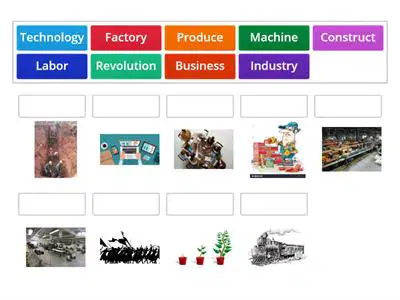
Directions: You will compete in an industrialization (word wall) match-up workforce game. Boys vs girls, you will choose one of your peers to represent your team. Each team will have an amount of time to drag and drop the words to match up to the correct workforce pictures. The team that has the most correct words to match the workforce pictures will win the game.
5
Key Vocabulary
Geography – physical features of an area.
Water power – energy produced by moving water.
Raw materials – natural resources used to make products.
Transportation routes – paths used to move goods and people.
Urbanization – growth of cities (as people move in)
6
Geography and the Rise of Factories During the Industrial Revolution
During the Industrial Revolution, geography, physical features of an area played a critical role in determining where factories were built. In the early 1800s, factory owners carefully selected locations based on access to natural resources, transportation routes, and available labor. These geographic factors helped businesses operate efficiently and increase production. One of the most important geographic influences on factory locations was water power, energy produced by moving water. Before electricity became widely available, factories relied on rivers and streams to power machinery. Fast-moving rivers provided the energy needed to turn waterwheels, which ran textile machines and other equipment. As a result, many early factories were built near rivers, especially in regions such as New England, where rivers were plentiful.
7
Multiple Choice
What is geography?
physical features of the sky
physical features of land
physical features of geographic factors
physical features of an area
8
Multiple Choice
Why were many early factories built near rivers?
rivers provided drinking water for workers
rivers allowed factories to avoid paying taxes
rivers provided water power to run machinery
rivers made factories easier to defend
9
Multiple Choice
What was water power used for during the early Industrial Revolution?
lightning factories
turning waterwheels to run machines
heating homes
transporting workers
10
Key geographic factors was access to raw materials, natural resources used to make products. Factories needed large amounts of resources like coal, iron, and cotton. Coal was essential for powering steam engines, while iron was used to make tools, machines, and railroad tracks. Areas close to coal mines or iron deposits, such as parts of Pennsylvania, became major industrial centers because transportation costs were lower and materials were readily available.
Transportation routes, paths used to move goods and people also influenced factory locations. Factories were often built near canals, rivers, and railroads to move raw materials to factories and ship finished goods to markets. Cities located along major waterways or railroad lines grew quickly because they allowed goods to be transported faster and more cheaply. This helped factories expand and reach customers across the country.

11
Match
Match the geographic factor to its description
Used to power steam engines
Used to make machines and tools
Transported goods to markets
Natural resources used to make products
coal
iron
railroads
raw materials
coal
iron
railroads
raw materials
12
Finally, factories needed workers, so many were built near growing towns and cities. As people moved from rural areas to urban centers in search of jobs, factory owners benefited from a steady labor supply. This led to rapid urbanization growth of cities, with cities growing around factory sites. Geography, combined with economic opportunity, shaped where people lived and worked during the Industrial Revolution.
Overall, geography strongly influenced the location of factories by providing power, materials, transportation, and labor. These geographic advantages allowed factories to thrive and helped transform the United States into an industrial nation.
13
Fill in the Blanks
14
Multiple Choice
What does urbanization means?
people moving from cities to farms
growth of factories only
growth of cities as people move in
the decline of rural areas
15
Open Ended
use 1-2 complete sentences to answer the exit ticket
Exit Ticket: What is the main idea of today's lesson
By Teresa Smith
(5 minutes)
Directions: You will read and respond to the prompt: If you received a “text message” from your friend explaining to you how their life has changed since they have started being a factory worker, how would you respond to your friend “text message”? You are required to write 3 or more sentences to respond to your friend “text message."
Show answer
Auto Play
Slide 1 / 15
SLIDE
Similar Resources on Wayground

13 questions
African Geography
Presentation
•
8th Grade
11 questions
Vietnam War: (Part 2) U.S. Early Involvement
Presentation
•
8th Grade
14 questions
Causes: War of 1812
Presentation
•
8th Grade
11 questions
10.2 Greek Society and Economy
Presentation
•
8th Grade
10 questions
Equations Of All Kinds!!!
Presentation
•
8th Grade
10 questions
Introduction Paragraph
Presentation
•
8th Grade
10 questions
System of Equations
Presentation
•
8th Grade
12 questions
LESSON 51: The Monroe Doctrine
Presentation
•
8th Grade
Popular Resources on Wayground
10 questions
How much do you know about our Portrait of an Eagle?

Quiz
•
10th Grade
10 questions
Fast Food Slogans
Quiz
•
6th - 8th Grade
21 questions
Continents and Oceans
Quiz
•
6th Grade
20 questions
Parts of Speech
Quiz
•
5th Grade
16 questions
Subject & Predicate
Quiz
•
5th Grade
25 questions
Multiplication Facts
Quiz
•
5th Grade
12 questions
Map Skills
Quiz
•
3rd Grade
22 questions
Continents and Oceans
Quiz
•
5th Grade
Discover more resources for Social Studies
10 questions
Exploring the Age of Exploration: Key Events and Figures

Interactive video
•
6th - 10th Grade
13 questions
13 Colonies Map Quiz
Quiz
•
6th - 8th Grade
20 questions
13 original colonies
Quiz
•
8th Grade
10 questions
Causes of the American Revolution
Quiz
•
8th Grade
10 questions
Pillars of Free Enterprise
Quiz
•
6th - 8th Grade
26 questions
QA 1 Review
Quiz
•
6th - 8th Grade
10 questions
Exploring the 13 Colonies Regions
Interactive video
•
6th - 10th Grade
3 questions
Unit 3 Road to Revolution Vocabulary
Quiz
•
8th Grade