Search Header Logo
  1. Resource Library
  2. Science
  3. Biology
  4. Fossils
  5. Fossils
Fossils

Fossils

Assessment

Presentation

Science

6th - 8th Grade

Medium

NGSS
MS-LS4-2, MS-LS4-1, MS-ESS1-4

+10

Standards-aligned

Created by

Lindsey Winn

Used 1+ times

FREE Resource

18 Slides • 33 Questions

1

media

2

media

3

Dropdown

Question image
Look at the Image below. Which grasshoppers are going die faster in a green field?

4

Hotspot

Which moth is better adapted to an environment with light trees?

5

Multiple Choice

Which of the following best describes the theory of evolution?

1

Species remain unchanged over time.

2

Species change over time due to helpful traits being passed on.

3

All individuals in a species are identical.

4

Evolution only occurs in fossils.

6

Open Ended

Why is the study of evolution significant for understanding life on Earth?

7

media

8

Multiple Choice

Which of the following pieces of evolution evidence deals with comparing similar structures in various species?
1
fossil record
2
comparing embryology
3
comparing biochemistry
4
comparing anatomy

9

Multiple Choice

Question image
Some organisms that share a common ancestor have features that have different functions, but similar structures.  These are known as
1
vestigial structures
2
analogous structures
3
homologous structures
4
fossil structures

10

Multiple Choice

Question image
How would you describe this evolution?
1
Homologous structure
2
Analogous structure
3
Structural adaption
4
Functional adaption

11

media

12

media

13

Multiple Choice

________ are evidence of things which were once alive that have since been turned to stone.

1

Fossils

2

Crystals

3

Minerals

4

Rocks

14

Multiple Choice

Where are fossils usually found?

1

in igneous rock

2

in sedimentary rock

3

in your classroom

4

in metamorphic rock

15

media

16

media

17

Multiple Choice

Which major change in Earth’s atmosphere allowed complex life to eventually evolve?

1

Increase in carbon dioxide

2

Transition from oxidizing to reducing

3

Enrichment of oxygen in the atmosphere

4

Loss of tectonic plate movement

18

media

19

Multiple Choice

What event during the Paleozoic Era is known as the largest mass extinction in Earth’s history?

1

Cambrian Explosion

2

End-Devonian extinction

3

Jurassic extinction

4

End-Permian extinction

20

media

21

Multiple Choice

Which group of organisms first appeared during the Jurassic period?

1

Flowering plants

2

Birds

3

mammals

4

marine reptiles

22

media

23

Multiple Choice

What major evolutionary development occurred during the late Cenozoic Era?

1

First dinosaurs appeared

2

First fish evolved

3

Humans evolved

4

First multicellular organisms formed

24

media

25

Multiple Choice

Scientists who study fossils are called

1

archeologists

2

geologists

3

hydrogeologists

4

paleontologists

26

media

27

Labelling

Label the layers that are the oldest and the youngest.

Drag labels to their correct position on the image

Oldest

Youngest

28

Multiple Choice

Question image

Which rock layer is probably the oldest?

1

A

2

B

3

C

29

Multiple Choice

Question image

Which rock layer is probably the youngest?

1

A

2

B

3

C

30

Multiple Choice

Question image
What fossil is the oldest?
1
d
2
b
3
a
4
c

31

Multiple Choice

Question image
What fossil is the youngest?
1
b
2
a
3
c
4
d

32

media

33

media

34

Multiple Choice

Question image
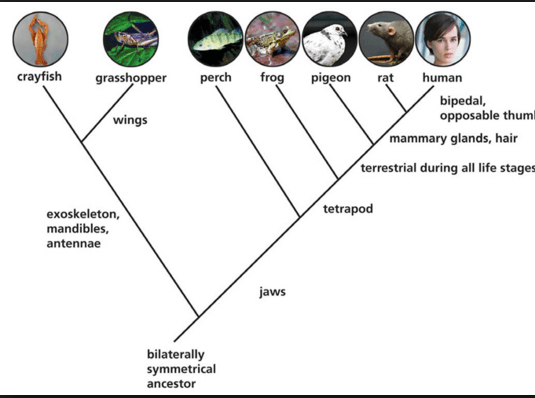
According to the cladogram, which organism is most distantly related to the human?
1
crayfish
2
grasshopper
3
perch
4
frog

35

Multiple Choice

Question image

Which organism is the most distantly related to all the others?

1

Raccoon

2

Dog

3

Giant Panda

4

Sun Bear

36

media

37

Fill in the Blank

38

Multiple Choice

Which of the following statements best explains the difference between faults and folds in rock layers?

1

Faults are breaks in the Earth's crust where rocks move, while folds are bends in rock layers caused by pressure.

2

Faults are formed by volcanic activity, while folds are formed by earthquakes.

3

Faults are always older than folds, while folds are always younger.

4

Faults and folds are both caused by erosion.

39

Multiple Choice

Question image

What is this?

1

Fault

2

Fold

40

Multiple Choice

Question image

What type of rock formation is this?

1

Fault

2

Fold

41

Multiple Select

Question image

What type of rock formation is this?

1

Fault

2

Fold

42

media

43

Multiple Choice

Question image
What type of fossil is an imprint in a rock?
1
cast 
2
trace 
3
mold
4
whole/part 

44

Multiple Choice

Question image
This type of fossil forms when a mold is filled with sand or mud that hardens into the shape of the organism.
1
mold
2
cast
3
trace
4
preserved

45

Multiple Choice

Question image
This type of fossil forms when minerals soak into the buried remains, replacing the remains, and changing them into rock.
1
mold
2
cast
3
petrified
4
preserved

46

Multiple Choice

Question image
What type of fossil is pictured? 
1
cast
2
petrified fossil
3
preserved remains
4
trace fossil

47

Multiple Select

Which of the following are types of fossils?

1

Preserved Remains

2

Trace Fossil

3

Mold Fossil

4

Carbon Film

48

media

49

Multiple Choice

Hardened tree sap is called
1
diamonds
2
amber
3
tar
4
syrup

50

media

51

Multiple Choice

What is one main idea behind the theory of evolution?

1

Species remain unchanged over time.

2

Individuals with helpful traits are more likely to survive and reproduce.

3

All species are identical.

4

Fossils do not provide any information about evolution.

media

Show answer

Auto Play

Slide 1 / 51

SLIDE