

Cell Organelle Interactions

Presentation
•
Biology
•
9th - 12th Grade
•
Medium
+4
Standards-aligned

Amy Kirkwood
Used 1+ times
FREE Resource
6 Slides • 35 Questions
1

2
3
Multiple Choice
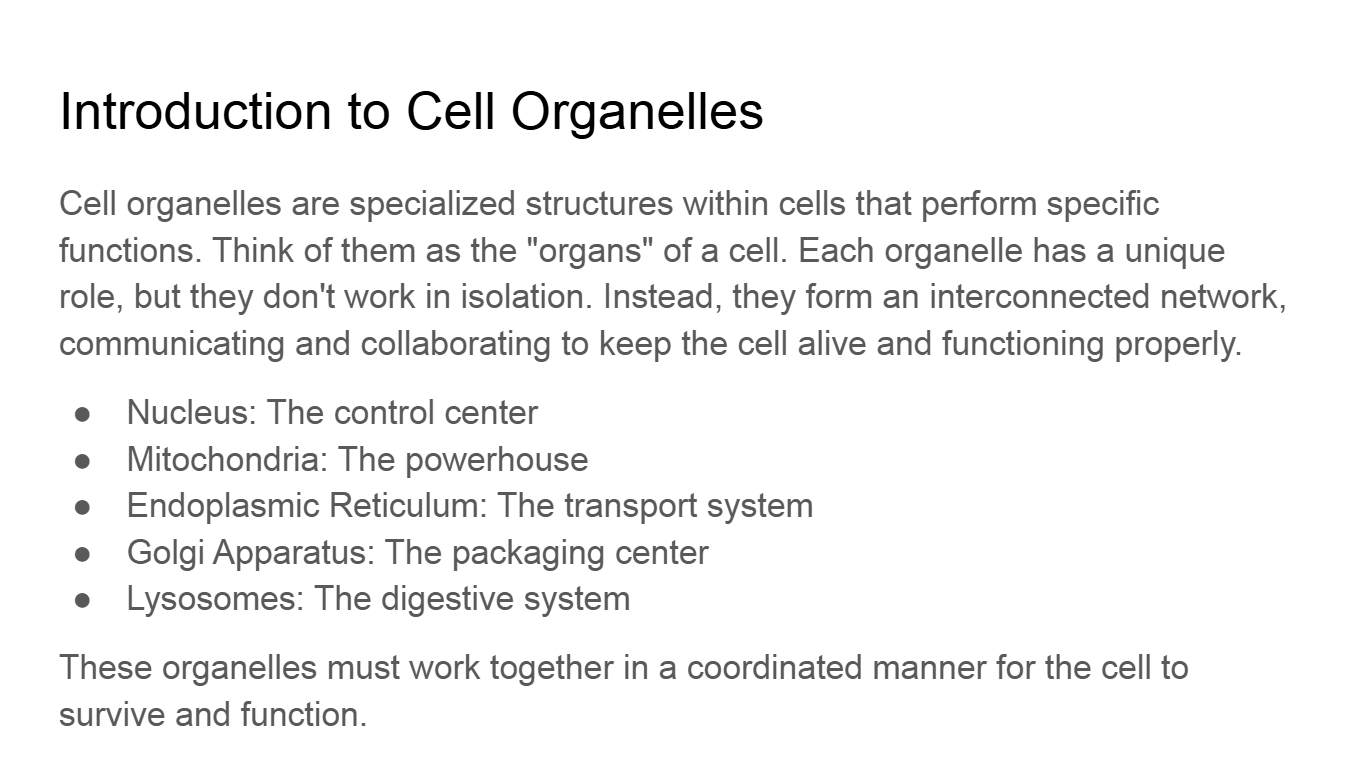
Why is it important for cell organelles to work together rather than in isolation?
Because each organelle has the same function
Because organelles can only survive alone
Because coordinated action ensures the cell survives and functions properly
Because organelles do not communicate
4
Multiple Choice
Which organelle is described as the cell’s control center because it houses genetic instructions?
Golgi packaging and modifying proteins
Lysosomes digesting cellular waste
Nucleus containing DNA instructions
Mitochondria powerhouse producing ATP
5
Multiple Choice
What is the primary role of mitochondria in a cell’s interconnected network?
Break down old organelles
Store and protect chromosomes
Generate usable cellular energy
Transport newly made proteins
6
Multiple Choice
Which scenario best shows organelles collaborating to keep a cell functioning?
Lysosomes create genetic codes
Nucleus forms ATP alone
Mitochondria package antibodies
ER synthesizes proteins, Golgi ships
7

8
Multiple Choice
Which organelle holds the genetic instructions that start protein production?
Rough ER houses protein genes
Golgi Apparatus stores RNA templates
Lysosome preserves amino codes
Nucleus contains DNA instructions
9
Multiple Choice
During the first step of protein synthesis, what is produced from DNA and exits through nuclear pores?
Lipids migrate through pores
Ribosomes pass to cytoplasm
Protein chains leave the nucleus
RNA is transcribed and exits
10
Multiple Choice
Where are many ribosomes located when assembling proteins for export?
Bound inside vesicles
Embedded in Golgi sacs
Attached to Rough ER
Floating free in cytosol
11
Multiple Choice
After ribosomes assemble polypeptides, which organelle folds them and adds early modifications?
Rough ER folds and modifies
Mitochondria make modifications
Smooth ER performs folding
Golgi apparatus only does folding
12
Multiple Choice
What is the role of transport vesicles right after the Rough ER step?
Deliver lipids to lysosomes
Export RNA to membranes
Move DNA to nucleus
Carry proteins to Golgi
13
Multiple Choice
Which organelle sorts, modifies, and packages proteins into vesicles for final destinations?
Ribosomes finalize vesicles
Mitochondria package proteins
Golgi apparatus handles sorting
Nucleus completes packaging
14
Multiple Choice
A protein is built in the rough endoplasmic reticulum. Which organelle most likely handles the next step before secretion?
Golgi apparatus modifies and packages
Lysosomes digest and recycle
Nucleus transcribes instructions
Mitochondria oxidize glucose
15
Multiple Choice
A protein needs to become part of the cell membrane. Which sequence best describes its path?
Golgi to ribosome to mitochondrion
Ribosome to Smooth ER to nucleus
Nucleus to lysosome to cytosol
Nucleus to RER to Golgi to vesicle
16
Open Ended
Describe how the nucleus, ribosomes, endoplasmic reticulum, and Golgi apparatus cooperate in the protein production pathway.
17

18
Multiple Choice
Which organelle directly produces ATP, the cell’s energy currency, during cellular respiration?
Chloroplast
Mitochondrion
Peroxisome
Lysosome
19
Multiple Choice
In plant cells, which process occurs in chloroplasts to capture light energy and build glucose?
Glycolysis pathway
Krebs cycle steps
Photosynthesis reactions
Fermentation cycle
20
Multiple Choice
Which statement best describes lysosomes’ role in cellular energy management?
They synthesize ATP directly
They transport proteins along microtubules
They break down materials to release nutrients
They capture light to form glucose
21
Multiple Choice
What is the main function of peroxisomes related to energy production cooperation?
Detoxify harmful byproducts
Transcribe energy genes
Store excess ATP safely
Move vesicles using ATP
22
Multiple Choice
A mutation alters genes that regulate energy production. Which structure is most likely affected first?
Chloroplast capturing light
Lysosome digesting materials
Cytoskeleton guiding transport
Nucleus controlling gene expression
23
Multiple Choice
A cell needs to deliver newly made ATP-powered transport vesicles across long distances. Which component primarily uses energy to move materials between organelles?
Mitochondrial cristae folds
Lysosomal acid hydrolases
Cytoskeleton motor systems
Peroxisome detox enzymes
24
Multiple Select
Which of the following organelles are directly involved in cellular energy production and utilization?
Mitochondria
Golgi Apparatus
Chloroplasts
Lysosomes
25
Multiple Choice
If lysosomes failed, which immediate cellular consequence is most plausible?
Energy production would cease
Membrane transport would stop
Waste and debris would accumulate
DNA replication would accelerate
26
27
Fill in the Blanks
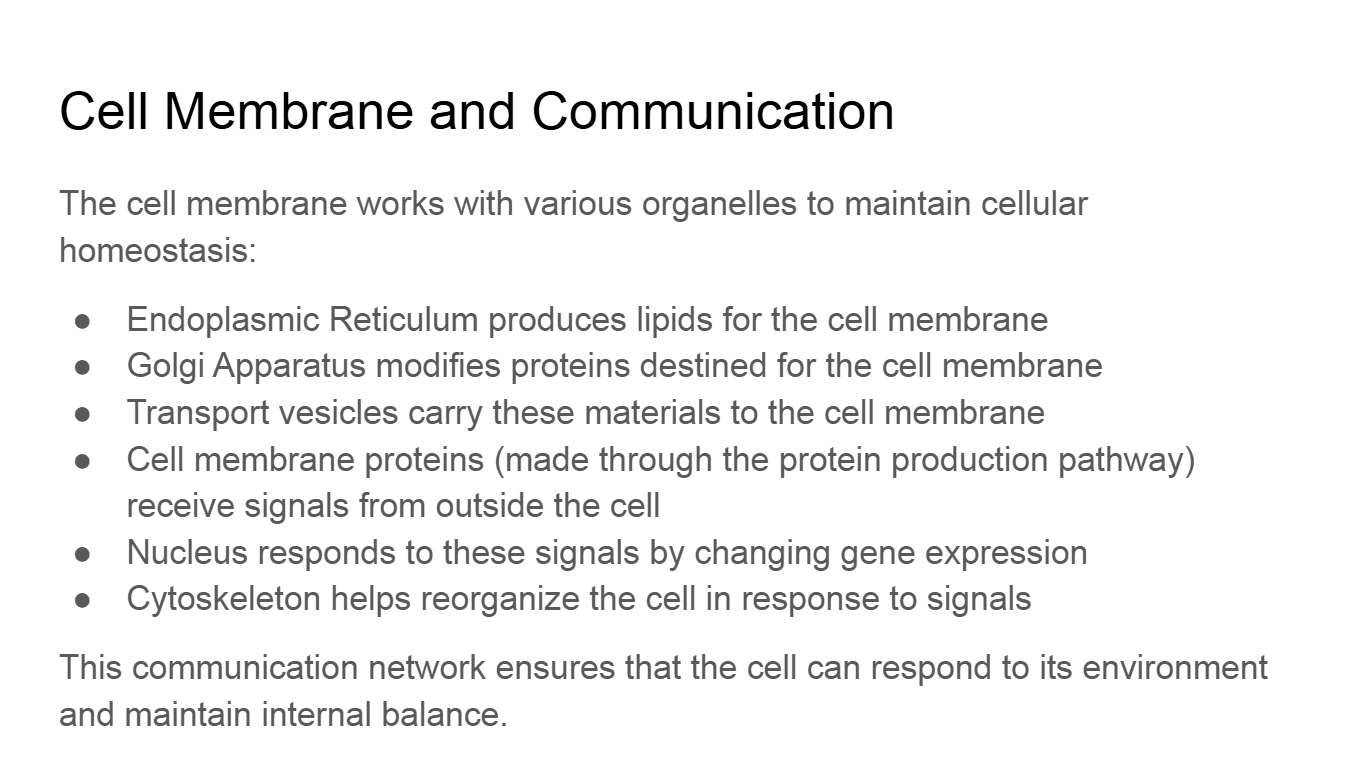
The cell membrane helps maintain
28
Multiple Choice
Which organelle primarily produces lipids that become part of the cell membrane?
Lysosome in lumen
Mitochondrion in cristae
Endoplasmic reticulum in membranes
Golgi apparatus in cisternae
29
Multiple Choice
What is the main role of transport vesicles in maintaining membrane function?
Generate ATP for membrane pumps
Store calcium for signaling events
Carry lipids and proteins to membrane
Break down old proteins quickly
30
Multiple Choice
Membrane proteins often act as receptors. What happens immediately after an external signal binds a receptor?
Golgi removes all sugars
Mitochondria start mitosis
Signal transduction begins
ER halts lipid synthesis
31
Multiple Choice
Which outcome shows the nucleus cooperating with membrane signaling to maintain homeostasis?
Changing gene expression patterns
Increasing vesicle budding rate
Exporting lactic acid rapidly
Digesting pathogens directly
32
Multiple Choice
After signaling, how can the cytoskeleton help the cell respond?
Activate ribosomes for translation
Copy mitochondrial DNA quickly
Secrete antibodies into plasma
Reorganize cell shape and transport
33
Multiple Choice
A receptor detects a hormone outside the cell. Which sequence best describes coordinated organelle actions to update membrane proteins?
Nucleus alters genes, ER synthesizes, Golgi modifies, vesicles deliver
Cytoskeleton digests lipids, peroxisomes export RNA, Golgi stops
Mitochondria oxidize lipids, lysosomes secrete hormones, ER divides
Golgi degrades proteins, ER stores calcium, nucleus replicates DNA
34

35
Multiple Choice
How does the nucleus contribute to cellular recycling and maintenance?
By pumping ATP to power lysosomal fusion
By coordinating processes through gene expression
By forming autophagosomes to trap organelles
By directly digesting components with enzymes
36
Multiple Choice
Which pair works together to replace damaged membrane components?
Nucleus and ribosome in protein coding
Endoplasmic reticulum and Golgi apparatus
Lysosome and peroxisome in detoxification
Mitochondrion and chloroplast in division
37
Multiple Choice
A cell has several malfunctioning mitochondria. What maintenance response would most directly restore mitochondrial function?
Divide healthy mitochondria to increase number
Send autophagosomes to engulf cell nuclei
Increase lysosomal enzyme secretion externally
Activate ribosomes to translate more histones
38
Multiple Choice
Which organelle’s enzymes primarily break down damaged cellular components for recycling?
Golgi apparatus hydrolases digest worn membranes
Lysosomal enzymes degrade damaged organelles
Mitochondrial enzymes rebuild faulty proteins
Ribosomal enzymes dismantle old vesicles
39
Open Ended
Explain how lysosomes and autophagosomes contribute to cellular recycling and maintenance.
40
Multiple Choice
Autophagosomes help maintain cells by performing which main task?
Synthesizing new membrane lipids
Producing ATP for energy release
Engulfing worn organelles for delivery
Exporting enzymes outside the cell
41
Open Ended
Do you have any questions or would you like to learn more about how cell organelles work together to keep cells healthy?
Show answer
Auto Play
Slide 1 / 41
SLIDE
Similar Resources on Wayground

36 questions
Plant Hormones and Responses (Tropisms)
Presentation
•
9th - 12th Grade
36 questions
DNA Notes Day 2: DNA Replication and Gene Expression
Presentation
•
9th - 12th Grade
35 questions
12-3 OtherPatternsofInheritanceNOTES/?s
Presentation
•
9th - 12th Grade
37 questions
Viruses
Presentation
•
9th - 12th Grade
36 questions
2nd 6wks
Presentation
•
9th - 12th Grade
37 questions
Phylogenies and Cladograms
Presentation
•
9th - 12th Grade
36 questions
Mutations and Pedigree Notes
Presentation
•
9th - 12th Grade
35 questions
Evidence of Evolution Lesson
Presentation
•
9th - 12th Grade
Popular Resources on Wayground
10 questions
Safety Day 2026 – Student Review

Quiz
•
9th Grade
21 questions
Continents and Oceans
Quiz
•
6th Grade
20 questions
Parts of Speech
Quiz
•
5th Grade
16 questions
Subject & Predicate
Quiz
•
5th Grade
25 questions
Multiplication Facts
Quiz
•
5th Grade
12 questions
Map Skills
Quiz
•
3rd Grade
22 questions
Continents and Oceans
Quiz
•
5th Grade
15 questions
Rounding Decimals
Quiz
•
5th Grade
Discover more resources for Biology
20 questions
Cell organelles and functions
Quiz
•
10th Grade
20 questions
Cell Transport
Quiz
•
9th - 12th Grade
25 questions
photosynthesis and cellular respiration
Quiz
•
9th Grade
20 questions
Cell Cycle
Quiz
•
9th Grade
8 questions
DNA vs. RNA
Presentation
•
9th - 12th Grade
14 questions
Ecological Succession: Primary and Secondary
Quiz
•
9th Grade
20 questions
Macromolecules
Quiz
•
10th Grade
20 questions
Characteristics of Life
Quiz
•
9th - 10th Grade