

SOUTHWEST ASIA & NORTHERN AFRICA HISTORY (REVISED)

Presentation
•
Social Studies
•
6th - 8th Grade
•
Practice Problem
•
Medium

Champayne Moore
Used 5+ times
FREE Resource
24 Slides • 25 Questions
1

2

3
Multiple Choice
Which of the following ancient civilizations originated in Southwestern Asia and North Africa?
Mesopotamia and Ancient Egypt
Ancient Greece and Rome
The Indus Valley and China
The Mayan and Inca
4
Multiple Choice
Why do you think early civilizations in Southwestern Asia and North Africa developed near major rivers?
5

6

7

8
Multiple Choice
What are two major advances made by both Mesopotamian and Egyptian civilizations?
Writing and math
Agriculture and hunting
Sailing and pottery
Architecture and painting
9
Multiple Choice
Which river was central to the development of Ancient Egypt?
Nile River
Tigris River
Euphrates River
Amazon River
10

11
Multiple Choice
How did European colonization impact the languages and cultures of North Africa and Southwestern Asia?
12

13
Multiple Choice
Describe one way in which trade influenced the development of cities like Cairo and Baghdad.
14
Fill in the Blanks
The Silk Road connected Asia, Africa, and
15

16
Fill in the Blanks
Many conflicts in North Africa and the Middle East began when countries tried to gain
17

18
Multiple Choice
Which of the following conflicts began after new countries were created in the region and still affects politics and daily life today?
Algeria and France (1954–1962)
Arab–Israeli Conflict (mid-1900s–today)
World War I
Umayyad Caliphate
19

20
Multiple Choice
How did the collapse of the Ottoman Empire after World War I contribute to long-lasting conflicts in the region?
21

22
Fill in the Blanks
Islam began in the
23

24
Multiple Select
Which of the following were ways Islam spread according to the slides?
Trade
Conquests
Migration due to famine
Cultural exchange
25

26
Open Ended
What is a caliphate and how did it help unite the Muslim world?
27

28
Fill in the Blanks
The Umayyad Caliphate controlled land from
29

30
Multiple Choice
Which city became a major center of learning and culture during the Abbasid Caliphate?
Baghdad
Cairo
Damascus
Cordoba
31

32
Multiple Choice
Explain how the achievements of the Abbasid Caliphate influenced modern math and science.
33

34
Multiple Select
Which of the following regions were part of the Ottoman Empire at its height?
Southeast Europe
Western Asia
North Africa
South America
35

36
Fill in the Blanks
The Ottomans built impressive
37

38
Multiple Choice
Describe how the Ottoman Empire contributed to the spread of different cultures and religions.
39

40
Fill in the Blanks
By the late
41

42

43
Multiple Choice
Which regions were influenced by the Ottoman Empire according to the slides?
Middle East, Europe, and North Africa
Asia and South America
Australia and Antarctica
North America and East Asia
44

45
Multiple Select
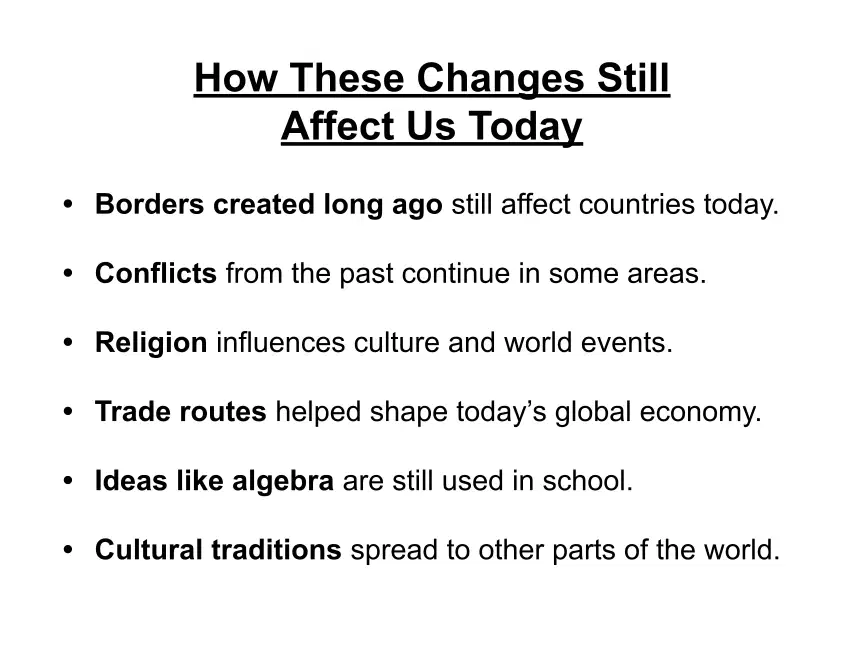
Select all the ways that changes from the past still affect us today, as mentioned in the slides.
Borders created long ago
Conflicts from the past
Religion influences culture
Trade routes shape the economy
46
47
Multiple Choice
Explain how the development of trade routes in Southwest Asia and North Africa contributed to the spread of ideas and cultures.
48
Multiple Choice
Which two ancient civilizations are mentioned as being located in Southwestern Asia and North Africa?
Mesopotamia and Ancient Egypt
Greece and Rome
Indus Valley and China
Maya and Inca
49
Multiple Choice
What are some ways that early civilizations in Southwestern Asia and North Africa have influenced the modern world?
Show answer
Auto Play
Slide 1 / 49
SLIDE
Similar Resources on Wayground

42 questions
Mga Katulong sa Komunidad Lesson
Presentation
•
KG
42 questions
Measuring
Presentation
•
7th - 8th Grade
48 questions
TNReady Locations Review
Presentation
•
6th - 8th Grade
48 questions
Figurative Language Review
Presentation
•
6th - 8th Grade
40 questions
FANBOYS
Presentation
•
6th - 8th Grade
46 questions
Forces
Presentation
•
6th - 8th Grade
46 questions
Cells
Presentation
•
6th - 8th Grade
43 questions
Geographic Factors and Impact in S. America: Last Ice Merchant
Presentation
•
6th - 8th Grade
Popular Resources on Wayground
6 questions
PRIDE Always and Everywhere
Presentation
•
12th Grade
20 questions
Lab Safety Quiz

Quiz
•
6th Grade
26 questions
KOR Review Kahoot Questions
Quiz
•
8th Grade
21 questions
Continents and Oceans
Quiz
•
6th Grade
12 questions
Unit Zero lesson 2 cafeteria
Presentation
•
9th - 12th Grade
20 questions
Parts of Speech
Quiz
•
5th Grade
10 questions
Riddles Riddles fun Riddles
Quiz
•
6th - 12th Grade
16 questions
Subject & Predicate
Quiz
•
5th Grade
Discover more resources for Social Studies
17 questions
SS8H1 Quiz
Quiz
•
8th Grade
15 questions
6th Grade Europe's Environmental Issues/Impact of Geography
Quiz
•
6th Grade
10 questions
Exploring the Age of Exploration: Key Events and Figures

Interactive video
•
6th - 10th Grade
10 questions
The 5 Themes of Geography
Quiz
•
6th Grade
20 questions
Primary and Secondary Sources
Quiz
•
7th Grade
13 questions
Primary and Secondary Sources
Quiz
•
6th Grade
21 questions
ss.7.cg.1.1- Ancient Influences
Quiz
•
7th Grade
12 questions
Latitude & Longitude
Interactive video
•
6th Grade