

AP Bio Lesson Topics 1.2-1.3: Elem. of Life, Intro to Macro.

Presentation
•
Biology
•
9th - 12th Grade
•
Easy
+1
Standards-aligned

James Franks
Used 1+ times
FREE Resource
41 Slides • 46 Questions
1
AP Biology Topics 1.2-1.3
1.2 Elements of Life
1.3 Introduction to Macromolecules
2
AP Biology Topics 1.2
1.2 Elements of Life
3
1.3 LO: Describe the key roles of carbon, hydrogen, nitrogen, sulfur, oxygen and phosphorus in the molecules found in living things.
Carbon — backbone atom of all major biomolecules; four bonds allow chains, rings, and diverse functional groups.
Hydrogen — in water and biomolecules; hydrogen bonding helps shape DNA/proteins; H+ sets pH and proton gradients power ATP synthesis.
Nitrogen — in the amino group of amino acids (proteins) and the nitrogenous bases of nucleotides (DNA, RNA, ATP).
Sulfur — found in the amino acids cysteine and methionine; disulfide bonds (–S–S–) help stabilize protein structure.
Oxygen — in water and many biomolecules; enables hydrogen bonding; final electron acceptor in aerobic respiration.
Phosphorus — phosphate groups in ATP (energy transfer), nucleic acids (sugar–phosphate backbone), and phospholipids (membranes).
4
Topic 1.2: The Elements of Life
CHNOPS: 99% of the mass of living things is composed of
Carbon
Hydrogen
Nitrogen
Oxygen
Phosphorus
Sulfur

5

Covalent Bond: bond formed between atoms sharing electrons
Electronegativity—the attractive force that an atomic nucleus exerts on electrons.
Depends on the number of protons and the distance between the nucleus and electrons.
Nonpolar Covalent Bond: If atoms have similar electronegativities, they share electrons equally
Polar Covalent Bond: If atoms have different electronegativities (a difference in electronegativity of 0.5 or greater), electrons tend to be near the most attractive atom
6
Carbon (C)
Carbon: 6 protons and 6 electrons, with 4 valence electrons in the outer shell.
Carbon must form four covalent bonds with other atoms to become stable (octet rule)
Hydrogen needs one bond and Oxygen needs two bonds to be stable.


7
Carbon atoms bond readily with each other, allowing them to form carbon skeletons that vary in three critical ways:
Linear Chains: Long strands of carbon (e.g., Fatty acids in lipids).
Branched Chains: Skeletons that split off in different directions (e.g., Glycogen).
Ring Structures: Carbons that loop back to connect to themselves (e.g., Glucose sugars, Nitrogenous bases in DNA).

8
Carbon's can form single, double, or triple bonds with itself:
Single Bonds (C-C): Allow for rotation and flexibility (e.g., Saturated fats pack tightly because the chains are straight).
Double Bonds (C=C): Create a rigid "kink" in the molecule, preventing rotation and changing the molecule's shape (e.g., Unsaturated fats are liquid because the kink prevents tight packing).
Triple Bonds (C≡C): Very strong and rigid, though less common in biological macromolecules.

9
Drag and Drop
10
Multiple Choice
Which of the following structural features of carbon is most directly responsible for the diversity of biological molecules (such as the difference between starch and cellulose or different lipids)?
Carbon's ability to form ionic bonds with other nonmetals.
Carbon's capacity to form single, double, and triple bonds with itself and other atoms.
Carbon's high electronegativity compared to Hydrogen.
Carbon's ability to dissolve in aqueous solutions.
11
Multiple Choice
Carbon has an atomic number of 6. Based on this, how many electrons are in its valence shell, and how many covalent bonds does it need to form to reach a stable configuration?
2 valence electrons; 2 bonds
4 valence electrons; 4 bonds
6 valence electrons; 6 bonds
4 valence electrons; 2 bonds
12
Multiple Choice
Which of the following correctly describes a characteristic of carbon that makes it central to organic molecules?
Carbon can form ionic bonds with a wide variety of elements.
Carbon atoms have a high electronegativity, allowing them to attract electrons from other atoms.
Carbon can form up to four covalent bonds, allowing for a diversity of stable compounds.
Carbon forms strong hydrogen bonds with hydrogen, oxygen, and nitrogen.
13
Multiple Choice
Carbon is often referred to as the 'backbone of life.' Which atomic property of carbon most directly allows it to form the complex, diverse, and large molecules required for biological systems?
It is capable of forming ionic bonds with other essential elements like hydrogen and oxygen.
It is the most abundant element in the Earth's crust, ensuring organisms have a steady supply.
It has four valence electrons, allowing it to form four stable covalent bonds with a variety of atoms.
It has a high electronegativity, allowing it to steal electrons from other atoms.
14
SUMMARY: Carbon's Unique Properties:
Has 4 valence electrons → forms 4 covalent bonds.
Bonds easily with itself (C-C) and CHONPS.
Can form Chains, Branches, or Rings
Forms Single, Double, or Triple bonds.
This versatility allows Carbon to form the complex, diverse structures (Isomers) required for life.
15
Multiple Choice
What type of bond does Carbon make other atoms?
Covalent
Hydrogen
Ionic
Van der Waals
16
Open Ended
Silicon is in the same column of the periodic table as Carbon and also has four valence electrons. Science fiction writers often propose 'silicon-based life forms.' However, life on Earth is exclusively carbon-based. IDENTIFY ONE chemical property of the carbon atom that allows it to form the complex backbones of macromolecules (proteins, carbohydrates, nucleic acids, lipids) and EXPLAIN how that property leads to molecular diversity
17
Isomers – Same Atoms, Different Shapes
Definition: Isomers are molecules with the same molecular formula (same number of atoms) but different structures and properties.
Even a slight change in the carbon arrangement changes the molecule's function.
18
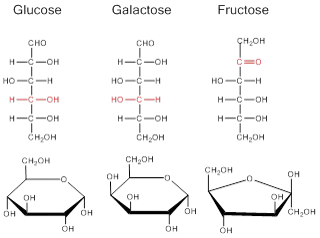
Type 1: Structural Isomers
Differ in the covalent arrangement of their atoms.
Ex. Glucose, Galactose, and Fructose all have the same formula C6H12O6 but different arrangements.
19
Multiple Choice
Glucose, galactose, and fructose all share the same chemical formula, C6H12O6, yet they have distinct chemical properties and tastes. These molecules are best described as:
isotopes
structural isomers
polymers
enantiomers
20
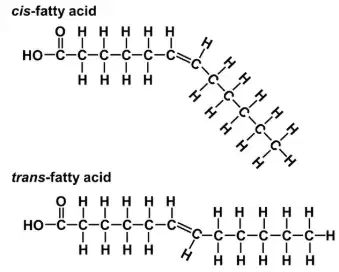
Type 2: Cis-Trans Isomers
Require a Carbon-Carbon Double Bond (which prevents rotation).
single bonds would allow rotation
Cis: Functional groups are on the Same Side of the double bond.
Trans: Functional groups are on Opposite Sides of the double bond (trans-fats linked to heart disease)
21
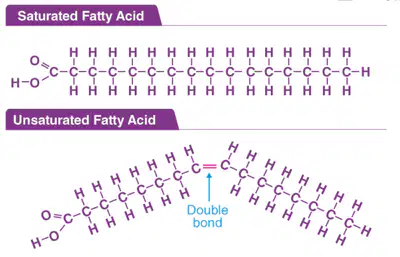
Saturated Fatty Acid - all single C-C bonds
Solid at room temperature
Unsaturated Fatty Acid - at least one double C=C bond
Liquid at room temperature
cis-isomer - hydrogens found on the same side of the double bond
found in nature
trans-isomer - hydrogens found on different sides of the double bond
rare in nature but man makes them (hydrogenated oils)
22
Multiple Choice
Cis-trans isomers differ in their arrangement of atoms around a double bond.
Why are these isomers NOT possible with single bonds?
Single bonds are too weak to hold isomers.
Single bonds allow the atoms to rotate freely, so the "cis" and "trans" positions are not fixed.
Single bonds only occur in inorganic molecules.
Single bonds are too short.
23
Multiple Choice
Two fatty acids have the same number of carbon and hydrogen atoms. However, Fatty Acid A is a straight chain and is solid at room temperature, while Fatty Acid B has a 'kink' or bend in its chain and is liquid at room temperature. What structural difference explains this?
Fatty Acid A contains more oxygen atoms than Fatty Acid B.
Fatty Acid B contains a trans-double bond between two carbon atoms.
Fatty Acid A is an enantiomer of Fatty Acid B.
Fatty Acid B contains a cis-double bond between two carbon atoms.
24
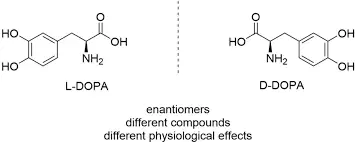
Type 3: Enantiomers
Molecules that are non-superimposable mirror images of each other.
Analogy: Your left and right hands. They have the same components (thumb, fingers) but you cannot fit a left hand into a right-handed glove.
Biological Consequence: Form dictates Function.

25
Multiple Choice
Thalidomide and L-dopa are examples of molecules where one form is biologically active (or safe) and the mirror-image form is inactive (or harmful). These pairs of molecules are known as:
Structural Isomers
Cis-Trans Isomers
Enantiomers
Isotopes
26
Enantiomers Case Study: Parkinson's Disease
Ex. Cellular receptors are specific; they only bind to the correct "hand.
L-dopa: The biologically active form. Fits the receptor; treats Parkinson's.
D-dopa: The biologically inactive form. Does not fit the receptor.
Takeaway: Even a subtle change in shape renders a molecule biologically useless.
27
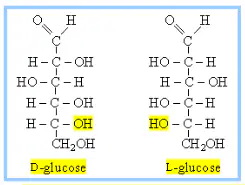
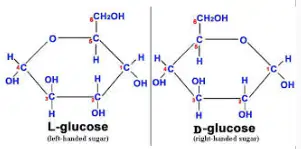
D-glucose is nature’s sugar
L-sugars are rarely found in nature.
L-sugar cannot be broken down and as it tastes the same as a D-sugar
28
Multiple Choice
The drug thalidomide was prescribed in the 1950s to treat morning sickness. However, while one form of the molecule was effective, its mirror image caused severe birth defects. This demonstrates the biological importance of which concept?
enantiomers
geometric isomers
radioactive isotopes
hydrophobic interactions
29
Hydrogen (H): The most abundant element in the universe.
Found in water and biomolecules (all macromolecules)
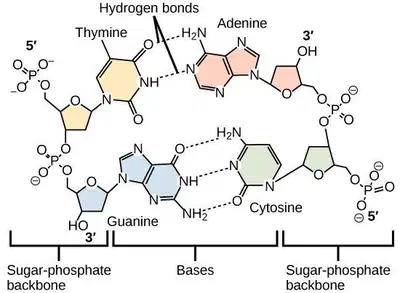
Hydrogen bonding helps shape DNA/proteins
Hydrogen ions (H+) determines pH and creates proton gradients that power ATP synthesis

30
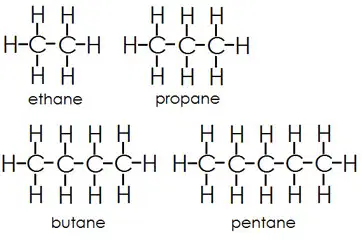
Hydrocarbons are organic molecules consisting entirely of carbon and hydrogen, such as methane (CH4).
The covalent bonds between Carbon and Hydrogen or Carbon and another Carbon atom store great amounts of energy (glucose)
Hydrocarbon chains form the backbone for organic molecules.
31
Oxygen (O):
Oxygens high electronegativity enables hydrogen bonding; ex. hydrogen bonds between water molecules
Free Oxygen (O2) is a sign of life, generated by photosynthetic bacteria starting ~3.5 billion years ago.
Accumulated oxygen formed the ozone layer (O3), protecting life from UV radiation and allowing colonization of land.
Final electron acceptor for aerobic cellular respiration to make ATP from energy stored in glucose
32
Nitrogen (N)
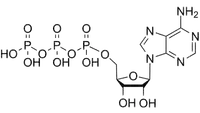
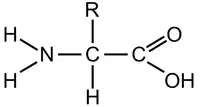
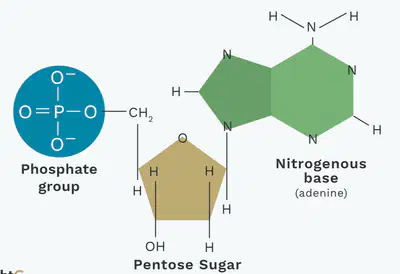
Found in amino groups of proteins and nitrogen bases of nucleic acids (DNA/RNA), and ATP.
Atmosphere is 78% Nitrogen gas (N2), but most organisms cannot use it directly.
Bacteria convert atmospheric N2 into usable forms for plants. Animals then eat plants to get their nitrogen
33
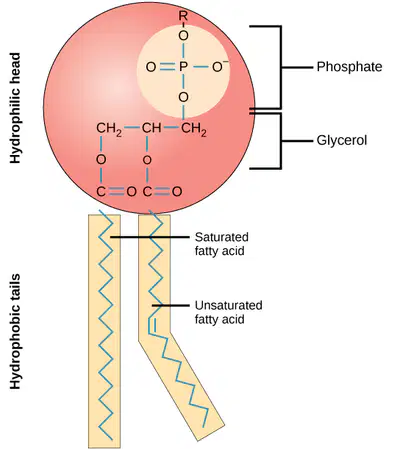
Phosphorus (P):
The core atom in Phosphate groups (PO4).
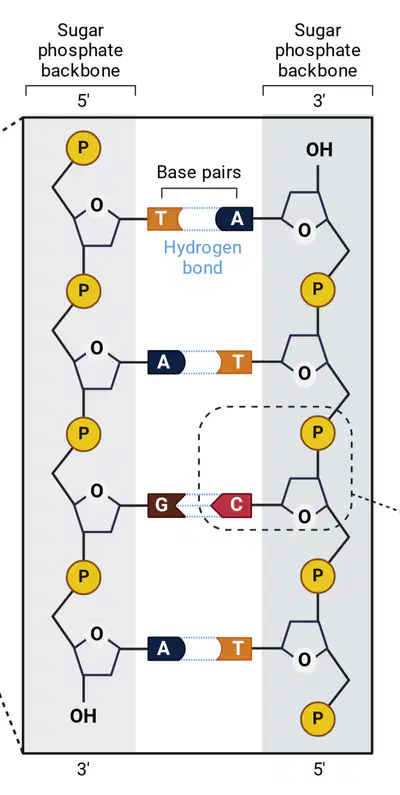
Found in the phosphate groups in ATP (energy transfer), nucleic acids (sugar–phosphate backbone), and phospholipids (membranes).
34
Multiple Choice
A typical bag of fertilizer contains high levels of nitrogen, phosphorus, and potassium but trace amounts of magnesium and calcium. Which of the following best matches the fertilizer component with the molecule in which it will be incorporated by organisms in the area?
Nitrogen will be incorporated into nucleic acids.
Phosphorus will be incorporated into amino acids.
Potassium will be incorporated into lipids.
Magnesium will be incorporated into carbohydrates.
35
Multiple Choice

A researcher analyzed four different samples of macromolecules. The results are shown below. Which claim is best supported by the data?
Sample A contains nucleic acids.
Sample B contains protein.
Sample C contains nucleic acids.
Sample D contains protein.
36
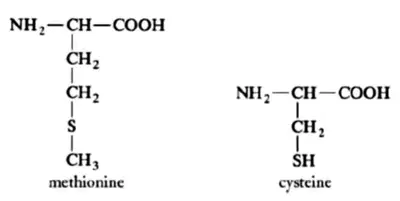
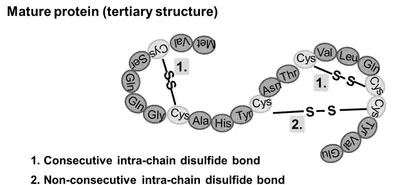
Sulfur (S)
found in the amino acids cysteine and methionine
Disulfide bridge: disulfide bonds (–S–S–) help stabilize protein structure.
37
AP Biology Topic 1.3
1.3 Introduction to Macromolecules
38
1.3 LO: Compare and contrast dehydration synthesis and hydrolysis reactions.
Dehydration synthesis reactions are endergonic and are used to build the complex molecules in living things.
Hydrolysis reactions are exergonic and are used to release energy and digest polymers into monomers.
Explain the relationship between monomers and polymers
Identify the key properties of functional groups
39
Functional groups are small groups of atoms with specific chemical properties
Confer these properties to larger molecules (e.g., polarity).
One biological molecule may contain many functional groups that determine molecular shape and reactivity.
40
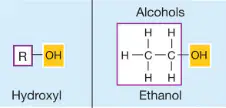
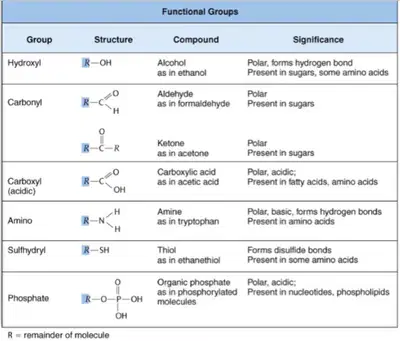
Hydroxyl (-OH): Makes a molecule Polar (hydrophilic)
Forms hydrogen bonds with water, helping dissolve organic compounds.
Carbohydrates: Simple sugars like glucose have many hydroxyl groups.
Nucleic Acids: The 3' end of a DNA strand ends in a hydroxyl group.
In some Amino Acids
41
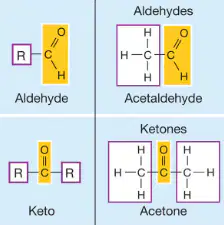
Carbonyl (>COOH)
Polar (hydrophilic) due to the electronegative oxygen.
Aldehyde: The Carbonyl is at the END of the carbon skeleton.
Ketone: The Carbonyl is in the MIDDLE of the carbon skeleton.
Found in simple sugars (monosaccharides).
42
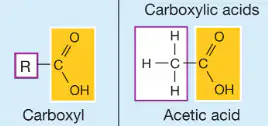
Carboxyl (-COOH)
Acidic. It donates H+ to the solution because the covalent bond between oxygen and hydrogen is so polar.
Usually found as -COO (ionized/charged) in cells.
Forms the "acid" part of Amino Acids and the head of Fatty Acids.
43
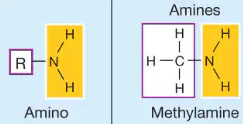
Amino (-NH₂): Makes a molecule Basic (accepts H+).
Note: Often found in Ionized form (NH3) in cells.
Forms the "amino" part of Amino Acids.
The charge allows it to form ionic bonds in protein folding.
44
Multiple Choice
A chemist wishes to make an organic molecule less acidic. Which of the following functional groups should be added to the molecule in order to do so?
sulfhydryl
hydroxyl
amino
phosphate
carboxyl
45
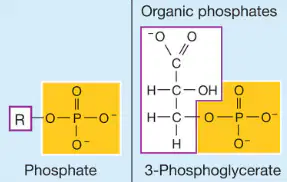
Phosphate (-OPO₃²⁻)
Negatively charged; acidic
DNA/RNA: The "backbone" of nucleic acids.
ATP: The unstable bonds between phosphate groups provide energy for cellular work.
Phospholipids: The negative charge makes the "head" of the molecule hydrophilic.
46
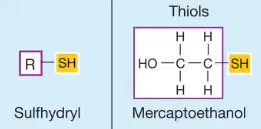
Sulfhydryl (-SH)
Polar
Found in the amino acid Cysteine.
Two sulfhydryl groups can react to form a Disulfide Bridge (a covalent bond), which stabilizes the tertiary structure of proteins.
47
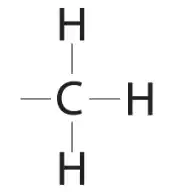
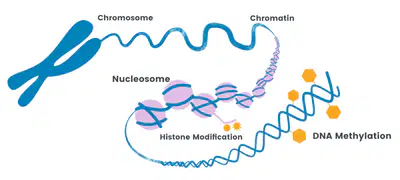
Methyl (-CH3)
Nonpolar (Hydrophobic)
Often acts as a "tag" on DNA (Methylation) that turns genes on or off
48
Match
Some functional groups can either donate or accept hydrogen bonds with other molecules, acting either as a donor (like the oxygen in a water molecule) or as an acceptor (like the hydrogens in a water molecule).
Donator
Acceptor
Donator and Acceptor
Hydroxyl
Carbonyl (Aldehyde)
Amino
Hydroxyl
Carbonyl (Aldehyde)
Amino
49
Functional Groups: Structural and Regulatory Functional Groups:
Sulfhydryl (-SH): Two -SH groups can react to form a "cross-link" (Disulfide Bridge) that stabilizes Protein structure.
Methyl (-CH₃): Makes a molecule Non-polar.
Function: Binds to DNA to turn genes OFF (methylation).
Acetyl (-COCH₃):
Function: Binds to DNA proteins to enhance gene expression (turns genes ON).
50

51
Open Ended
Why is the carbon/carbon bond non-polar but with carbon/oxygen polar?
52
Multiple Choice
Which functional group acts as an acid by donating H+ ions to the solution?
Amino group
(NH2)
Hydroxyl group
(-OH)
Carboxyl group
(-COOH)
Methyl group
(-CH3)
53
Multiple Choice
Which functional group is responsible for "disulfide bridges" that stabilize protein tertiary structure?
Sulfhydryl
(-SH)
Phosphate
(-PO4)
Carbonyl
(>C=O)
Acetyl
(-COCH3)
54
Multiple Choice
Which functional group is non-polar and often functions as a "tag" on DNA to turn genes OFF?
Hydroxyl
Methyl
Phosphate
Amino
55
Match
Match the following
This group acts as a base, often picking up an H+ from the surrounding solution to become positively charged.
A nonpolar group that often acts as a "tag" on DNA to modify gene expression.
Critical for energy transfer (ATP) and forms the acidic, negatively charged backbone of DNA.
This group makes a molecule acidic because it can donate an H+ to the solution.
Amino
Methyl
Phosphate
Carboxyl
Amino
Methyl
Phosphate
Carboxyl
56
Match
Match the following
A polar group found in abundance in alcohols and carbohydrates; makes molecules water-soluble.
Found within the carbon skeleton of sugars; consists of a carbon double-bonded to an oxygen.
Along with a Carboxyl group, this is the other functional group found in every amino acid.
Two of these groups can form a covalent "bridge" that stabilizes the tertiary structure of a protein.
Hydroxyl
Carbonyl
Amino
Sulfhydryl
Hydroxyl
Carbonyl
Amino
Sulfhydryl
57
Drag and Drop
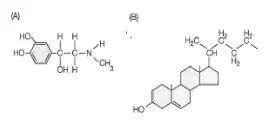
58
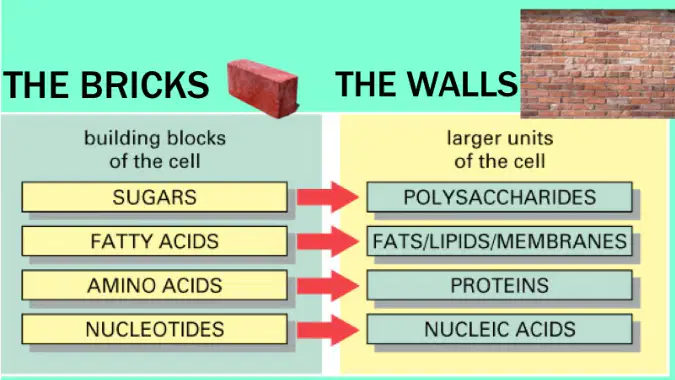
Monomer: the "brick" building block
Polymer: the "wall" made of bricks
59
Dropdown
60
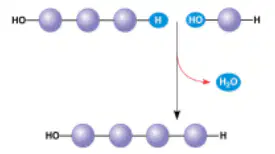
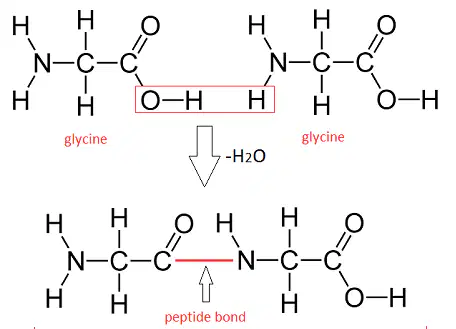
Dehydration Synthesis (condensation reaction)
Removes water to join monomers.
Example: Joining amino acids (requires Nitrogen) to build a protein.
MATH: Number of water molecules released = Number of Monomers minus 1
61
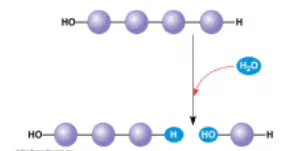
Hydrolysis:
Adds water to break polymers.
Example: Digesting starch (releasing Glucose/Hydrogen energy).
62
Dropdown
63
Multiple Choice
Which of the following best defines a dehydration synthesis reaction?
A reaction where water is added to split a polymer into monomers.
A reaction where two monomers are joined, and a water molecule is released as a byproduct.
A reaction where an ionic bond is formed between two atoms.
A reaction where a carbon atom is removed from the chain.
64
Multiple Choice
The diagram below represents a biological reaction. Which of the following best explains the reaction?
The reaction is the hydrolysis of a nucleic acid and results in the formation of a nucleotide.
The reaction is the hydrolysis of a nucleic acid and results in the formation of a phospholipid.
It is a dehydration synthesis reaction involved in the formation of a polypeptide.
It is a dehydration synthesis reaction involved in the formation of a lipid.
65
Multiple Choice
Which of the following best describes the chemical process of a hydrolysis reaction?
A water molecule is removed to form a covalent bond between two monomers.
A water molecule is added to break the covalent bond holding a polymer together.
Two monomers are joined together by an ionic bond, releasing energy.
A polymer folds into a specific 3D shape due to hydrogen bonding with water.
66
Multiple Choice
Which of the following best describes the hydrolysis of carbohydrates?
The removal of a water molecule breaks a covalent bond between sugar monomers.
The removal of a water molecule forms a covalent bond between sugar monomers.
The addition of a water molecule breaks a covalent bond between sugar monomers.
The addition of a water molecule forms a covalent bond between sugar monomers.
67
Multiple Choice
The process of breaking bonds by splitting water
Dehydration
Hydrolysis
68
Multiple Choice
Process of forming bonds by removing water molecules
Dehydration
Hydrolysis
69
Multiple Choice
Reaction to synthesize polymers from monomers
Dehydration
Hydrolysis
70
Multiple Choice
Reaction to remove monomers from polymers
Dehydration
Hydrolysis
71
Macromolecules are large molecules that make up living things.
They are found in the foods you eat.
Carbohydrates are sugars. They are in candy, fruits, bread, pasta, and potatoes.
Lipids are fats and oils.
Proteins are found in meats, nuts, fish, and beans.
Nucleic Acids are DNA and RNA
72
Carbohydrates - CHO
Carbon, Hydrogen, Oxygen 1:2:1
Lipids - CHO
Carbon, Hydrogen, Oxygen
Proteins - CHON
Carbon, Hydrogen, Oxygen, Nitrogen
Nucleic Acids - CHOPN
Carbon, Hydrogen, Oxygen, Phosphorus, Nitrogen
Macromolecules are made of CARBON covalently bonded with other elements:
73
Multiple Choice
What type of bond does Carbon make other atoms?
Covalent
Hydrogen
Ionic
Van der Waals
74
Match
Match the macromolecules to the correct elements.
nucleic acids
proteins
lipids
carbohydrates
CHOPN
CHON
CHO
CHO 1:2:1
CHOPN
CHON
CHO
CHO 1:2:1
75
Multiple Choice
A macromolecule is found to have C, H, O, N, and S. Identify?
Carbohydrate
Lipid
Nucleic Acid
Protein
76
Multiple Choice
A macromolecule is found to have C, H, O, N, and P. Identify?
Carbohydrate
Lipid
Nucleic Acid
Protein
77
Multiple Choice
Which of the following macromolecules include nitrogen?
Carbohydrates & Lipids
Lipids & Nucleic Acids
Nucleic Acids & Proteins
Proteins & Carbohydrates
78
Multiple Choice
Which of the following macromolecules has phosphate?
Carbohydrate
Fat
Nucleic Acid
Protein
79
Multiple Choice
Which of the following macromolecules has phosphate?
Carbohydrate
Fat
Nucleic Acid
Protein
80
Multiple Choice
Which of the following macromolecules has sulfur?
Carbohydrate
Fat
Nucleic Acid
Protein
81
Multiple Choice
Which macromolecule has a ratio of 1:2:1 ratio with C:H:O?
Carbohydrates
Lipids
Nucleic Acids
Proteins
82
Multiple Choice
Phospholipids are a type of lipid that include…
Nitrogen
Phosphorus
Sulfur
83
Multiple Choice
What elements are found in all lipids?
CHO
CHON
CHOS
CHOP
84
Carbohydrates - CHO
Monosaccharides
Lipids - CHO
Fatty Acids and Glycerol
Proteins - CHON
Amino Acids
Nucleic Acids - CHOPN
Nucleotides
Macromolecules are made of building blocks called MONOMERS.
85
Match
Match the macromolecules to the correct monomer.
carbohydrates
proteins
lipids
nucleic acids
monosaccharides
amino acids
fatty acids
nucleotides
monosaccharides
amino acids
fatty acids
nucleotides
86
Carbohydrates - CHO
Main source of energy for cells
Lipids - CHO
Long-term energy
Proteins - CHON
parts and structures
speed up chemical reactions
Nucleic Acids - CHOPN
Stores and transmits genetic information
Macromolecules have many different function (jobs) in living things.
87
Match
Match the macromolecule to its main function:
carbohydrates
lipids
proteins
nucleic acids
main source of energy
long term energy storage
make up structures
store and transmit genetic information
main source of energy
long term energy storage
make up structures
store and transmit genetic information
AP Biology Topics 1.2-1.3
1.2 Elements of Life
1.3 Introduction to Macromolecules
Show answer
Auto Play
Slide 1 / 87
SLIDE
Similar Resources on Wayground

84 questions
Anatomy of Root, Stem and Leaves
Presentation
•
11th Grade
83 questions
fluids
Presentation
•
9th - 12th Grade
82 questions
Masque Vocabulary
Presentation
•
9th - 12th Grade
79 questions
Introduction to Ecology
Presentation
•
10th - 12th Grade
80 questions
Nature of Gases, Kinetic Molecular Theory and Gas Laws
Presentation
•
9th - 12th Grade
83 questions
Parts of Speech and Figurative Language 1
Presentation
•
9th - 12th Grade
82 questions
Human, Grwth & Dev. Theories
Presentation
•
9th - 12th Grade
79 questions
Les nombres 61-100
Presentation
•
9th - 12th Grade
Popular Resources on Wayground
10 questions
Safety Day 2026 – Student Review

Quiz
•
9th Grade
21 questions
Continents and Oceans
Quiz
•
6th Grade
20 questions
Parts of Speech
Quiz
•
5th Grade
16 questions
Subject & Predicate
Quiz
•
5th Grade
25 questions
Multiplication Facts
Quiz
•
5th Grade
12 questions
Map Skills
Quiz
•
3rd Grade
22 questions
Continents and Oceans
Quiz
•
5th Grade
15 questions
Rounding Decimals
Quiz
•
5th Grade
Discover more resources for Biology
20 questions
Cell organelles and functions
Quiz
•
10th Grade
20 questions
Cell Transport
Quiz
•
9th - 12th Grade
25 questions
photosynthesis and cellular respiration
Quiz
•
9th Grade
20 questions
Cell Cycle
Quiz
•
9th Grade
8 questions
DNA vs. RNA
Presentation
•
9th - 12th Grade
14 questions
Ecological Succession: Primary and Secondary
Quiz
•
9th Grade
20 questions
Macromolecules
Quiz
•
10th Grade
20 questions
Characteristics of Life
Quiz
•
9th - 10th Grade