

Christianity Roman Empire Day 2

Presentation
•
History
•
9th Grade
•
Practice Problem
•
Medium

Allison Bair
Used 7+ times
FREE Resource
22 Slides • 15 Questions
1

Page 141
2

3

4
Multiple Choice
What were the reasons for the arrest and crucifixion of Jesus according to the image?
Jewish leaders felt challenged
Romans feared rebellion
He was a political threat
He performed miracles
5
6
Multiple Choice
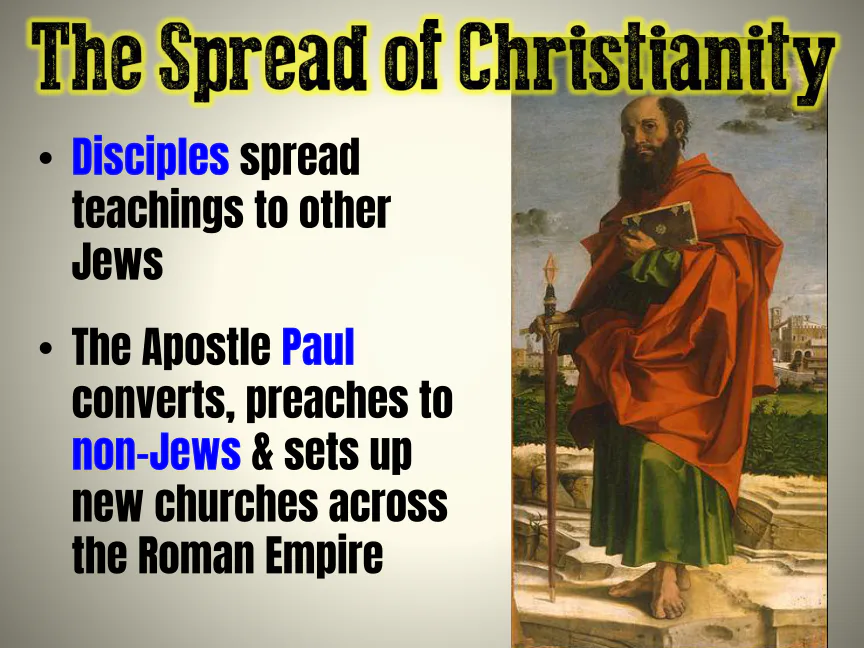
What role did the Apostle Paul play in the spread of Christianity?
He spread teachings to other Jews
He converted and preached to non-Jews
He set up new churches only in Jerusalem
He was one of the original disciples
7

8
Multiple Choice
They were persecuted for refusing to worship Roman gods and the emperor.
9

10
Multiple Select
What were the key reasons for the appeal of Christianity?
Attractive to the wealthy
Did not discriminate by class
Women could participate
Promise of salvation for all
11

12
Multiple Choice
What significant action did Constantine take in 313 A.D.?
He banned Christianity
He issued the Edict of Milan
He started a new war
He built a new city
13

14
Multiple Choice
What significant action did the Edict of Thessalonica take regarding religion in the Roman Empire?
It established paganism as the state religion
It made Christianity the state religion
It allowed multiple religions to coexist
It banned all religions
15

16
Multiple Choice
Why do you think Christianity was able to grow in Rome despite the persecution of early followers?
Christianity grew due to the dedication of its followers.
17
Multiple Choice
What were the main challenges faced by Christians during the Roman Empire?
Persecution
Acceptance
Indifference
Support
18
Multiple Choice
What do Jesus's followers believe happened after his death?
He was resurrected three days later.
His body was stolen from the grave.
Most of his followers converted back to Judaism
19
Multiple Choice
What happened to Christians in 64 AD?
They were given freedom to worship
They were blamed for a massive fire in Rome
They were sent to exile
They were given positions in the government
20
Multiple Choice

Which of the following things did Jesus teach?
His followers should love all people and care for the poor and sick.
His followers should obey all of the Jewish religious ceremonies.
His followers should overthrow the Roman emperor.
21
Multiple Choice

What was Paul of Tarsus responsible for?
Spreading Christianity around Roman World
Causing uprisings against Roman government
22
Page 142
23
Find evidence in the slide text to support the claim at the top of the Slide.
Evidence can be a name of a person, a phrase or a fact from the text.
Write this evidence in your notebook.
Directions
24
While Romans accepted and tolerated some religions, they persecuted others. Christianity began in the Roman Empire. The founder of Christianity, Jesus Christ, was killed by Roman officials in the province of Judea after being charged with sedition. Soon after, Christ's followers began spreading Christ's message throughout the Roman Empire and beyond. They refused to participate in traditional Roman religious activities.
After a massive fire burned much of Rome in 64 CE, the Emperor Nero blamed the fire on the city's Christian community. Some claimed that Nero started the fire to clear room for a new palace. That is unproven, but Christians were an easy group to scapegoat. They were seen as outsiders by most traditional Romans. Many Christians were arrested and executed, and some were even thrown to the lions at the Colosseum.
The early Christians were persecuted because they were seen as outsiders and disliked by some of the Roman emperors.
25
Despite the widespread persecution of Christians, Christianity grew rapidly. The religion mostly appealed to the poor in Rome. Many were drawn to the religion’s belief in salvation and that if you lived a good life you would go to heaven.
Rome’s paganistic religion believed that heaven was only for gods and that everyone else would spend eternity in the underworld. People were also drawn to Christianity because the religion believed in equality, and that everyone was equal without hierarchy or caste.
Christianity appealed to some Romans because it offered an alternative to the Roman way of life.
26
Christianity's spread among the poor and soldiers was eventually tolerated. Under the emperor Trajan, Christians would no longer be prosecuted. Progress was slow and occurred in patches at various times during the empire. The Roman Empire became so vast that it grew to tolerate the different people who became part of it.
The Roman emperors began to tolerate Christianity because it had become widespread among the Roman people.
27
During one of his battles, Emperor Constantine had a vision of Christ and was directed to fight with Christian standards. The victory in this battle resulted in Constantine’s new faith in Christianity. He would convert to Christianity in 312 CE and declare that Christians and Pagans should be allowed to worship freely through the Edict of Milan in 313 CE.
In 380 CE Emperor Theodosius issued the Edict of Thessalonica. This made Christianity the state religion of the Roman Empire.
It would take over a hundred years before Christianity was adopted by emperors and protected. However, paganism remained and continued to pose a challenge to the rising Christian faith.
Rome officially accepted Christianity because one emperor had a personal experience with the religion.
28
Page 148
29
Read the primary souce about Gladiators
Answer the questions in your notebook.
Directions
30
To distract and control the people of Rome, the government held games and gladiator contests at the Colosseum. This massive arena could hold 50,000 people. Seneca the Younger was a Stoic philosopher, who here describes how gladiators engaged in combat with each other and with exotic animals, all for the entertainment of the crowd.
Gladiatorial Combat in Ancient Rome
31
"By chance I attended a mid-day exhibition, expecting some fun, wit, and relaxation—an exhibition at which men’s eyes have respite from the slaughter of their fellow-men. But it was quite the reverse. The previous combats were the essence of compassion; but now all the trifling is put aside and it is pure murder. The men have no defensive armor. They are exposed to blows at all points, and no one ever strikes in vain…
In the morning, they throw men to the lions and the bears; at noon, they throw them to the spectators. The spectators demand that the slayer shall face the man who is to slay him in his turn; and they always reserve the latest conqueror for another butchering. The outcome of every fight is death, and the means are fire and sword. This sort of thing goes on while the arena is empty.
Gladiatorial Combat in Ancient Rome
32
You may retort: “But he was a highway robber; he killed a man!” And what of it? Granted that, as a murderer, he deserved this punishment, what crime have you committed, poor fellow, that you should deserve to sit and see this show? In the morning, they cried “Kill him! Lash him! Burn him! Why does he meet the sword in so cowardly a way? Why does he strike so feebly? Why doesn’t he die game? Whip him to meet his wounds! Let them receive blow for blow, with chests bare and exposed to the stroke!” And when the games stop for the intermission, they announce: “A little throat-cutting in the meantime, so that there may still be something going on!”
From Seneca’s Moral Epistles VII
Gladiatorial Combat in Ancient Rome
33
Multiple Choice
How does Seneca characterize the gladiator combats?
34
Multiple Choice
How does it seem the audience justifies people being thrown to the animals?
35
Multiple Choice
...what crime have you committed, poor fellow,
that you should deserve to sit and see this show?
What does Seneca mean by this quote?
Seneca is critiquing the gladiator battles and the unfair nature of punishment.
36
Opinion
What do you imagine the people were like in attendance?
Who do you think would attend the gladiator battles
How do you think the audience would act during the battles?
37
Opinion
Would you attend a gladiator event at the Colosseum if you lived in Ancient Rome?
Explain why or why not.
Page 141
Show answer
Auto Play
Slide 1 / 37
SLIDE
Similar Resources on Wayground

28 questions
Days and Months in Spanish
Presentation
•
9th Grade
34 questions
Pax Romana & Contributions
Presentation
•
9th Grade
32 questions
The Legislative Process
Presentation
•
9th Grade
30 questions
SOCIALISM IN EUROPE AND THE RUSSIAN REVOLUTION
Presentation
•
9th Grade
32 questions
Protein Synthesis
Presentation
•
9th - 10th Grade
33 questions
Diffusion and Osmosis Notes
Presentation
•
9th Grade
28 questions
Covalent Bonding
Presentation
•
9th Grade
31 questions
SSWH11 Tokugawa_Ming_Qing
Presentation
•
10th Grade
Popular Resources on Wayground
10 questions
HCS SCI 03 Summer School Review 4

Quiz
•
3rd Grade
11 questions
HSMS - Standard Response Protocol
Quiz
•
6th - 8th Grade
16 questions
1.1-1.2 Quiz Review
Quiz
•
9th - 12th Grade
12 questions
Exponent Expressions
Quiz
•
6th Grade
20 questions
Adding and Subtracting Integers
Quiz
•
6th - 7th Grade
11 questions
Northeast States
Quiz
•
3rd - 4th Grade
10 questions
Characterization
Quiz
•
3rd - 7th Grade
10 questions
Common Denominators
Quiz
•
5th Grade