
World War One Revision

Presentation
•
History
•
9th Grade
•
Medium

Serina PENNAY
Used 2+ times
FREE Resource
2 Slides • 31 Questions
1
Revision
Grade 9 History
2
Students will apply knowledge to questioning in regard to World War 1.
Success Criteria
Students will use prior knowledge developed throughout the unit to answer questions.
Focus
3
Poll
Brain Jog:
How confident do you feel about taking this quiz?
Confident
Semi-Confident
ok
I'll practice
today!
4
Multiple Select
World War I is often called ‘the ................ War’, ‘the first ......................... war’ or ‘the war to ............... all wars’.
Great
begin
end
modern
5
Fill in the Blanks
It was the first war in which modern machine guns, chemical weapons, tanks, fighter aircraft and submarines were used to cause devastation on a g
6
Multiple Choice
At the end of World War I, the map of Europe was re.......................
7
Dropdown
8
Fill in the Blanks
There were four main factors that contributed to the growing tensions between European countries in the lead-up, to World War I including:
1. the alliance system
2. nationalism
3. imperialism
4. m
9
Fill in the Blanks
One of the key factors that led to the outbreak of World War I was the
10
Multiple Choice
True or False:
Nationalism was another important factor that contributed to the outbreak of war in 1914. Put simply, nationalism is a sense of pride in, and a love of, one’s nation. Nationalism grows out of an understanding of common goals and beliefs between the people of a nation.
11
Multiple Choice
True or False:
Another factor that led to tensions between European countries in the lead-up to World War I was imperialism. Imperialism is a policy by which a country increases its power by gaining control over new territories to create an empire. This is usually carried out for financial and strategic reasons.
12
Multiple Choice
True or False:
Militarism is the disbelief that all nations should build and maintain strong armed forces so that they are prepared to defend themselves against attack or promote their national interests. In the lead up to World War I, many European countries competed with each other not only over the size of their empires, but also over the size of their armies.
13
Fill in the Blanks
On 28 June 1914, while many people lined the streets to welcome the royal couple, a Serb nationalist by the name of Gavrilo Princip took the opportunity to show his feelings towards their imperial rulers. During the parade, he shot and
14
Drag and Drop
15
Drag and Drop
16
Drag and Drop
17
Dropdown
18
Fill in the Blanks
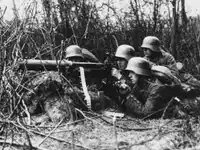
Over the course of World War I, many new technologies were introduced and existing technologies such as military vehicles and weapons were improved. Developments in powerful long-range weaponry, such as the machine gun and heavy artillery, were particularly important. Deadly new
19
Labeling
Label the Appropriate Alliances within the map of conflict.
Cohort Powers
Central Powers
Allied Powers
Allied Powers
Ocean Powers
20
Fill in the Blanks
Following the sinking of two more British ships carrying .................................... passengers, Germany agreed to stop submarine attacks on ships carrying civilians. This pledge lasted until March 1917, when German submarines sunk more ................................ ships. As a result of these attacks, on 6 April 1917, the USA declared war on Germany.
21
Dropdown
22
Labeling
Label the conflict map of the Western Front.
Germany
France
German Occupied
Trenches Line
23
Dropdown
24
Multiple Choice
What does ANZAC stand for?
25
Fill in the Blanks
The Gallipoli campaign was launched because Britain and France needed to move troops, equipment and weapons to allied troops in Russia. In order to do this they needed to travel across the
26
Multiple Choice
True or False:
The first part of the campaign plan was launched in March 1915. This involved a naval attack through the Dardanelles – a sea passage from the Mediterranean Sea to the Black Sea. This action failed because the entrance to the Dardanelles had been laid with underwater mines. Three Allied battleships were destroyed by these mines, and another three were badly damaged.
27
Drag and Drop
28
Dropdown
29
Fill in the Blanks
While the Armistice put an end to the fighting, it was initially only to last for 30 days and it did not determine how peace could be secured and maintained. The ceasefire was made permanent the following year when members of the Commonwealth and the League of Nations signed the Treaty of ........................... While the ..................................... Treaty was the peace treaty that officially ended World War I, a number of its terms were so controversial that it also set the stage for World War II.
30
Multiple Choice
How many referendums were undertaken to bring in conscription of WW1?
31
Fill in the Blanks
Over the course of the war, nearly 7000 people were classified by the government as ‘enemy aliens’ and imprisoned in
32
Multiple Choice
For Australians, ......................................... of World War I has always been closely tied to the Gallipoli landing on 25 April 1915. Despite Australians being involved in more successful campaigns and battles during World War I, it is Gallipoli that has come to symbolise Australia’s war experience.
commemoration
33
Word Cloud
Brain Wrap:
One word of how confident are you feeling now?
Revision
Grade 9 History
Show answer
Auto Play
Slide 1 / 33
SLIDE
Similar Resources on Wayground

26 questions
SouthEast Asia
Presentation
•
9th Grade
26 questions
Mean, Median, Mode, & Range
Presentation
•
9th Grade
26 questions
17.4 Evidence of Evolution
Presentation
•
9th Grade
27 questions
Viruses review
Presentation
•
9th Grade
24 questions
Primary and Secondary Sources
Presentation
•
9th Grade
26 questions
Cold War Review
Presentation
•
9th Grade
26 questions
Indian Removal Cherokee
Presentation
•
8th Grade
27 questions
Chapter 11: Lesson 1
Presentation
•
8th Grade
Popular Resources on Wayground
10 questions
Safety Day 2026 – Student Review

Quiz
•
9th Grade
21 questions
Continents and Oceans
Quiz
•
6th Grade
20 questions
Parts of Speech
Quiz
•
5th Grade
16 questions
Subject & Predicate
Quiz
•
5th Grade
25 questions
Multiplication Facts
Quiz
•
5th Grade
12 questions
Map Skills
Quiz
•
3rd Grade
22 questions
Continents and Oceans
Quiz
•
5th Grade
15 questions
Rounding Decimals
Quiz
•
5th Grade
Discover more resources for History
25 questions
The American Revolution
Quiz
•
7th - 10th Grade
15 questions
The Bill of Rights
Quiz
•
8th - 12th Grade
15 questions
Ancient Rome
Quiz
•
7th - 10th Grade
16 questions
Students of Civics Unit 2: The Constitution
Quiz
•
7th - 11th Grade
10 questions
Exploring the 7 Principles of the Constitution

Interactive video
•
6th - 10th Grade
10 questions
Significance of the Declaration of Independence
Interactive video
•
6th - 10th Grade
22 questions
Beginning of WW2 Quiz
Quiz
•
9th Grade
10 questions
Exploring the Age of Exploration
Interactive video
•
6th - 10th Grade