

2.6 Notes- Free Trade and Comparative Advantage

Presentation
•
Social Studies
•
12th Grade
•
Practice Problem
•
Easy

Sarah Jager
Used 1+ times
FREE Resource
7 Slides • 10 Questions
1

2

3
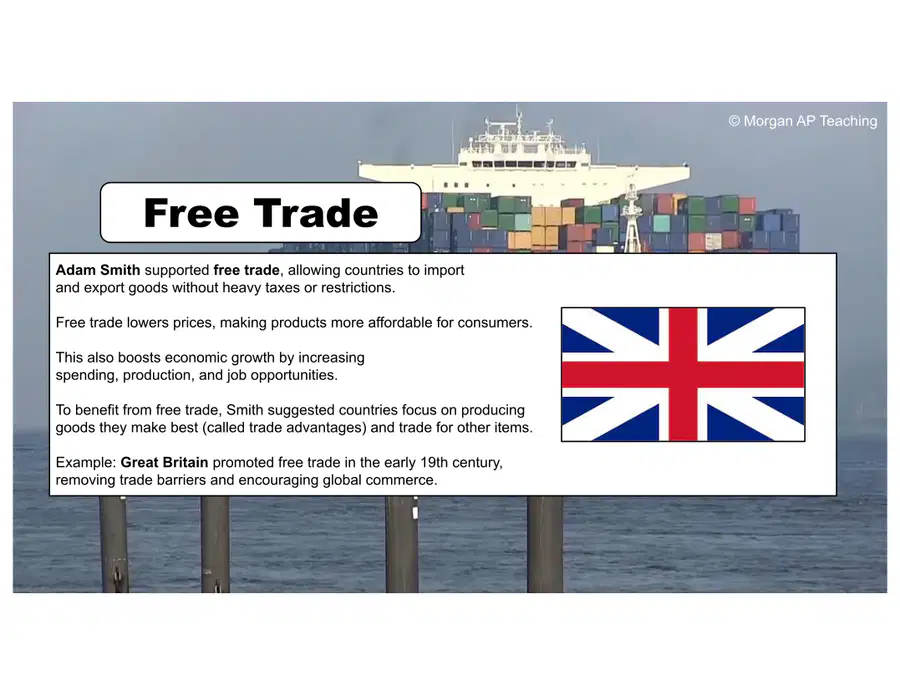
Take notes on these slides today
4
Multiple Choice
Which economist is most closely associated with the idea of free trade, and what is one benefit of free trade according to the slide?
Adam Smith; Free trade lowers prices for consumers.
John Maynard Keynes; Free trade increases government revenue.
Karl Marx; Free trade eliminates competition.
David Ricardo; Free trade reduces job opportunities.
5
Open Ended
Why do you think free trade is important in today's global economy?
6

7
8
Multiple Choice
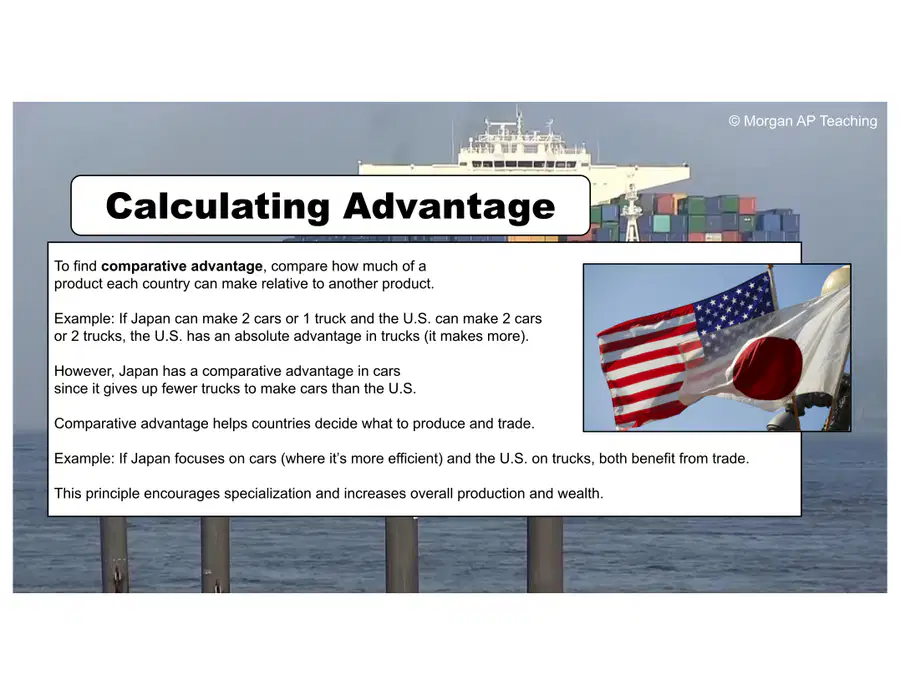
Which of the following statements about comparative advantage is correct?
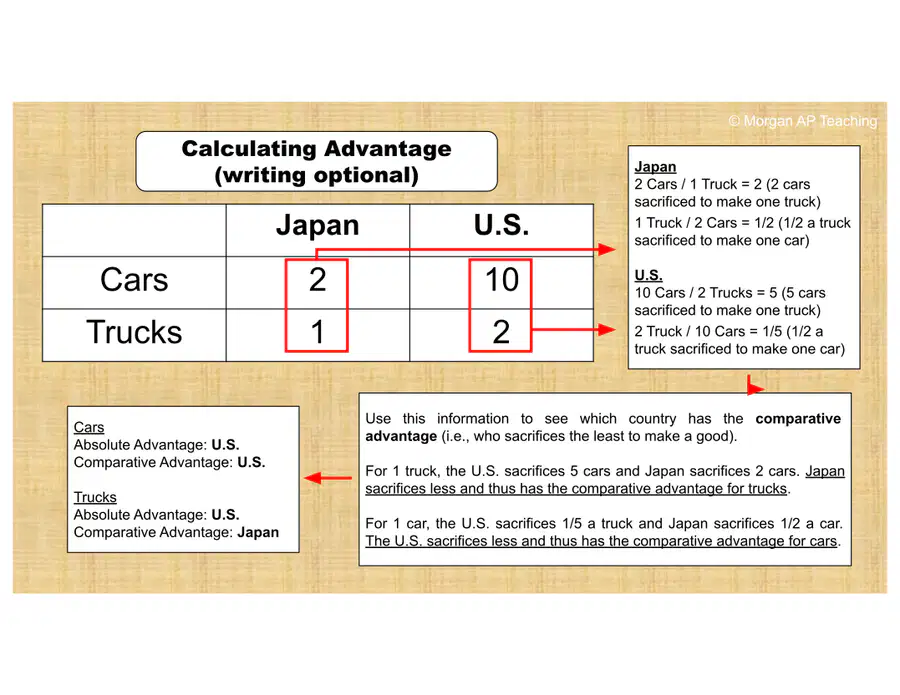
A country has a comparative advantage if it can produce a good at a lower opportunity cost than another country.
A country has a comparative advantage if it can produce more of a good overall than another country.
Comparative advantage does not consider opportunity cost.
Comparative advantage means producing all goods more efficiently than others.
9
Open Ended
Explain the difference between comparative advantage and absolute advantage using an example from the slides.
10
11
Fill in the Blanks
12
13
Multiple Choice
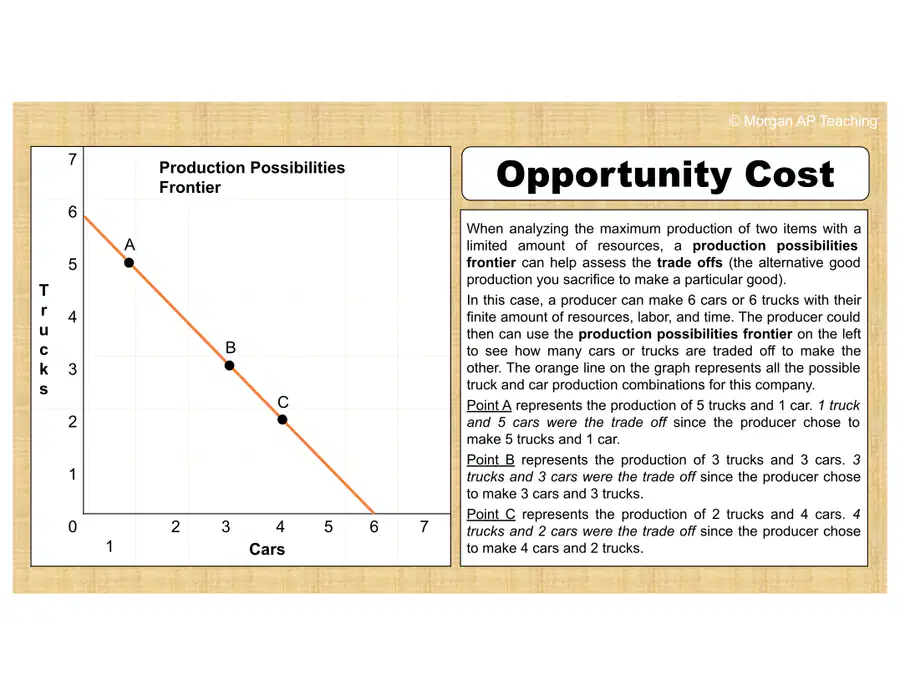
Which of the following best describes the concept of opportunity cost in international trade?
The total cost of producing goods in a country
The value of the next best alternative foregone when making a trade decision
The amount of money exchanged between countries
The difference between imports and exports
14
Multiple Choice
Based on the production possibilities frontier, what is the opportunity cost of moving from point B to point C on the graph?
1 truck and 1 car
1 truck and 2 cars
1 truck and 3 cars
1 truck and 4 cars
15
Open Ended
How does free trade contribute to global economic interdependence?
16
Open Ended
What questions do you still have about free trade and comparative advantage after today's lesson?
17
Match

EXIT TICKET: Match the following
an economic problem of humans having limited resources while
also having unlimited needs and wants
a social science
that studies how people, acting individually and in groups, decide to use
scarce resources to satisfy their wants.
Behind each choice, there is an alternative choice that could have
been made. The value of that second-best option.
rewards or penalties that influence an individual to make or avoid a specific choice.
Scarcity
Economics
Opportunity Cost
Incentives
Scarcity
Economics
Opportunity Cost
Incentives
Show answer
Auto Play
Slide 1 / 17
SLIDE
Popular Resources on Wayground

19 questions
Naming Polygons

Quiz
•
3rd Grade
10 questions
Prime Factorization
Quiz
•
6th Grade
20 questions
Math Review
Quiz
•
3rd Grade
15 questions
Fast food
Quiz
•
7th Grade
20 questions
Main Idea and Details
Quiz
•
5th Grade
20 questions
Context Clues
Quiz
•
6th Grade
20 questions
Inferences
Quiz
•
4th Grade
19 questions
Classifying Quadrilaterals
Quiz
•
3rd Grade
Discover more resources for Social Studies
30 questions
AP Psychology Unit 4: Social Psychology and Personality
Quiz
•
12th Grade
48 questions
Civics EOC Practice Questions
Quiz
•
12th Grade
43 questions
U.S. History EOC Practice Questions
Quiz
•
12th Grade
50 questions
Economics Final Exam Review
Quiz
•
12th Grade
28 questions
Semester Review Part 1
Quiz
•
9th - 12th Grade
24 questions
Spring Semester Exam Part 2 Review
Quiz
•
9th - 12th Grade
10 questions
Exploring Financial Literacy and Personal Growth

Interactive video
•
9th - 12th Grade