

BOYLE'S LAW

Presentation
•
Science
•
10th Grade
•
Practice Problem
•
Hard

MARK ANTHONY ROLUNA
FREE Resource
26 Slides • 28 Questions
1

2
Multiple Choice
Why is classroom observation important in understanding student learning and teaching effectiveness?
It helps teachers identify areas for improvement.
It allows students to evaluate their teachers.
It is required for school accreditation.
It is only useful for administrative purposes.
3
4
Open Ended
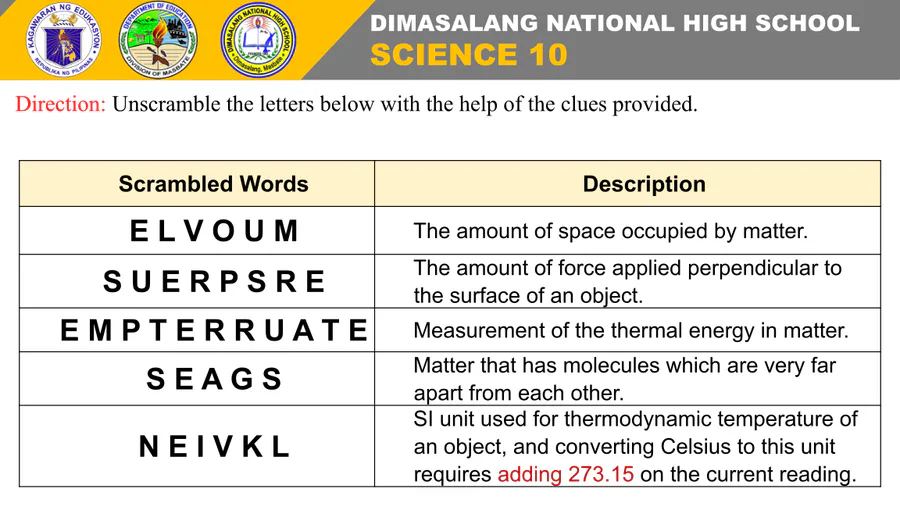
How do the concepts of volume, pressure, temperature, and states of matter relate to each other in the study of science?
5
6
7
Open Ended
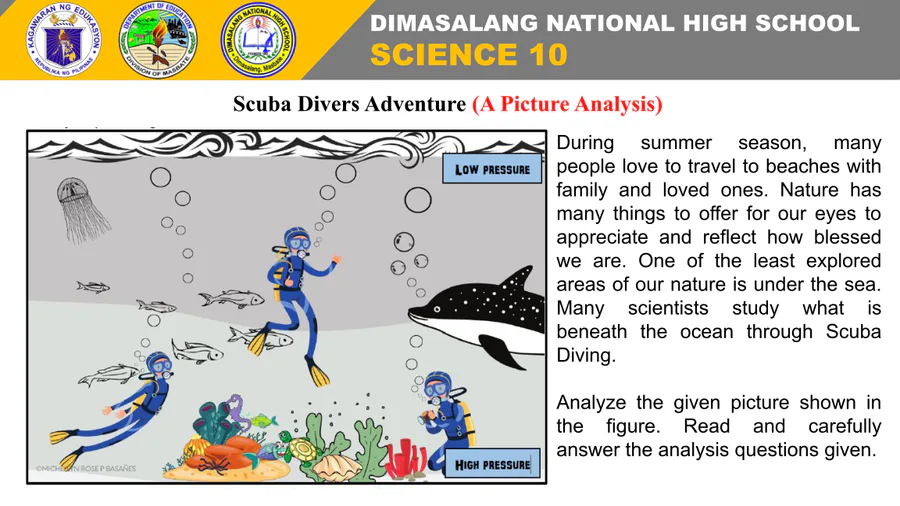
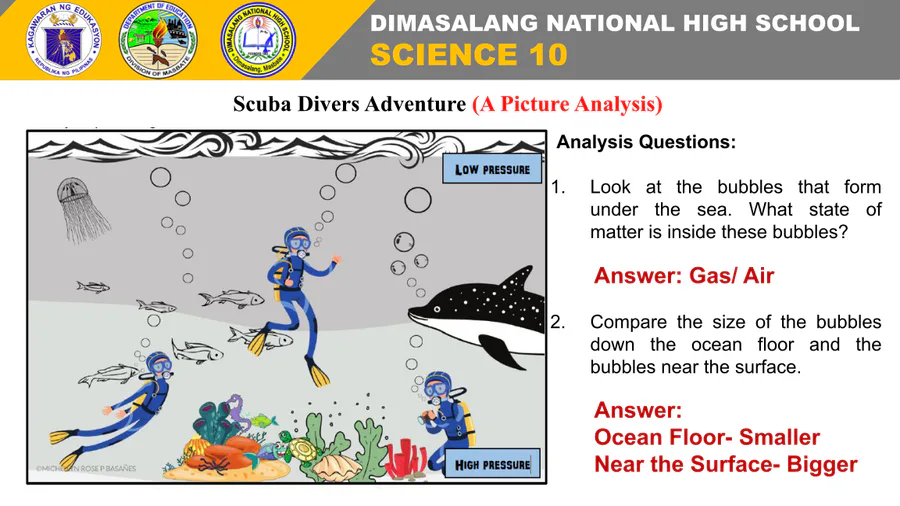
Compare the size of the bubbles at the ocean floor and near the surface. What causes the difference in their sizes?
8
Multiple Choice
Which state of matter is present inside the bubbles formed under the sea during scuba diving?
Solid
Liquid
Gas
Plasma
9
10
11
Multiple Choice
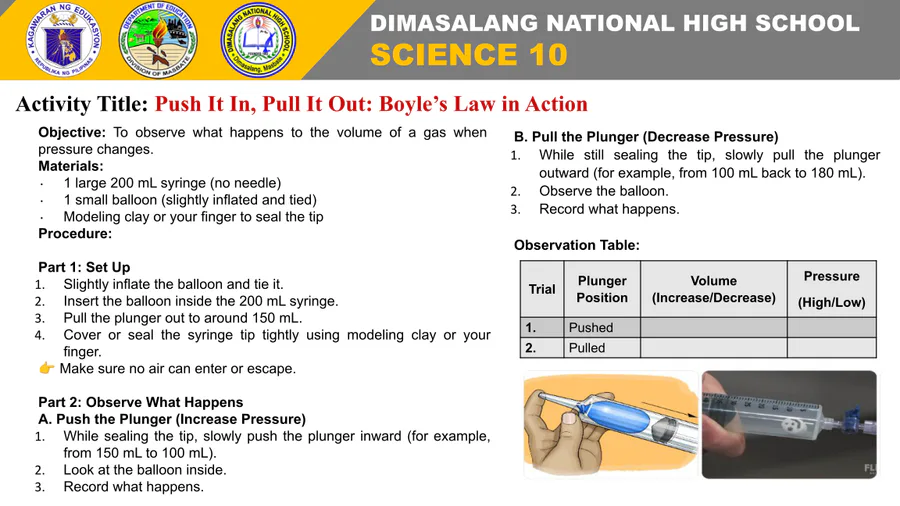
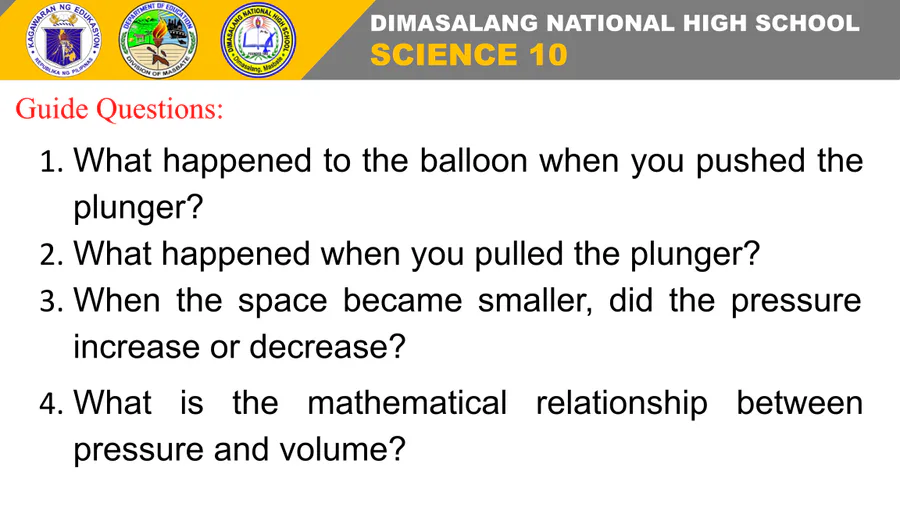
What happens to the volume of a balloon when the plunger of a syringe is pushed inward, and what happens when it is pulled outward?
Volume increases when pushed, decreases when pulled
Volume decreases when pushed, increases when pulled
Volume stays the same
Volume disappears
12
13
Multiple Select
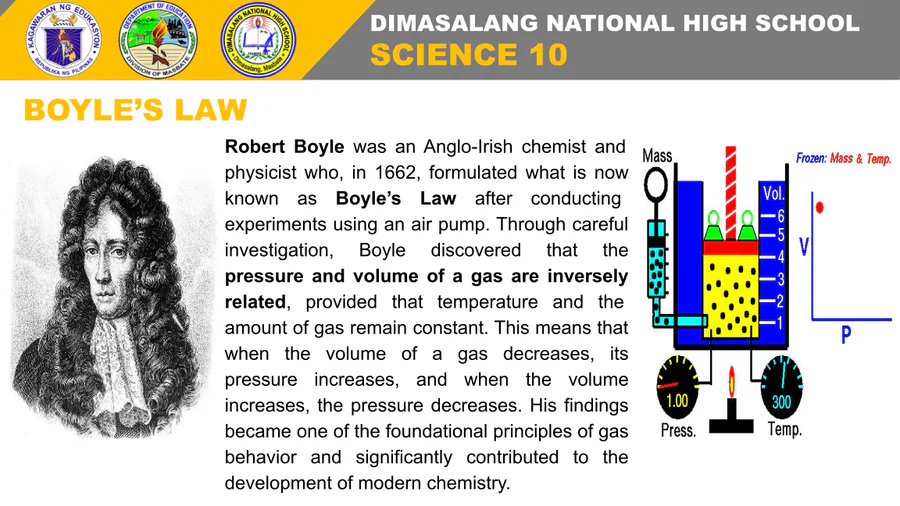
Select all conditions that must remain constant for Boyle's Law to apply.
Temperature
Amount of gas
Pressure
Volume
14
Fill in the Blanks
Type answer...
15
Multiple Choice
Which of the following statements correctly describes Boyle's Law?
Pressure and volume of a gas are directly related.
Pressure and volume of a gas are inversely related.
Pressure and volume of a gas are unrelated.
Pressure and volume of a gas both increase together.
16

17
18
Multiple Choice
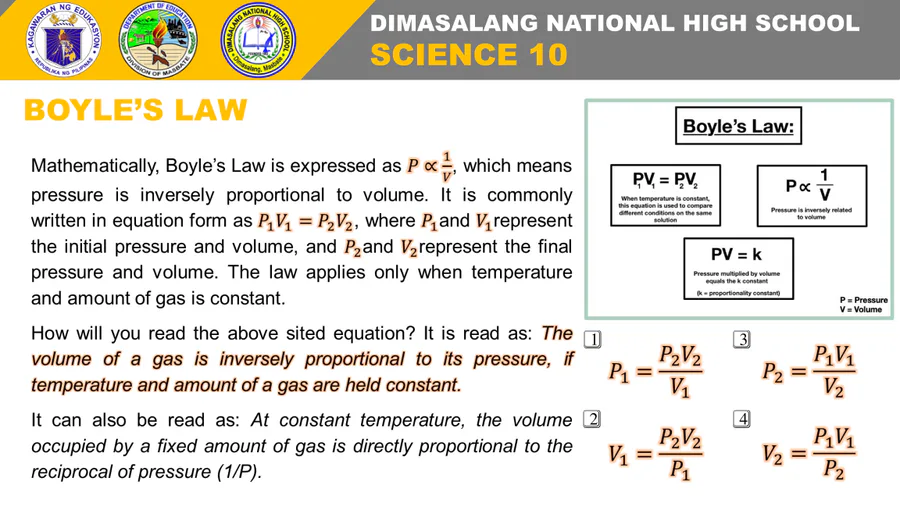
Which equation best represents Boyle's Law when temperature and the amount of gas are constant?
P1V1 = P2V2
P1V1 = P1V2
P1V1 = P2V1
P1V1 = P1V1
19
20
Open Ended
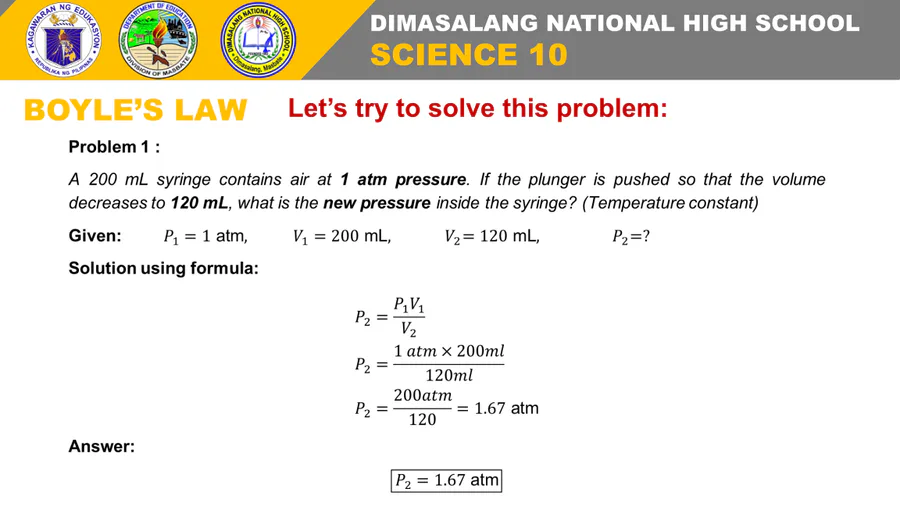
Explain how Boyle's Law applies to the relationship between pressure and volume in a syringe when the temperature is constant, using the example provided.
21
22
Open Ended
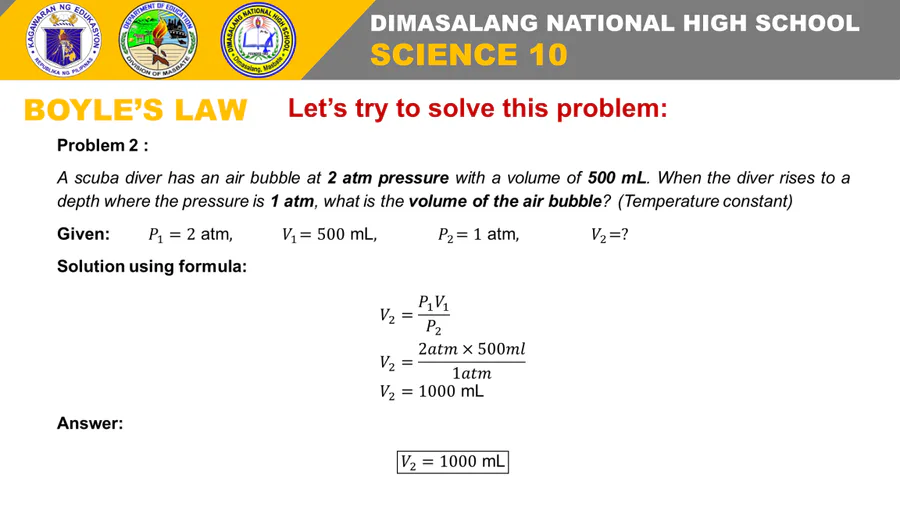
Compare the solutions to the two practice problems involving Boyle's Law. What similarities and differences do you observe in the approach and calculations?
23
Multiple Select
Based on the scuba diver example, which of the following statements are correct about Boyle's Law?
As pressure decreases, volume increases.
As pressure increases, volume decreases.
Pressure and volume are directly proportional.
Temperature must remain constant for Boyle's Law to apply.
24
25
26
Fill in the Blanks
Type answer...
27
28
Multiple Choice
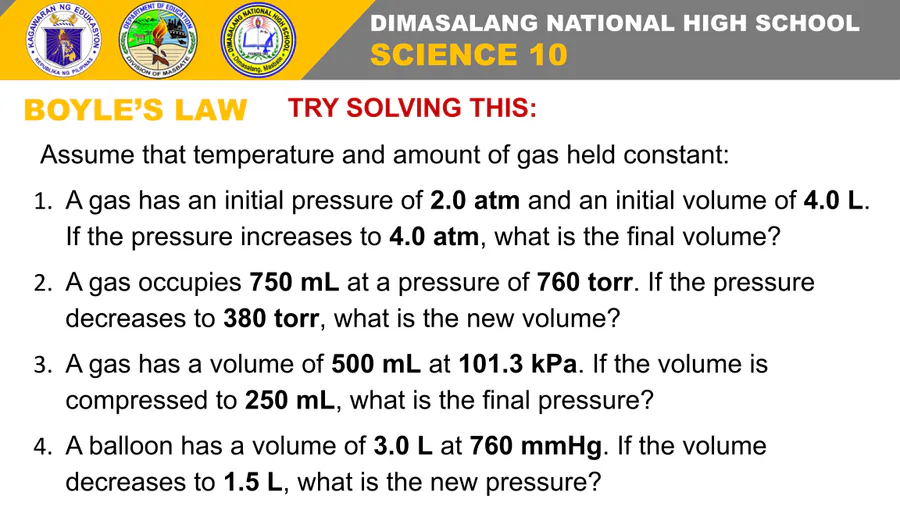
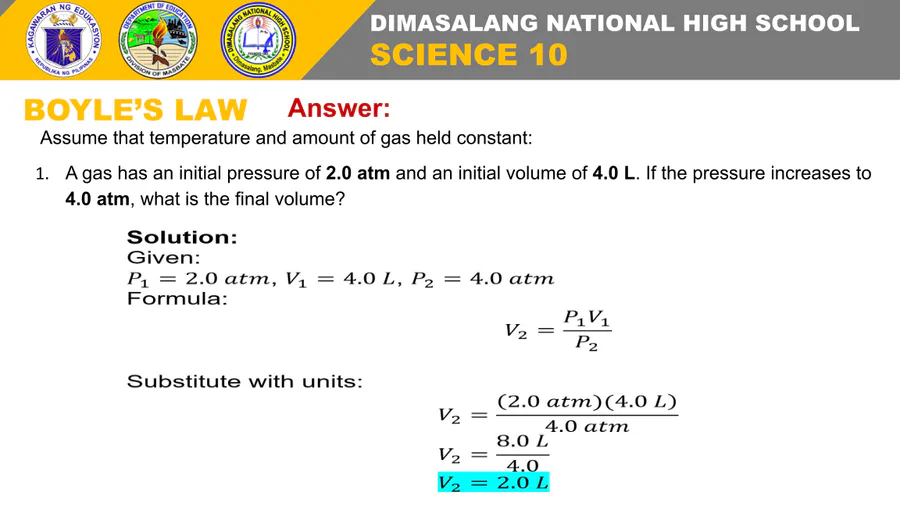
If a gas has an initial pressure of 2.0 atm and an initial volume of 4.0 L, and the pressure increases to 4.0 atm, what is the final volume?
2.0 L
4.0 L
8.0 L
1.0 L
29
30
Open Ended
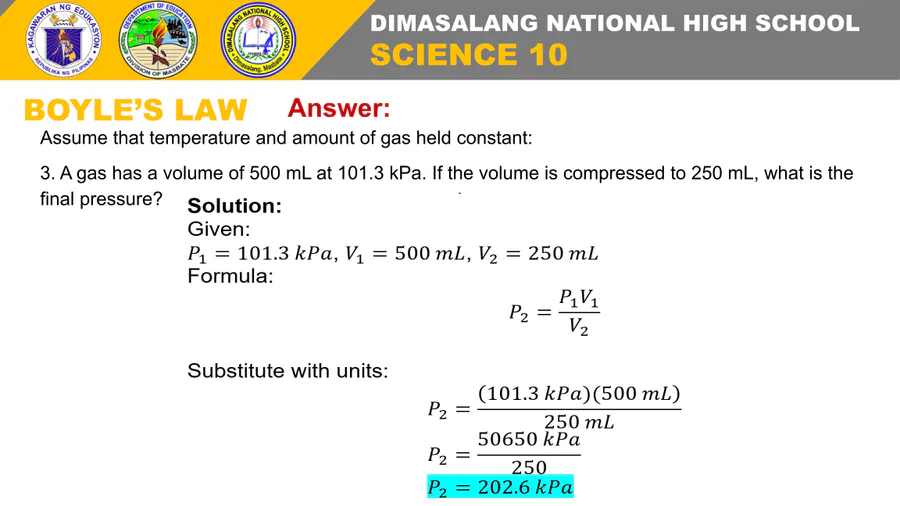
A gas has a volume of 500 mL at 101.3 kPa. If the volume is compressed to 250 mL, what is the final pressure?
31
32
Open Ended
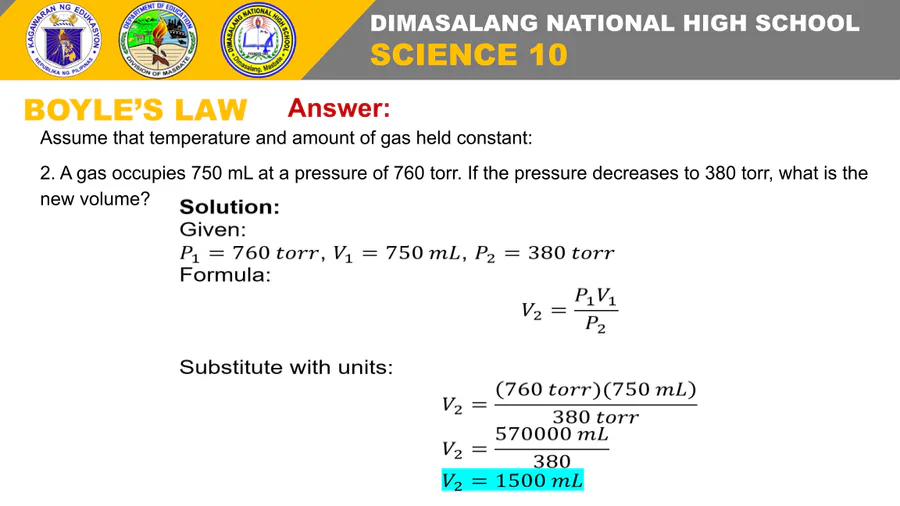
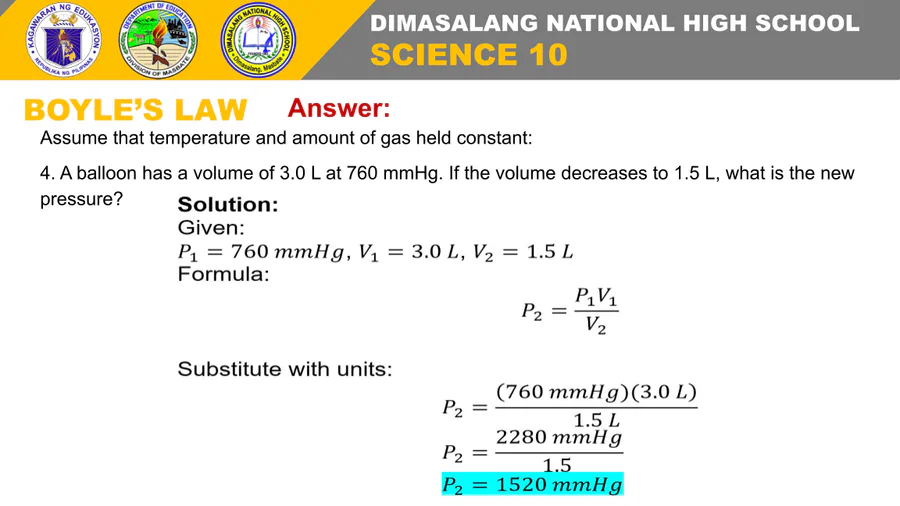
Compare the calculation steps for finding the final pressure in both examples. What is the main similarity in the approach used?
33
34
Fill in the Blanks
Type answer...
35
Multiple Choice
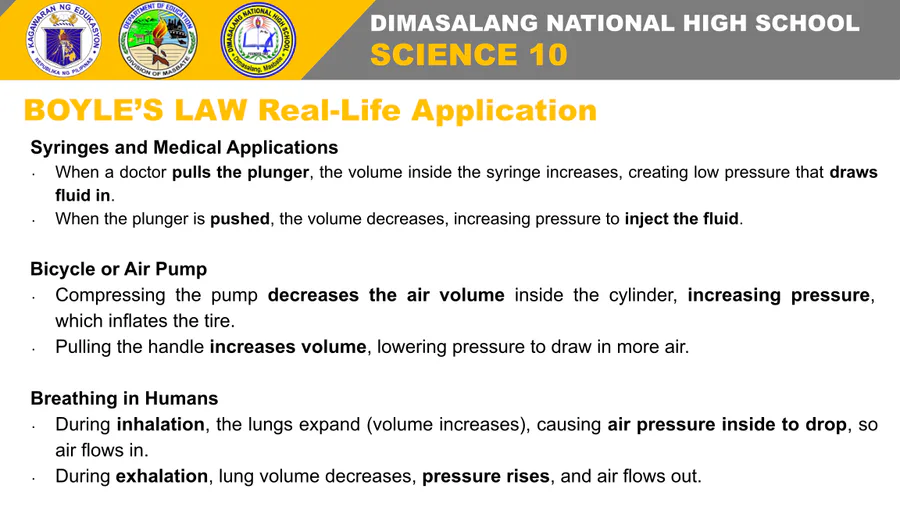
Which of the following is a real-life application of Boyle's Law?
A doctor pulls the plunger of a syringe, increasing volume and lowering pressure.
Compressing the pump decreases air volume and increases pressure in a bicycle tire.
During inhalation, lung volume increases and air pressure drops.
All of the above
36
37
Multiple Select
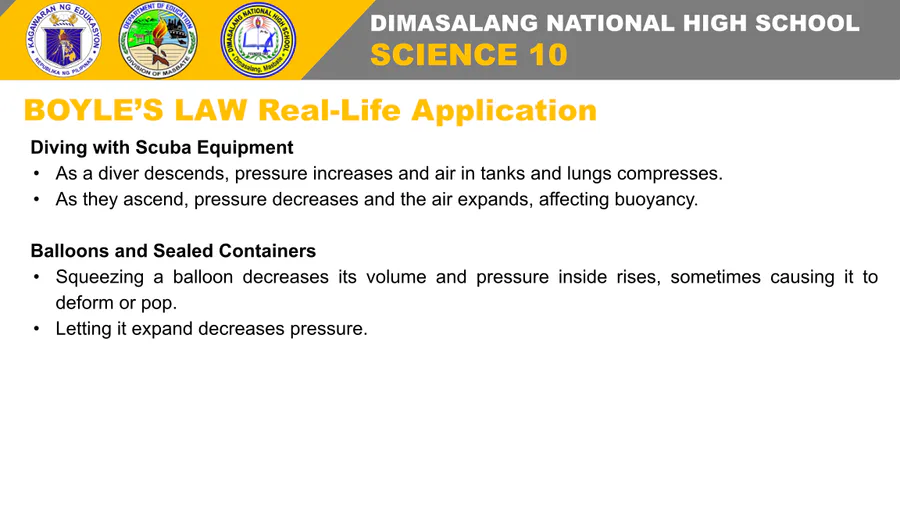
Select all situations where Boyle's Law is applied.
Diving with scuba equipment
Squeezing a balloon
Heating a gas at constant volume
Pulling the handle of an air pump
38
39
40
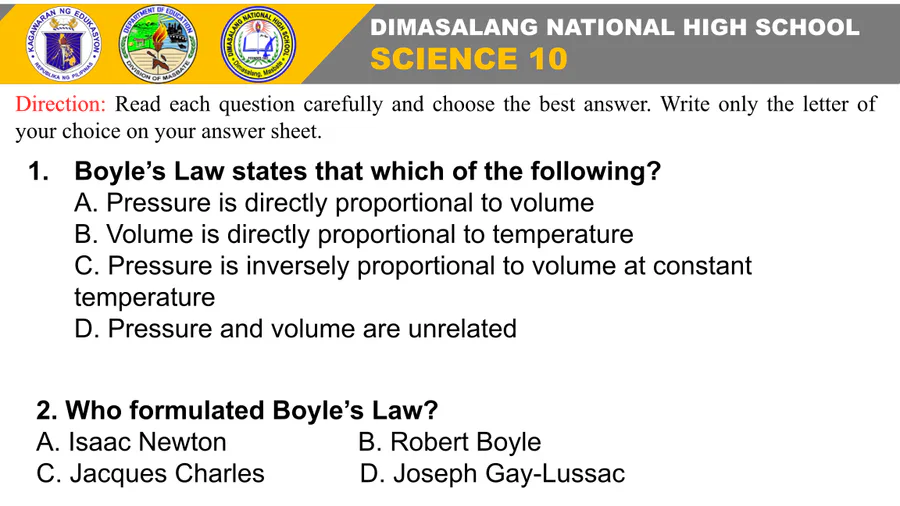
Multiple Choice
Boyle’s Law states that which of the following?
Pressure is directly proportional to volume
Volume is directly proportional to temperature
Pressure is inversely proportional to volume at constant temperature
Pressure and volume are unrelated
41
42
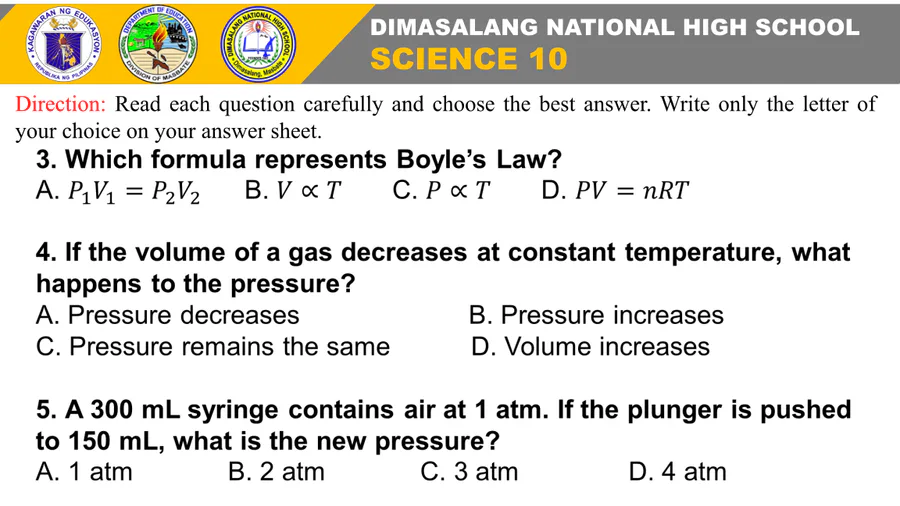
Multiple Choice
If the volume of a gas decreases at constant temperature, what happens to the pressure?
Pressure decreases
Pressure increases
Pressure remains the same
Volume increases
43
Multiple Choice
Which formula represents Boyle’s Law?
P1V1 = P2V2
V ∝ T
P ∝ T
PV = nRT
44
45
Fill in the Blanks
Type answer...
46
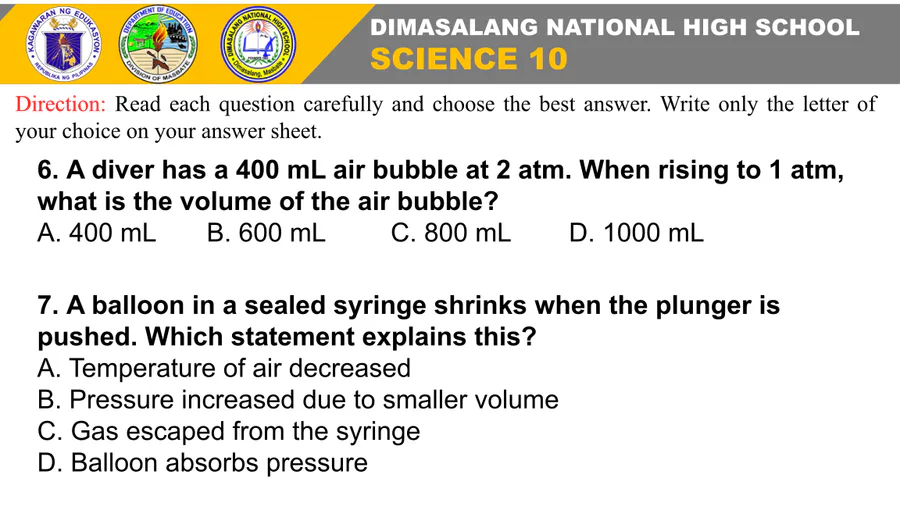
Multiple Choice
A diver has a 400 mL air bubble at 2 atm. When rising to 1 atm, what is the volume of the air bubble?
400 mL
600 mL
800 mL
1000 mL
47
48
Multiple Choice
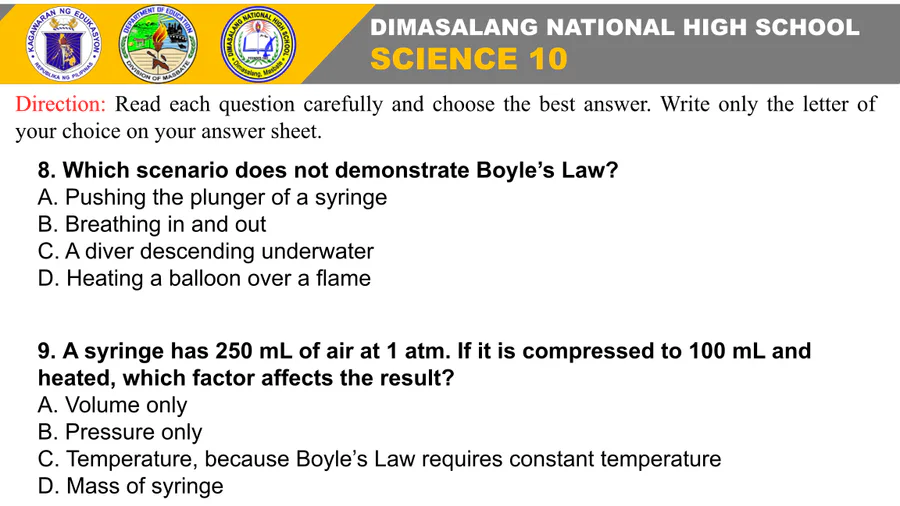
Which scenario does not demonstrate Boyle’s Law?
Pushing the plunger of a syringe
Breathing in and out
A diver descending underwater
Heating a balloon over a flame
49
50
51
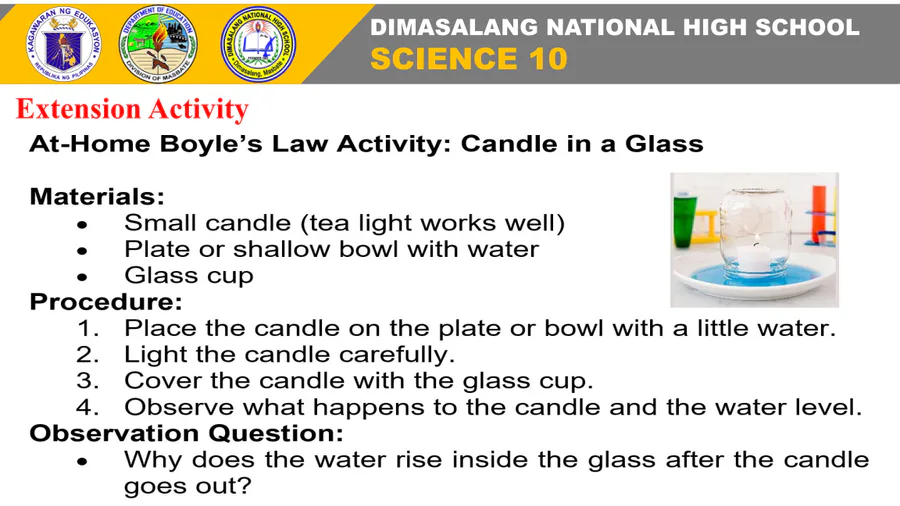
Open Ended
Why does the water rise inside the glass after the candle goes out?
52
53
Fill in the Blanks
Type answer...
54
Open Ended
What are the key concepts you learned about matter and its properties from today's lesson?
Show answer
Auto Play
Slide 1 / 54
SLIDE
Popular Resources on Wayground

15 questions
Grade 3 Simulation Assessment 1

Quiz
•
3rd Grade
22 questions
HCS Grade 4 Simulation Assessment_1 2526sy
Quiz
•
4th Grade
16 questions
Grade 3 Simulation Assessment 2
Quiz
•
3rd Grade
19 questions
HCS Grade 5 Simulation Assessment_1 2526sy
Quiz
•
5th Grade
17 questions
HCS Grade 4 Simulation Assessment_2 2526sy
Quiz
•
4th Grade
20 questions
Equivalent Fractions
Quiz
•
3rd Grade
24 questions
HCS Grade 5 Simulation Assessment_2 2526sy
Quiz
•
5th Grade
20 questions
Math Review
Quiz
•
3rd Grade
Discover more resources for Science
20 questions
Earth Day Trivia
Quiz
•
9th - 12th Grade
100 questions
Biology EOC Review
Quiz
•
9th - 12th Grade
20 questions
Earth Day
Quiz
•
3rd - 12th Grade
38 questions
Biology EOC Review Game
Quiz
•
10th Grade
10 questions
Exploring Natural Selection Concepts

Interactive video
•
6th - 10th Grade
10 questions
Exploring Air Masses and Weather Fronts
Interactive video
•
6th - 10th Grade
20 questions
Cladograms and Phylogenetic Trees
Quiz
•
9th - 12th Grade
31 questions
STAAR Strand 1 TEKS(11,12)
Quiz
•
9th - 12th Grade