
LSRL Practice
Authored by Kimberly Wilson
Mathematics
12th Grade
CCSS covered
Used 82+ times


AI Actions
Add similar questions
Adjust reading levels
Convert to real-world scenario
Translate activity
More...
About
This quiz focuses on linear regression analysis, specifically the Least Squares Regression Line (LSRL), and is appropriate for Grade 12 students in an advanced mathematics or statistics course. The questions comprehensively assess students' understanding of regression equations, including calculating and interpreting the slope and y-intercept, making predictions using regression models, and understanding correlation coefficients. Students need to master the fundamental concepts of linear relationships between variables, interpret the meaning of correlation values ranging from -1 to +1, understand what constitutes strong versus weak correlations, and analyze residuals on scatterplots. The mathematical reasoning required includes substituting values into linear equations, understanding that the slope represents the rate of change between variables, and recognizing that residuals indicate whether actual data points fall above or below the regression line. Created by Kimberly Wilson, a Mathematics teacher in US who teaches grade 12. This quiz serves as an excellent tool for formative assessment, allowing you to gauge student comprehension of regression analysis before moving to more complex statistical concepts. It works particularly well as a review activity after teaching LSRL concepts, or as targeted practice homework to reinforce calculation skills and conceptual understanding. The quiz can also function as an effective warm-up before introducing advanced topics like multiple regression or as preparation for standardized assessments. The variety of question types—from computational problems requiring students to identify correct regression equations to conceptual questions about correlation strength—makes this quiz versatile for different instructional needs. This assessment aligns with Common Core standards HSA-CED.A.3 and HSS-ID.B.6, which focus on representing constraints by linear functions and representing data on two quantitative variables and summarizing relationships between variables.
Content View
Student View
11 questions
Show all answers
1.
MULTIPLE CHOICE QUESTION
3 mins • 1 pt

The table shown is comparing a person's foot length to their height in cm. Calculate the regression equation
Tags
CCSS.8.EE.C.8C
2.
MULTIPLE CHOICE QUESTION
2 mins • 1 pt
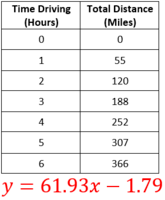
The linear regression equation is y = 61.93x - 1.79. Use the equation to predict how far this person will travel after 10 hours of driving.
Tags
CCSS.HSF.LE.B.5
3.
MULTIPLE CHOICE QUESTION
1 min • 1 pt

A restaurant sells pizza for the prices in the data table. Calculate the linear regression equation of the data.
Tags
CCSS.8.EE.C.8C
4.
MULTIPLE CHOICE QUESTION
1 min • 1 pt

The linear regression equation for the data is y = 1.5x + 12. Use the equation to predict the cost of a pizza that has 8 toppings.
$8
$12
$24
$28
Tags
CCSS.8.EE.C.8C
5.
MULTIPLE CHOICE QUESTION
5 mins • 1 pt
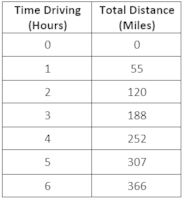
A person travels by car. They record their miles driven in a data table. Calculate the linear regression equation of this data.
Tags
CCSS.HSA.CED.A.2
CCSS.HSS.ID.B.6
CCSS.HSS.ID.C.7
6.
MULTIPLE CHOICE QUESTION
1 min • 1 pt

Determine the predicted income if 22 hours were worked on an assembly job.
Tags
CCSS.HSF.LE.B.5
7.
MULTIPLE CHOICE QUESTION
1 min • 1 pt
A correlation value (r) that has a strong, positive linear association would have a value close to
1
0
-1
Cannot be answered
Tags
CCSS.HSS.ID.C.8


Access all questions and much more by creating a free account
Create resources
Host any resource
Get auto-graded reports

Continue with Google

Continue with Email

Continue with Classlink

Continue with Clever
or continue with

Microsoft
%20(1).png)
Apple

Others
Already have an account?

