
Water, Carbon, & Nitrogen Cycles
Authored by Jenna Rubino
Biology
11th Grade
Used 4+ times


AI Actions
Add similar questions
Adjust reading levels
Convert to real-world scenario
Translate activity
More...
Content View
Student View
30 questions
Show all answers
1.
DROPDOWN QUESTION
30 sec • 1 pt
Snow and hail are examples of (a)
Precipitation
Evaporation
Condensation
Answer explanation
Snow and hail are examples of precipitation. Precipitation occurs when water droplets or ice crystals in the atmosphere combine and become heavy enough to fall to the ground. This includes rain, snow, sleet, and hail. Evaporation and condensation are related processes, but they do not describe the falling of snow and hail.
2.
DROPDOWN QUESTION
30 sec • 1 pt
When water evaporates, it changes from a liquid to a (a)
gas
solid
Answer explanation
When water evaporates, it undergoes a phase change from a liquid to a gas. This process occurs when water molecules gain enough energy to break free from the liquid state and become water vapor. Therefore, the correct answer is 'gas'.
3.
MULTIPLE CHOICE QUESTION
30 sec • 1 pt
The process of water that is added to the atmosphere from plants is called
Condensation
Evaporation
Precipitation
Transpiration
Answer explanation
Transpiration is the correct answer because it refers to the process by which water is released into the atmosphere from plants, mainly through their leaves. This process is essential for plants as it helps in cooling, nutrient uptake, and maintaining turgor pressure. Condensation, evaporation, and precipitation are related to the water cycle but do not specifically involve water release from plants.
4.
MATCH QUESTION
30 sec • 1 pt

D
Condensation
C
Precipitation
A
Transpiration
B
Evaporation
5.
MULTIPLE CHOICE QUESTION
1 min • 1 pt
When water is heated in the ocean by the sun and turns into water vapor
condensation
evaporation
transpiration
runoff
Answer explanation
The process described in the question is evaporation. When the sun heats water in the ocean, the water molecules gain energy and turn into water vapor, rising into the atmosphere. This is different from condensation, transpiration, and runoff, which involve different aspects of the water cycle.
6.
MULTIPLE CHOICE QUESTION
5 mins • 1 pt
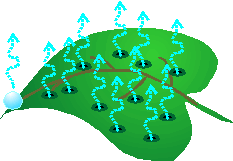
What is it called when plants give off water vapor as a waste product?
condensation
evaporation
sublimation
transpiration
Answer explanation
Transpiration is the process by which plants release water vapor as a waste product. It occurs mainly through the stomata, small openings on the leaves' surface. This process helps in cooling the plant and maintaining water balance. Unlike condensation, evaporation, and sublimation, transpiration specifically refers to the release of water vapor by plants.
7.
MULTIPLE CHOICE QUESTION
20 sec • 1 pt

What is the role of the sun in the water cycle?
provide heat energy for evaporation
provide heat energy for condensation
dry out the soil for runoff to occur
provide thermal energy for accumulation
Answer explanation
The sun plays a crucial role in the water cycle by providing heat energy for evaporation. This heat energy causes water to change from a liquid state to a gaseous state, forming water vapor. This process is a key component of the water cycle, as it allows water to be transferred from the Earth's surface to the atmosphere, eventually leading to condensation and precipitation.


Access all questions and much more by creating a free account
Create resources
Host any resource
Get auto-graded reports

Continue with Google

Continue with Email

Continue with Classlink

Continue with Clever
or continue with

Microsoft
%20(1).png)
Apple

Others
Already have an account?

