
Illustrative Mathematics - Geometry - Mathematics - Unit 1 - Lesson 21
Authored by Wayground Content
Algebra I, Algebra II, Geometry, Math
G covered


AI Actions
Add similar questions
Adjust reading levels
Convert to real-world scenario
Translate activity
More...
Content View
Student View
8 questions
Show all answers
1.
OPEN ENDED QUESTION
3 mins • 1 pt

The triangles here are each obtained by applying rigid motions to triangle 1. Which triangles are translations of triangle 1? Explain how you know.Which triangles are not translations of triangle 1? Explain how you know.
Evaluate responses using AI:
OFF
Tags
G.CO.1
G.CO.9
2.
OPEN ENDED QUESTION
3 mins • 1 pt

The quadrilateral is a parallelogram. Find the measure of angles 1, 2, and 3.
Evaluate responses using AI:
OFF
Tags
G.CO.1
G.CO.9
3.
OPEN ENDED QUESTION
3 mins • 1 pt

Angle BDE is congruent to angle BAC. Name another pair of congruent angles. Explain how you know.
Evaluate responses using AI:
OFF
Tags
G.CO.1
G.CO.9
4.
OPEN ENDED QUESTION
3 mins • 1 pt
Describe a transformation that could be used to show that corresponding angles are congruent.Describe a transformation that could be used to show that alternate interior angles are congruent.
Evaluate responses using AI:
OFF
Tags
G.CO.1
G.CO.9
5.
MULTIPLE SELECT QUESTION
45 sec • 1 pt

Lines AD and EC meet at point B.Which of these must be true? Select all that apply.
Tags
G.CO.1
G.CO.9
6.
OPEN ENDED QUESTION
3 mins • 1 pt
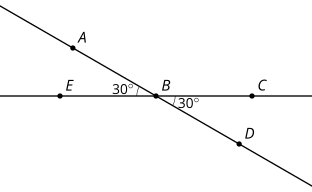
Points E, B, and C are collinear. Explain why points A, B, and D are collinear.
Evaluate responses using AI:
OFF
Tags
G.CO.1
G.CO.9
7.
OPEN ENDED QUESTION
3 mins • 1 pt

Draw the image of figure ACTS after a clockwise rotation around point C using angle CTS and then a translation by the directed line segment CT.Describe another sequence of transformations that will result in the same image.
Evaluate responses using AI:
OFF
Tags
G.CO.1
G.CO.9

Access all questions and much more by creating a free account
Create resources
Host any resource
Get auto-graded reports

Continue with Google

Continue with Email

Continue with Classlink

Continue with Clever
or continue with

Microsoft
%20(1).png)
Apple

Others
Already have an account?


