
1st Nine Weeks Biology Benchmark Review
Authored by Alicia Norris
Science
10th Grade
NGSS covered
Used 18+ times


AI Actions
Add similar questions
Adjust reading levels
Convert to real-world scenario
Translate activity
More...
Content View
Student View
25 questions
Show all answers
1.
MULTIPLE CHOICE QUESTION
5 mins • 1 pt
Scientific researchers discovered agents that behaved like bacteria causing diseases such as rabies and hoof-and-mouth, but were much smaller. It became the general view that viruses were biologically "alive." This perception changed in 1935 when the tobacco mosaic virus was crystallized and scientists demonstrated that the particles lacked any mechanisms necessary for metabolic function. It was determined that viruses consisted of a nucleic acid, DNA or RNA, surrounded by a protein shell. Viruses exist in two distinct states. When not in contact with a host cell, the virus remains entirely dormant. During this time there are no biological activities occurring and the virus is nothing more than a static organic particle. Viruses can remain like this for extended periods of time, waiting to come into contact with the appropriate host. When the virus comes into contact with a host, it becomes active, reacts to its environment and/or host and directs its efforts toward self-replication. The viral goal now is to produce more viruses to attack host cells. The characteristics of life: many are listed in the passage describing viruses. One important piece of evidence arguing against life for viruses is implied by the passage; not stated directly. Viruses are not living, because, as implied by the passage, they
have no DNA.
lack a nucleus.
are not cellular.
do not reproduce.
2.
MULTIPLE CHOICE QUESTION
2 mins • 1 pt
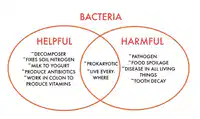
The Venn diagram details some of the helpful and harmful effects of bacteria. In what ways are viruses like bacteria?
Viruses are also pathogenic.
Viruses are also decomposers.
Viruses are also prokaryotes.
Viruses can also cause food to spoil.
Tags
NGSS.MS-LS4-4
3.
MULTIPLE CHOICE QUESTION
2 mins • 1 pt
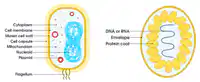
Based on the information seen in the image above, what is a major difference between viruses and bacteria?
A) Bacteria can reproduce but viruses cannot.
B) Bacteria contain DNA and viruses contain RNA.
C) All bacteria are pathogenic, but only some viruses are pathogenic.
D) Viruses are surrounded by a protein coat; bacteria are surrounded by a cell wall.
4.
MULTIPLE CHOICE QUESTION
2 mins • 1 pt
Cell theory states: all living things are composed of one or more cells; a cell is the smallest unit that still retains the properties of life; and new cells only come from cells that already exist. Based on cell theory, which of these answer choices would describe one reason a virus is considered nonliving?
A) A virus does not have a nucleus.
B) A virus does not contain genetic material.
C) A virus is too small to be considered a cell.
D) A virus cannot reproduce itself without a host cell.
5.
MULTIPLE CHOICE QUESTION
2 mins • 1 pt
Which feature is not used to classify a virus?
A) size
B) genetic material
C) shape of the capsid
D) shape of its nucleus
6.
MULTIPLE CHOICE QUESTION
2 mins • 1 pt
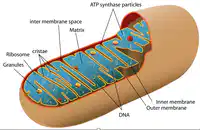
Here is an image of the mitochondria. Mitochondria numbers can differ between cell types based on the function of the cell. Which of these cells would contain the highest number of mitochondria?
A) skin cell
B) lung cell
C) muscle cell
D) red blood cell
Tags
NGSS.MS-LS1-2
NGSS.MS-LS1-7
7.
MULTIPLE CHOICE QUESTION
5 mins • 1 pt
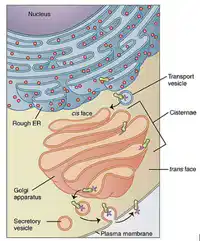
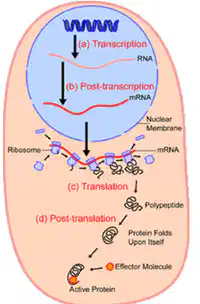
A researcher incubates a cell with radiolabeled amino acids. These amino acids are incorporated into the proteins as they are synthesized by the cell. Select which piece of data would indicate the incorporation of radiolabeled amino acids during protein synthesis?
A) Radioactivity levels would increase first at the nucleus, followed by the Golgi, and then the cell membrane.
B) Radioactivity levels would increase first at the nucleus, followed by the ribosomes, and then the secretory vesicles.
C) Radioactivity levels would increase first at the rough endoplasmic reticulum, followed by the Golgi, and then the secretory vesicles.
D) Radioactivity levels would increase first at the rough endoplasmic reticulum, followed by the nucleus, and then the secretory vesicles.
Access all questions and much more by creating a free account
Create resources
Host any resource
Get auto-graded reports

Continue with Google

Continue with Email

Continue with Classlink

Continue with Clever
or continue with

Microsoft
%20(1).png)
Apple

Others
Already have an account?


