
4.7 Smedes Solar Radiation & Seasons
Authored by Teneal Metcalf
Science
9th - 12th Grade
NGSS covered
Used 2+ times


AI Actions
Add similar questions
Adjust reading levels
Convert to real-world scenario
Translate activity
More...
Content View
Student View
10 questions
Show all answers
1.
MULTIPLE CHOICE QUESTION
30 sec • Ungraded
Make sure you completed #037.1 and are at least done with qs 1-3 of #037.2 before starting.
Practice building on your knowledge, write what you currently know before moving forward; then watch without pauses. If you absolutely must pause, restrict your pauses to every couple of minutes, i.e. at chapters. The video has been divided into chapters for you with notes.
Braindump at the end, then rewatch, revise your notes (the second viewing, you can use pauses.)
Fiiiiine. I'm bitter about it, but I'll follow the guidance from #000.13.
I'll take notes by pausing as I've done for all my classes: it's given me the results I want on diagnostics and full AP exams. I reject #000.13 and all it stands for.
I've been following the guidance from #000.13 comfortably and will continue to do so.
Okay, I'm no longer bitter about the guidance from #000.13.
I have been taking notes in the style suggested by #000.13 and will continue to do so.
2.
MATCH QUESTION
1 min • 1 pt
Throughout the closed captioning, there are some consistent errors in automatic transcription. Check your writing, this spelling matters.
insulation
causing or intending to cause offense
insulting
amount of solar radiation received
insolation
material or construction that leads to higher energy retention
3.
MULTIPLE SELECT QUESTION
45 sec • 1 pt
Compare your pre-writing to the standards shown on this page. Mark all items you included clearly. The phrasing does not have to be the same, but the idea communicated should be nearly the same. Essentially- would your writing help a student identify these phrases as 'true'?
You are discouraged from making additions or alterations to your writing here: I would prefer you watch the rest of the video as an uninterrupted lecture, and then reference the report at the end for corrections. That will leave you with a more complete understanding.
You probably didn't include all of these ideas, and that's absolutely fine. This question's accuracy will not count against you; it just gives you a sort of checklist for later.
more radiation at equator, less radiation at poles
angle of sun's rays determines intensity of radiation
latitude directly 'horizontal' to radiation receives highest radiation
Answer explanation
Remember, you're discouraged from writing thorough notes at this point. If you made a minor vocab error and want to strike it out and replace it, sure.
If you skipped pre-writing, your answers should all be in the 'not addressed' category, because you didn't write. :(
Remember: These points will not count against you. Thank you for your honesty in self-assessing.
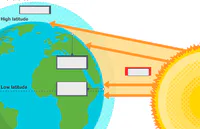
When you review this activity, not during the first lecture, this drawing from #037.1 describes these concepts, and you're encouraged to draw it and label it in your notebook.
* insolation depends on season (not addressed until the Formative) and latitude
* latitude directly 'horizontal' to radiation receives highest radiation (where the arrows are short)
* angle of sun's rays determines intensity of radiation (compare the lines to the pole vs the lines to the equator in the image)
4.
MULTIPLE SELECT QUESTION
45 sec • 1 pt
Compare your pre-writing to the standards shown on this page. Mark all items you included clearly. The phrasing does not have to be the same, but the idea communicated should be nearly the same. Essentially- would your writing help a student identify these phrases as 'true'?
You are discouraged from making additions or alterations to your writing here: I would prefer you watch the rest of the video as an uninterrupted lecture, and then reference the report at the end for corrections. That will leave you with a more complete understanding.
You probably didn't include all of these ideas, and that's absolutely fine. This question's accuracy will not count against you; it just gives you a sort of checklist for later.
insolation depends on season and latitude
tilt of axis results in seasons and variable day length
solar radiation varies seasonally; the longer the day, the more radiation
Answer explanation
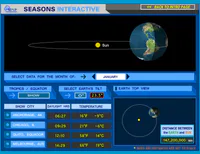
These ideas came more from the Formative #037.2 and you should have written about them carefully during q. 3.
Double-check that you ended up with green marked for your writing by the end.
If you did not write these ideas, you are encouraged to replay the simulator- either now, before you watch the video, or during review of this video (after you watch it as an uninterrupted lecture).
https://lawrencehallofscience.org/apps/sepup/simulations/seasons/
Tags
NGSS.MS-ESS1-1
5.
MULTIPLE CHOICE QUESTION
30 sec • Ungraded
If you're feeling overwhelmed and want to do less lecture at a time, this is an acceptable break to revise pre-write or take additional notes.
You should still write from recall, not record notes verbatim from the lecture. Don't incorporate what's on the screen right NOW- write about what was on the screen for the last 3 or so minutes.
I want to stop and process. I'll write from recall or edit my pre-write or doodle what I remember seeing.
Going to keep watching and write from recall/edit etc later.
Answer explanation
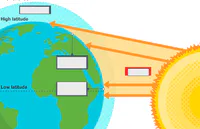
These ideas were explored heavily in #037.1, so if you want to reinforce them, do the Waygrounds lesson for Insolation & Atmosphere again (later, not now! Use the feedback/report to remind you to come back here.)
For simplicity's sake, I condensed both diagrams down into the shown diagram, and you are strongly encouraged to draw that diagram and then label it accordingly, rather than to try to write from the slide exactly.
6.
MULTIPLE CHOICE QUESTION
30 sec • Ungraded
If you're feeling overwhelmed and want to do less lecture at a time, this is an acceptable break to revise pre-write or take additional notes.
You should still write from recall, not record notes verbatim from the lecture. Don't incorporate what's on the screen right NOW- write about what was on the screen for the last 3 or so minutes.
I want to stop and process. I'll write from recall or edit my pre-write or doodle what I remember seeing.
Going to keep watching and write from recall/edit etc later.
Answer explanation
These ideas come from #037.2, so if it was a challenge, feel free to replay the simulation at https://lawrencehallofscience.org/apps/sepup/simulations/seasons/
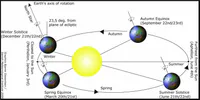
You need to know the differences between solstices and equinoxes, so drawing and labeling those concepts would be a great idea- but again, you're encouraged to do the close-review of this video later, after you've watched it with minimal interruption.
7.
MULTIPLE CHOICE QUESTION
30 sec • Ungraded
If you're feeling overwhelmed and want to do less lecture at a time, this is an acceptable break to revise pre-write or take additional notes.
You should still write from recall, not record notes verbatim from the lecture. Don't incorporate what's on the screen right NOW- write about what was on the screen since the last poll opportunity.
I want to stop and process. I'll write from recall or edit my pre-write or doodle what I remember seeing.
Going to keep watching and write from recall/edit etc later.
Answer explanation
You're best off if your notes here include the diagram and labeling.
This concept was new from the video and was not previously addressed in activities #037.1 or #037.2, so make sure you interact with it as needed.
Access all questions and much more by creating a free account
Create resources
Host any resource
Get auto-graded reports

Continue with Google

Continue with Email

Continue with Microsoft
or continue with

%20(1).png)
Apple

Others
By signing up, you agree to our Terms of Service & Privacy Policy
Already have an account?


