
Ocean Currents and Air Masses
Authored by Marci Wilson
Science
8th Grade
NGSS covered
Used 1+ times


AI Actions
Add similar questions
Adjust reading levels
Convert to real-world scenario
Translate activity
More...
Content View
Student View
8 questions
Show all answers
1.
MULTIPLE CHOICE QUESTION
30 sec • 1 pt
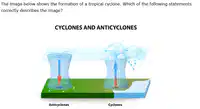
Which of the following statements correctly describes the image?
Cool air rises over warm ocean water.
Warm air rises over warm ocean water.
The ocean currents push the warm air along the surface of the water.
A storm forms over cool ocean currents
Tags
NGSS.MS-ESS2-6
NGSS.MS-ESS2-5
2.
MULTIPLE CHOICE QUESTION
30 sec • 1 pt
Which conditions produce a hurricane?
Which conditions produce a hurricane?
Cool, dry air rises over warm water.
Warm, moist air rises over cool water.
Warm, moist air rises over warm water.
Cool, dry air rises over cool water.
Tags
NGSS.MS-ESS2-6
NGSS.MS-ESS2-5
3.
MULTIPLE CHOICE QUESTION
30 sec • 1 pt
Which of the following correctly describes how a tropical cyclone is formed?
Tropical cyclones are formed when warm water evaporates from the surface of the ocean, rises quickly, and creates an area of low pressure.
Tropical cyclones are formed when cold water evaporates from the surface of the ocean, rises quickly, and creates an area of low pressure.
Tropical cyclones are formed when cold water evaporates from the surface of the ocean, rises slowly, and creates an area of high pressure.
Tropical cyclones are formed when warm water evaporates from the surface of the ocean, rises slowly, and creates an area of low pressure.
Tags
NGSS.MS-ESS2-6
4.
MULTIPLE CHOICE QUESTION
30 sec • 1 pt
What is the difference between a hurricane and a typhoon?
Typhoons are large waves that can cause flooding. Hurricanes are like tornadoes on water.
Hurricanes are typically warm, wet storms with a lot of rain. Typhoons are cold and dry storms with a lot of wind and little rain.
Both form when warm water evaporates, rises quickly, and creates an area of low pressure. The names are different based on location.
Typhoons form when warm air meets cold water, and hurricanes form when warm air meets warm water.
Tags
NGSS.MS-ESS2-6
NGSS.MS-ESS2-5
NGSS.MS-ESS3-2
5.
MULTIPLE CHOICE QUESTION
30 sec • 1 pt
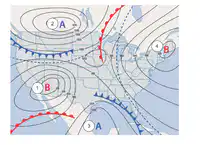
A student created a poster that represents the predicted weather across the United States. At which location is a tropical cyclone most likely to form?
A student created a poster that represents the predicted weather across the United States. At which location is a tropical cyclone most likely to form?
1
2
3
4
Tags
NGSS.MS-ESS2-6
NGSS.MS-ESS2-5
6.
MULTIPLE SELECT QUESTION
45 sec • 1 pt
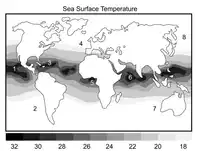
The map provided displays ocean surface temperatures on Earth. In what areas will tropical cyclones, hurricanes, and typhoons most likely form? Pick 4 areas
The map provided displays ocean surface temperatures on Earth. In what areas will tropical cyclones, hurricanes, and typhoons most likely form? Pick 4 areas
1
2
3
5
6
Tags
NGSS.MS-ESS2-6
NGSS.MS-ESS2-5
7.
MULTIPLE CHOICE QUESTION
30 sec • 1 pt
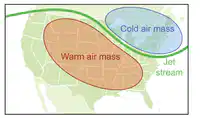
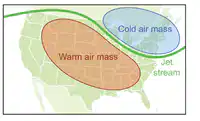
Which weather patterns are most likely in the southern part of the US due to the conditions in the map?
Dry, cool winds will bring in warmer temperatures.
Heavy rain and strong winds will bring in cooler temperatures
Snow is likely to form in the southern part of the US
Hurricanes are more likely to form in the gulf between Texas and Florida
Tags
NGSS.MS-ESS2-6
NGSS.MS-ESS2-5
Access all questions and much more by creating a free account
Create resources
Host any resource
Get auto-graded reports

Continue with Google

Continue with Email

Continue with Classlink

Continue with Clever
or continue with

Microsoft
%20(1).png)
Apple

Others
Already have an account?


