
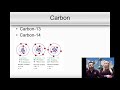
Exploring Isotopes and Average Atomic Mass

Interactive Video
•
Science
•
6th - 10th Grade
•
Practice Problem
•
Easy
Standards-aligned

Emma Peterson
Used 24+ times
FREE Resource
Standards-aligned
10 questions
Show all answers
1.
MULTIPLE CHOICE QUESTION
30 sec • 1 pt
What makes an atom neutral?
Equal number of protons and neutrons
Equal number of protons and electrons
More protons than electrons
More electrons than protons
2.
MULTIPLE CHOICE QUESTION
30 sec • 1 pt
What are the negatively charged particles in an atom called?
Ions
Protons
Electrons
Neutrons
3.
MULTIPLE CHOICE QUESTION
30 sec • 1 pt
How does an atom become a positively charged ion?
By losing electrons
By losing protons
By gaining protons
By gaining electrons
4.
MULTIPLE CHOICE QUESTION
30 sec • 1 pt
What happens to the element if the number of protons in an atom changes?
It remains the same element
It becomes an isotope
It becomes a different element
It becomes an ion
5.
MULTIPLE CHOICE QUESTION
30 sec • 1 pt
What defines an isotope of an element?
Different number of ions
Different number of neutrons
Different number of electrons
Different number of protons
6.
MULTIPLE CHOICE QUESTION
30 sec • 1 pt
Which of the following is an example of an isotope?
Hydrogen-1 and Hydrogen-2
Oxygen-16 and Oxygen-18
All of the above
Carbon-12 and Carbon-13
7.
MULTIPLE CHOICE QUESTION
30 sec • 1 pt
What does the number after an element's name (e.g., Carbon-14) represent?
Atomic number
Number of protons
Number of electrons
Mass number
Tags
NGSS.HS-PS1-8
Access all questions and much more by creating a free account
Create resources
Host any resource
Get auto-graded reports

Continue with Google

Continue with Email

Continue with Microsoft
or continue with

%20(1).png)
Apple

Others
By signing up, you agree to our Terms of Service & Privacy Policy
Already have an account?

