
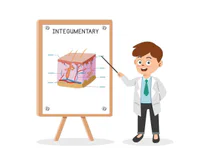
Exploring the Integumentary System: Skin, Hair, and Nails

Interactive Video
•
Physical Ed
•
8th Grade
•
Practice Problem
•
Easy

Sophia Harris
Used 1+ times
FREE Resource
Read more
10 questions
Show all answers
1.
MULTIPLE CHOICE QUESTION
30 sec • 1 pt
What are the three major components of the integumentary system?
Heart, brain, and lungs
Kidneys, liver, and pancreas
Skin, hair, and nails
Bones, muscles, and nerves
2.
MULTIPLE CHOICE QUESTION
30 sec • 1 pt
Which layer of the skin is responsible for new cell formation?
Stratum germinativum
Stratum corneum
Dermis
Hypodermis
3.
MULTIPLE CHOICE QUESTION
30 sec • 1 pt
What is the main function of the dermis layer?
Temperature regulation and sensation
Producing hair
Protecting against UV radiation
Storing fat
4.
MULTIPLE CHOICE QUESTION
30 sec • 1 pt
How does the body regulate temperature through the skin?
Through hair growth
By changing skin color
By dilating or constricting blood vessels
By absorbing sunlight
5.
MULTIPLE CHOICE QUESTION
30 sec • 1 pt
What causes goosebumps?
Pores constricting
Pores dilating
Hair growth
Sweat evaporation
6.
MULTIPLE CHOICE QUESTION
30 sec • 1 pt
What is the function of sweat glands?
To cool the body
To produce oil
To sense temperature
To grow hair
7.
MULTIPLE CHOICE QUESTION
30 sec • 1 pt
What is the role of sebaceous glands?
To detect pressure
To absorb nutrients
To produce sebum
To produce sweat
Access all questions and much more by creating a free account
Create resources
Host any resource
Get auto-graded reports

Continue with Google

Continue with Email

Continue with Microsoft
or continue with

%20(1).png)
Apple

Others
Already have an account?

