
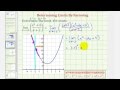
Understanding Limits through Factoring

Interactive Video
•
Mathematics
•
9th - 12th Grade
•
Practice Problem
•
Medium
Standards-aligned

Emma Peterson
Used 3+ times
FREE Resource
Standards-aligned
Read more
10 questions
Show all answers
1.
MULTIPLE CHOICE QUESTION
30 sec • 1 pt
Why is factoring important when determining limits of rational functions?
It changes the function to a polynomial.
It makes the function continuous everywhere.
It eliminates all discontinuities.
It helps in simplifying the function for direct substitution.
Tags
CCSS.HSA.APR.D.6
2.
MULTIPLE CHOICE QUESTION
30 sec • 1 pt
What is the issue with performing direct substitution for the limit as x approaches 2 in the first example?
The function is continuous at x = 2.
The denominator becomes zero.
The numerator becomes zero.
The function is undefined for all x.
Tags
CCSS.HSA.APR.D.6
3.
MULTIPLE CHOICE QUESTION
30 sec • 1 pt
What is the simplified form of the function in the first example after factoring?
(x + 1) / (x + 3)
(x - 2) / (x - 3)
(x + 2) / (x + 4)
(x - 1) / (x - 3)
Tags
CCSS.HSA.APR.D.6
4.
MULTIPLE CHOICE QUESTION
30 sec • 1 pt
What is the limit of the function as x approaches 2 in the first example?
5/3
2/3
3/5
1/2
Tags
CCSS.HSF-IF.C.7D
5.
MULTIPLE CHOICE QUESTION
30 sec • 1 pt
In the second example, what is the graphical behavior of the function at x = -2?
The function is continuous.
The function has a hole.
The function has a vertical asymptote.
The function is undefined everywhere.
Tags
CCSS.HSA.APR.D.6
6.
MULTIPLE CHOICE QUESTION
30 sec • 1 pt
What is the algebraic form of the numerator in the second example after factoring?
x^2 - 4x + 4
x^2 - 2x + 4
x^2 + 2x + 4
x^2 + 4x + 4
Tags
CCSS.HSF-IF.C.7D
7.
MULTIPLE CHOICE QUESTION
30 sec • 1 pt
What is the limit of the function as x approaches -2 in the second example?
14
12
10
8
Tags
CCSS.HSA.APR.D.6
Access all questions and much more by creating a free account
Create resources
Host any resource
Get auto-graded reports

Continue with Google

Continue with Email

Continue with Microsoft
or continue with

%20(1).png)
Apple

Others
By signing up, you agree to our Terms of Service & Privacy Policy
Already have an account?

