
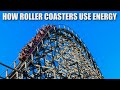
The Physics of Roller Coasters Energy Transformation and Motion

Interactive Video
•
Physics, Science, Other
•
8th Grade
•
Practice Problem
•
Medium

Patricia Brown
Used 3+ times
FREE Resource
Read more
10 questions
Show all answers
1.
MULTIPLE CHOICE QUESTION
30 sec • 1 pt
What type of energy is stored when a roller coaster climbs to the top of a hill?
Kinetic energy
Potential energy
Mechanical energy
Thermal energy
2.
MULTIPLE CHOICE QUESTION
30 sec • 1 pt
As a roller coaster descends a hill, what happens to its potential energy?
It is converted into kinetic energy
It remains constant
It is lost as heat
It increases
3.
MULTIPLE CHOICE QUESTION
30 sec • 1 pt
What role does friction play in a roller coaster ride?
It increases potential energy
It speeds up the ride
It has no effect
It slows down the ride
4.
MULTIPLE CHOICE QUESTION
30 sec • 1 pt
What happens to the kinetic energy of a roller coaster as it climbs a hill?
It is converted into potential energy
It remains constant
It increases
It is lost as sound
5.
MULTIPLE CHOICE QUESTION
30 sec • 1 pt
How do magnetic brakes help in stopping a roller coaster?
They use air resistance to stop the train
They convert kinetic energy into potential energy
They create a magnetic field that slows the train
They increase the speed
6.
MULTIPLE CHOICE QUESTION
30 sec • 1 pt
What is unique about King Naka compared to traditional roller coasters?
It uses a lift hill
It relies on mechanical energy for its launch
It has no brakes
It is slower than traditional coasters
7.
MULTIPLE CHOICE QUESTION
30 sec • 1 pt
What happens during a 'rollback' on King Naka?
The train doesn't make it over the hill and rolls back
The train speeds up
The train stops completely
The train gains more potential energy
Access all questions and much more by creating a free account
Create resources
Host any resource
Get auto-graded reports

Continue with Google

Continue with Email

Continue with Classlink

Continue with Clever
or continue with

Microsoft
%20(1).png)
Apple

Others
Already have an account?

