
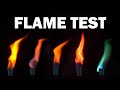
Colorful Reactions: The Science Behind Flame Tests and Metal Emissions

Interactive Video
•
Physics, Chemistry, Science
•
9th - 10th Grade
•
Practice Problem
•
Hard

Patricia Brown
FREE Resource
Read more
10 questions
Show all answers
1.
MULTIPLE CHOICE QUESTION
30 sec • 1 pt
What is the primary reason different metals produce different colors when burned?
The number of electrons and their energy levels
The characteristic color of the metal
The number of protons in the nucleus
The size of the metal atoms
2.
MULTIPLE CHOICE QUESTION
30 sec • 1 pt
What happens to electrons when they are excited by heat?
They jump to a higher energy state
They move closer to the nucleus
They lose energy and fall to a lower state
They change into protons
3.
MULTIPLE CHOICE QUESTION
30 sec • 1 pt
Which color is typically associated with low-frequency light emissions?
Purple
Green
Blue
Red
4.
MULTIPLE CHOICE QUESTION
30 sec • 1 pt
What color does magnesium produce when burned?
Orange-yellow
Bright white
Deep red
Pale purple
5.
MULTIPLE CHOICE QUESTION
30 sec • 1 pt
Sodium chloride in a flame test produces which color?
Orange-yellow
Green
Blue
Lilac
6.
MULTIPLE CHOICE QUESTION
30 sec • 1 pt
What is the color produced by potassium chloride in a flame test?
Pale purple
Bright white
Deep red
Orange-yellow
7.
MULTIPLE CHOICE QUESTION
30 sec • 1 pt
Which metal is known for producing a deep red color in fireworks?
Barium
Copper
Strontium
Magnesium
Access all questions and much more by creating a free account
Create resources
Host any resource
Get auto-graded reports

Continue with Google

Continue with Email

Continue with Microsoft
or continue with

%20(1).png)
Apple

Others
Already have an account?


