
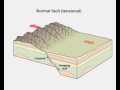
Fault Types and Movements

Interactive Video
•
Science, Geography, Other
•
9th - 10th Grade
•
Practice Problem
•
Hard

Patricia Brown
FREE Resource
Read more
10 questions
Show all answers
1.
MULTIPLE CHOICE QUESTION
30 sec • 1 pt
What is the primary movement direction in a normal fault?
Diagonal
Vertical
Circular
Horizontal
2.
MULTIPLE CHOICE QUESTION
30 sec • 1 pt
Which type of stress leads to the formation of a normal fault?
Compressional stress
Rotational stress
Tensional stress
Shear stress
3.
MULTIPLE CHOICE QUESTION
30 sec • 1 pt
Which type of fault is associated with the formation of tilted fault block mountains?
Normal fault
Reverse fault
Strike-slip fault
Thrust fault
4.
MULTIPLE CHOICE QUESTION
30 sec • 1 pt
What is the term for the down-dropped basins formed by normal faulting?
Rift
Horst
Graben
Scarp
5.
MULTIPLE CHOICE QUESTION
30 sec • 1 pt
What is a key characteristic of a reverse fault?
The fault does not move
The upthrown block overrides the downthrown block
The fault plane is horizontal
The fault plane is vertical
6.
MULTIPLE CHOICE QUESTION
30 sec • 1 pt
What type of stress causes a reverse fault to form?
Compressional stress
Shear stress
Thermal stress
Tensional stress
7.
MULTIPLE CHOICE QUESTION
30 sec • 1 pt
In a strike-slip fault, how do the blocks move relative to each other?
Horizontally
In a circular motion
Diagonally
Vertically
Access all questions and much more by creating a free account
Create resources
Host any resource
Get auto-graded reports

Continue with Google

Continue with Email

Continue with Classlink

Continue with Clever
or continue with

Microsoft
%20(1).png)
Apple

Others
Already have an account?

