
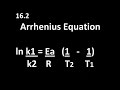
Chemical Reaction Rates and Constants

Interactive Video
•
Chemistry, Physics, Science
•
11th - 12th Grade
•
Practice Problem
•
Hard

Patricia Brown
FREE Resource
Read more
10 questions
Show all answers
1.
MULTIPLE CHOICE QUESTION
30 sec • 1 pt
What happens to the rate of reaction if the concentration of a reactant is doubled in a second-order reaction?
The rate doubles.
The rate quadruples.
The rate halves.
The rate remains the same.
2.
MULTIPLE CHOICE QUESTION
30 sec • 1 pt
Which factor does NOT change the rate constant in a chemical reaction?
Temperature
Catalyst
Concentration of reactants
Pressure
3.
MULTIPLE CHOICE QUESTION
30 sec • 1 pt
How does increasing temperature affect the number of molecules with enough energy to react?
It increases the number of molecules.
It has no effect on the number of molecules.
It decreases the number of molecules.
It decreases the energy of the molecules.
4.
MULTIPLE CHOICE QUESTION
30 sec • 1 pt
In a first-order reaction, what must be done to double the rate if the concentration of reactants remains unchanged?
Double the rate constant.
Double the volume.
Double the temperature.
Double the pressure.
5.
MULTIPLE CHOICE QUESTION
30 sec • 1 pt
What is the initial rate constant (K1) in the example problem discussed?
0.1
0.01
10.0
1.0
6.
MULTIPLE CHOICE QUESTION
30 sec • 1 pt
What is the final temperature (T2) calculated in the example problem for doubling the reaction rate?
300 Kelvin
320 Kelvin
311 Kelvin
310 Kelvin
7.
MULTIPLE CHOICE QUESTION
30 sec • 1 pt
In the second example problem, what is expected of the new rate constant at a higher temperature?
It should be lower than 0.5.
It should be higher than 0.5.
It should remain the same.
It should be zero.
Access all questions and much more by creating a free account
Create resources
Host any resource
Get auto-graded reports

Continue with Google

Continue with Email

Continue with Classlink

Continue with Clever
or continue with

Microsoft
%20(1).png)
Apple

Others
Already have an account?

