
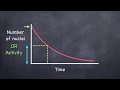
Radioactive Decay and Half-Life Concepts

Interactive Video
•
Physics
•
9th - 10th Grade
•
Practice Problem
•
Hard

Patricia Brown
FREE Resource
Read more
10 questions
Show all answers
1.
MULTIPLE CHOICE QUESTION
30 sec • 1 pt
What is a radioisotope?
An unstable atom
A form of electromagnetic radiation
A stable atom
A type of chemical bond
2.
MULTIPLE CHOICE QUESTION
30 sec • 1 pt
What is the process called when a parent radioisotope transforms into a daughter isotope?
Thermal expansion
Chemical reaction
Nuclear fusion
Radioactive decay
3.
MULTIPLE CHOICE QUESTION
30 sec • 1 pt
Which of the following best describes radioactive decay?
A random and spontaneous process
A predictable process
A reversible process
A process influenced by temperature
4.
MULTIPLE CHOICE QUESTION
30 sec • 1 pt
What is the half-life of uranium-235?
3.4 milliseconds
1,000 years
704 million years
432 years
5.
MULTIPLE CHOICE QUESTION
30 sec • 1 pt
After two half-lives, what fraction of the original radioactive atoms remains?
One eighth
One third
One quarter
One half
6.
MULTIPLE CHOICE QUESTION
30 sec • 1 pt
If you start with 100,000 atoms of americium-241, how many will remain after 1,296 years?
50,000
12,500
25,000
6,250
7.
MULTIPLE CHOICE QUESTION
30 sec • 1 pt
What is the half-life of americium-241?
1,296 years
3.4 milliseconds
704 million years
432 years
Access all questions and much more by creating a free account
Create resources
Host any resource
Get auto-graded reports

Continue with Google

Continue with Email

Continue with Classlink

Continue with Clever
or continue with

Microsoft
%20(1).png)
Apple

Others
Already have an account?

