
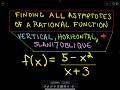
Understanding Asymptotes and Remainders

Interactive Video
•
Mathematics
•
9th - 10th Grade
•
Practice Problem
•
Hard

Thomas White
FREE Resource
Read more
27 questions
Show all answers
1.
MULTIPLE CHOICE QUESTION
30 sec • 1 pt
What is the primary focus of the video tutorial?
Finding the roots of a polynomial
Understanding asymptotes in rational functions
Solving linear equations
Graphing quadratic functions
2.
MULTIPLE CHOICE QUESTION
30 sec • 1 pt
What is the first step in identifying vertical asymptotes?
Performing long division
Checking the degree of the numerator
Factoring the rational function
Setting the numerator equal to zero
3.
MULTIPLE CHOICE QUESTION
30 sec • 1 pt
What do you do if there are no common factors in the rational function?
Set the numerator equal to zero
Set the denominator equal to zero
Add one to the degree of the numerator
Perform polynomial division
4.
MULTIPLE CHOICE QUESTION
30 sec • 1 pt
How many vertical asymptotes does the function in the video have?
Two
One
Three
None
5.
MULTIPLE CHOICE QUESTION
30 sec • 1 pt
What is the purpose of factoring the rational function?
To determine the degree of the numerator
To find the horizontal asymptote
To find common factors
To simplify the function
6.
MULTIPLE CHOICE QUESTION
30 sec • 1 pt
Under what condition do horizontal asymptotes occur?
When there are no common factors
When the degree of the denominator is greater than the numerator
When the degree of the numerator equals the degree of the denominator
When the degree of the numerator is greater than the denominator
7.
MULTIPLE CHOICE QUESTION
30 sec • 1 pt
What is the degree of the numerator in the given function?
Three
One
Zero
Two
Access all questions and much more by creating a free account
Create resources
Host any resource
Get auto-graded reports

Continue with Google

Continue with Email

Continue with Classlink

Continue with Clever
or continue with

Microsoft
%20(1).png)
Apple

Others
Already have an account?

