
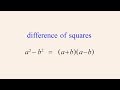
Understanding Quadratic Equations and Difference of Squares

Interactive Video
•
Mathematics
•
9th - 10th Grade
•
Practice Problem
•
Hard

Jennifer Brown
FREE Resource
10 questions
Show all answers
1.
MULTIPLE CHOICE QUESTION
30 sec • 1 pt
What is the standard form of a quadratic equation?
ax + b = 0
ax^2 + bx + c = 0
ax^3 + bx^2 + c = 0
ax^2 + bx = 0
2.
MULTIPLE CHOICE QUESTION
30 sec • 1 pt
Why are quadratic equations generally more complex to solve than linear equations?
They have more variables.
They require graphing.
They have no real solutions.
They involve higher powers of x.
3.
MULTIPLE CHOICE QUESTION
30 sec • 1 pt
What is a special product in the context of quadratic expressions?
A product of two quadratic equations.
A quadratic expression that can be easily factored.
A quadratic equation with no solutions.
A linear equation with two variables.
4.
MULTIPLE CHOICE QUESTION
30 sec • 1 pt
How can a difference of squares be factored?
(a - b)(a + b)
(a - b)(a - b)
(a + b)(a + b)
(a + b)(a - b)
5.
MULTIPLE CHOICE QUESTION
30 sec • 1 pt
What are the roots of the quadratic function x^2 - 4?
-2 and 2
0 and 4
-1 and 1
-4 and 4
6.
MULTIPLE CHOICE QUESTION
30 sec • 1 pt
In the expression 9x^2 - 25, what are the linear factors?
(3x + 25) and (3x - 25)
(3x + 5) and (3x - 5)
(9x + 5) and (9x - 5)
(x + 5) and (x - 5)
7.
MULTIPLE CHOICE QUESTION
30 sec • 1 pt
Can a difference of squares have non-integer constants?
Only if they are rational numbers.
Only if they are perfect squares.
Yes, they can be any real numbers.
No, they must be integers.
Access all questions and much more by creating a free account
Create resources
Host any resource
Get auto-graded reports

Continue with Google

Continue with Email

Continue with Classlink

Continue with Clever
or continue with

Microsoft
%20(1).png)
Apple

Others
Already have an account?

