
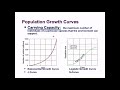
Ecology Unit: Carrying Capacity and Population Growth Curves

Interactive Video
•
Biology
•
9th - 10th Grade
•
Practice Problem
•
Hard

Evelyn Hayes
FREE Resource
10 questions
Show all answers
1.
MULTIPLE CHOICE QUESTION
30 sec • 1 pt
Which of the following is NOT an example of a limiting factor in population growth?
Natural disasters
Competition
Photosynthesis
Predation
2.
MULTIPLE CHOICE QUESTION
30 sec • 1 pt
What is a characteristic of density-dependent factors?
They affect populations regardless of size.
They operate strongly when population density is high.
They are unrelated to population size.
They only affect abiotic factors.
3.
MULTIPLE CHOICE QUESTION
30 sec • 1 pt
Which factor is considered density-independent?
Competition
Disease
Predation
Unusual weather
4.
MULTIPLE CHOICE QUESTION
30 sec • 1 pt
What does the term 'carrying capacity' refer to?
The maximum number of individuals an environment can support
The initial growth rate of a population
The speed at which a population grows
The minimum number of individuals needed for survival
5.
MULTIPLE CHOICE QUESTION
30 sec • 1 pt
What happens when a population surpasses its carrying capacity?
It continues to grow indefinitely
It stabilizes at a new higher level
It becomes immune to limiting factors
It depletes resources and growth slows
6.
MULTIPLE CHOICE QUESTION
30 sec • 1 pt
What shape does an exponential growth curve typically form?
S curve
U curve
J curve
L curve
7.
MULTIPLE CHOICE QUESTION
30 sec • 1 pt
In a logistic growth model, what happens after the initial exponential growth phase?
The population declines rapidly
The population continues to grow exponentially
The population levels off around the carrying capacity
The growth rate remains constant
Access all questions and much more by creating a free account
Create resources
Host any resource
Get auto-graded reports

Continue with Google

Continue with Email

Continue with Classlink

Continue with Clever
or continue with

Microsoft
%20(1).png)
Apple

Others
Already have an account?

