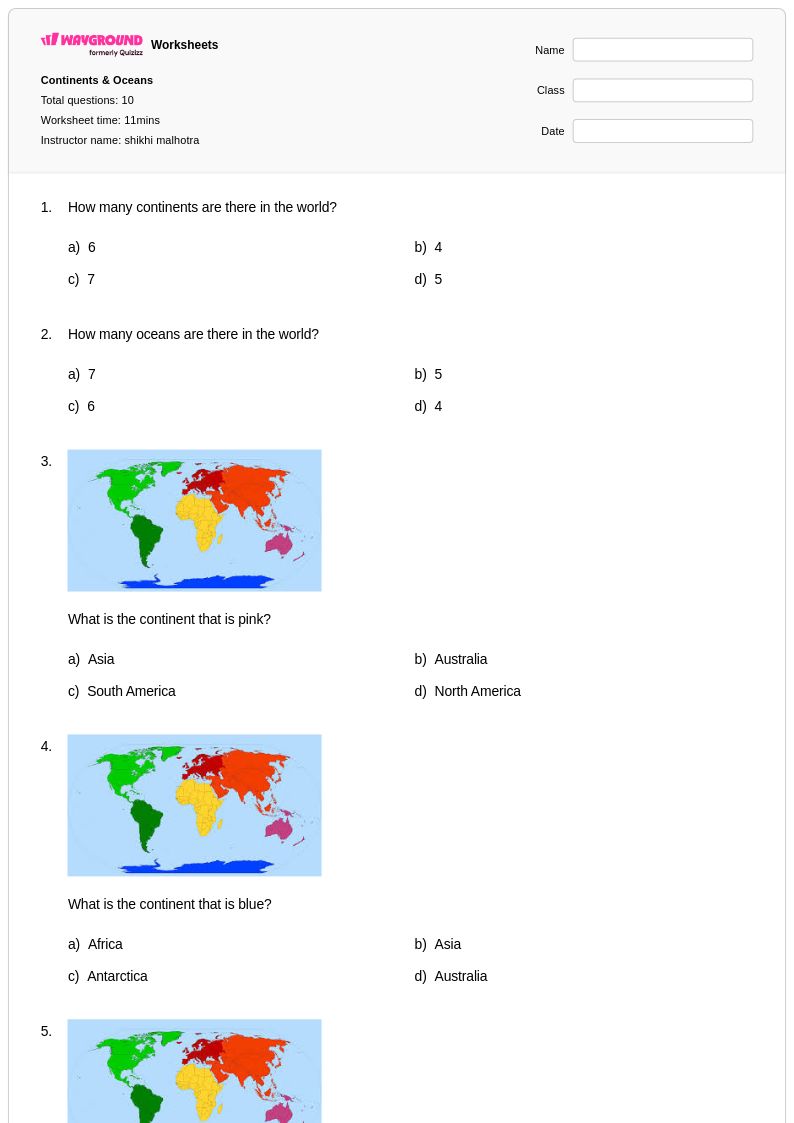
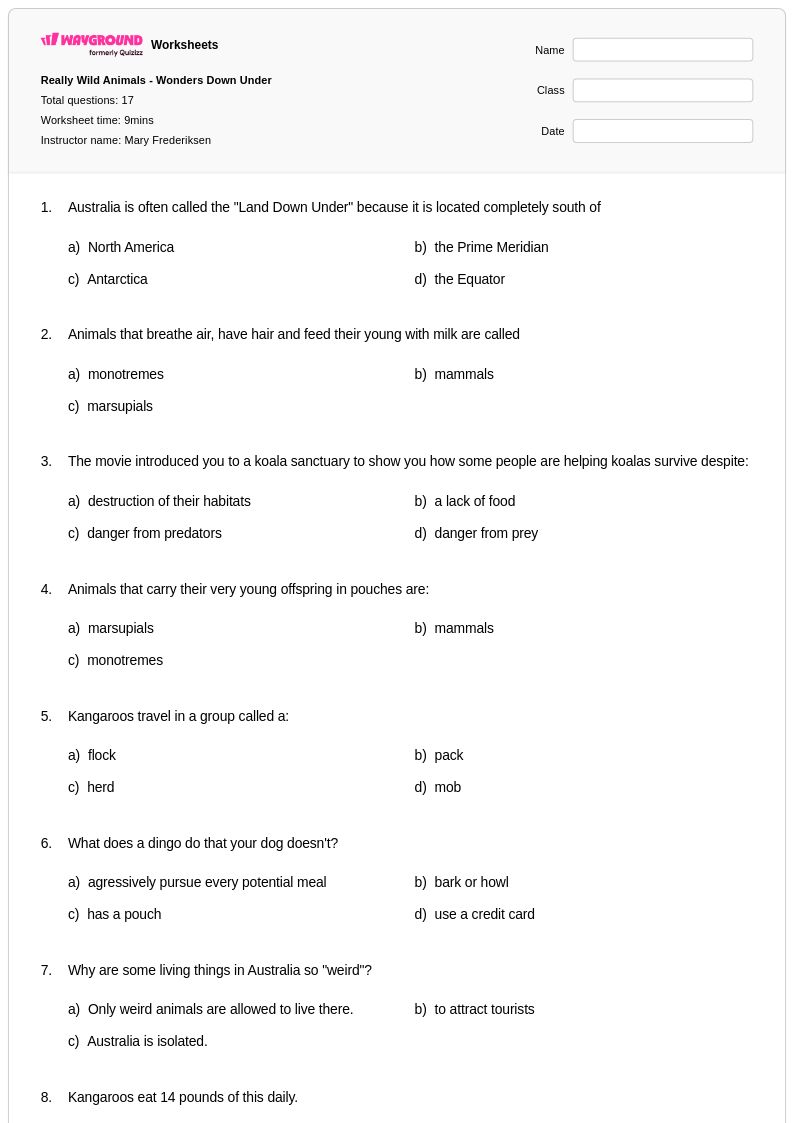
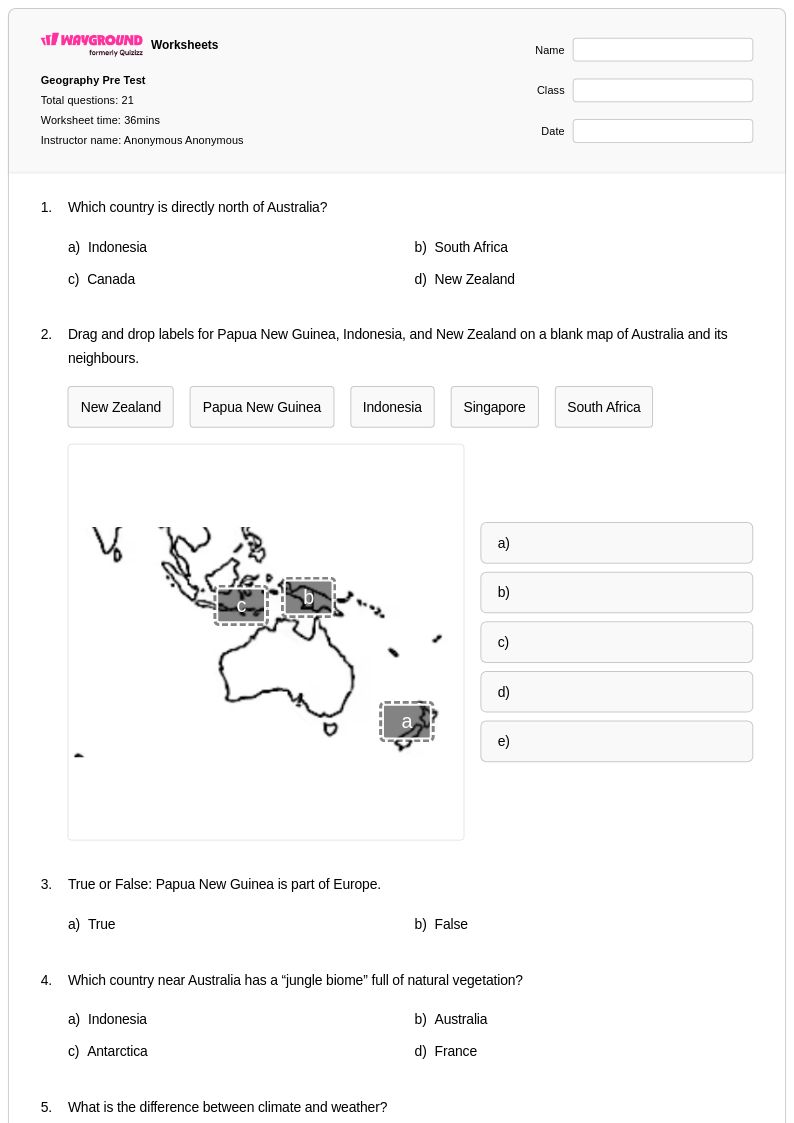
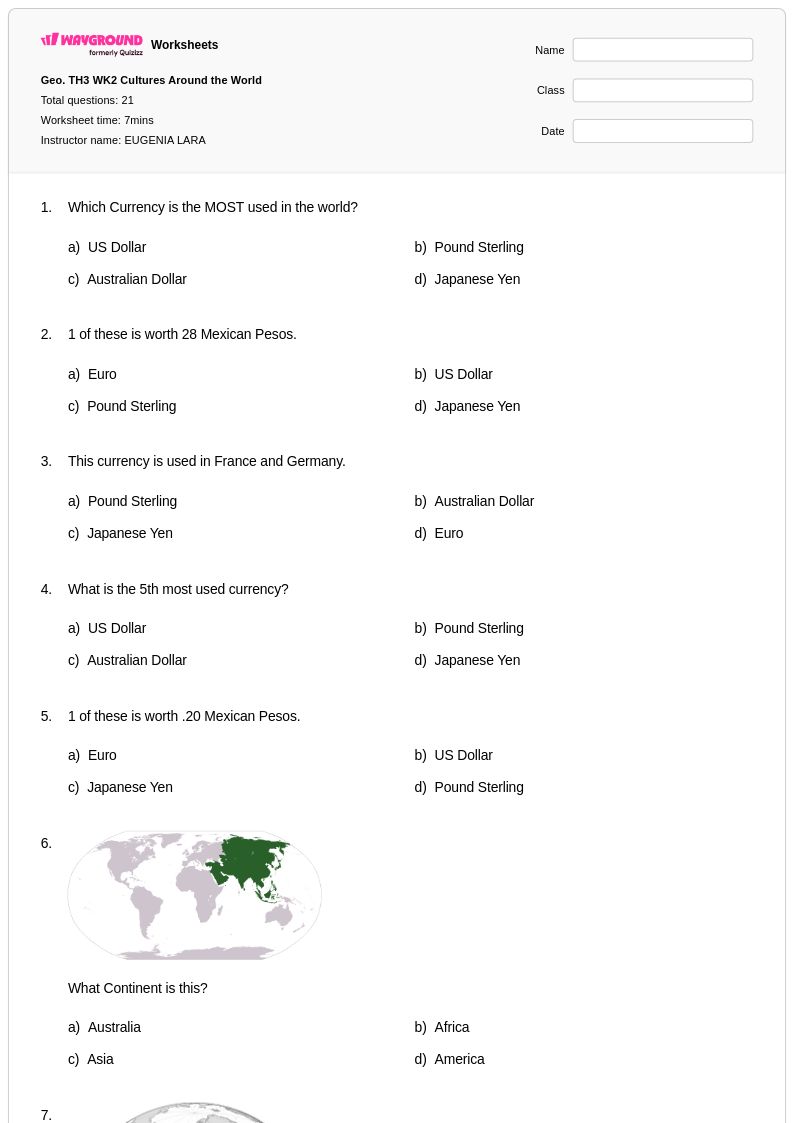
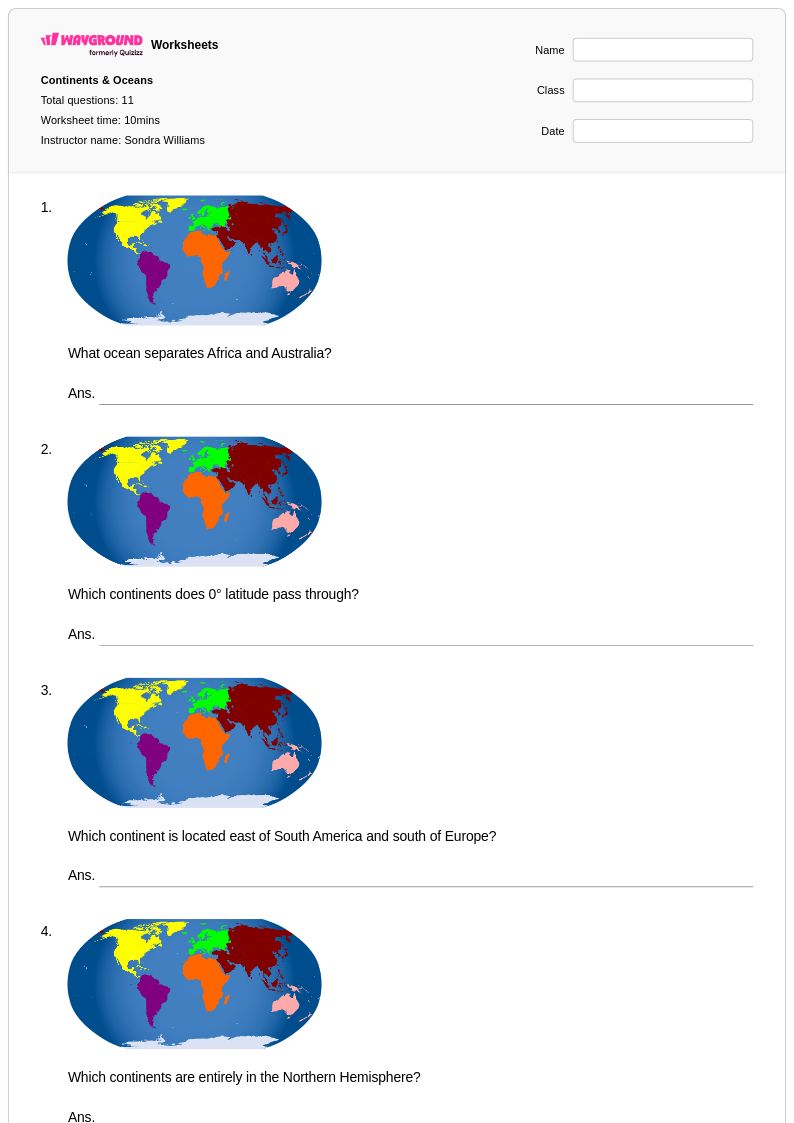
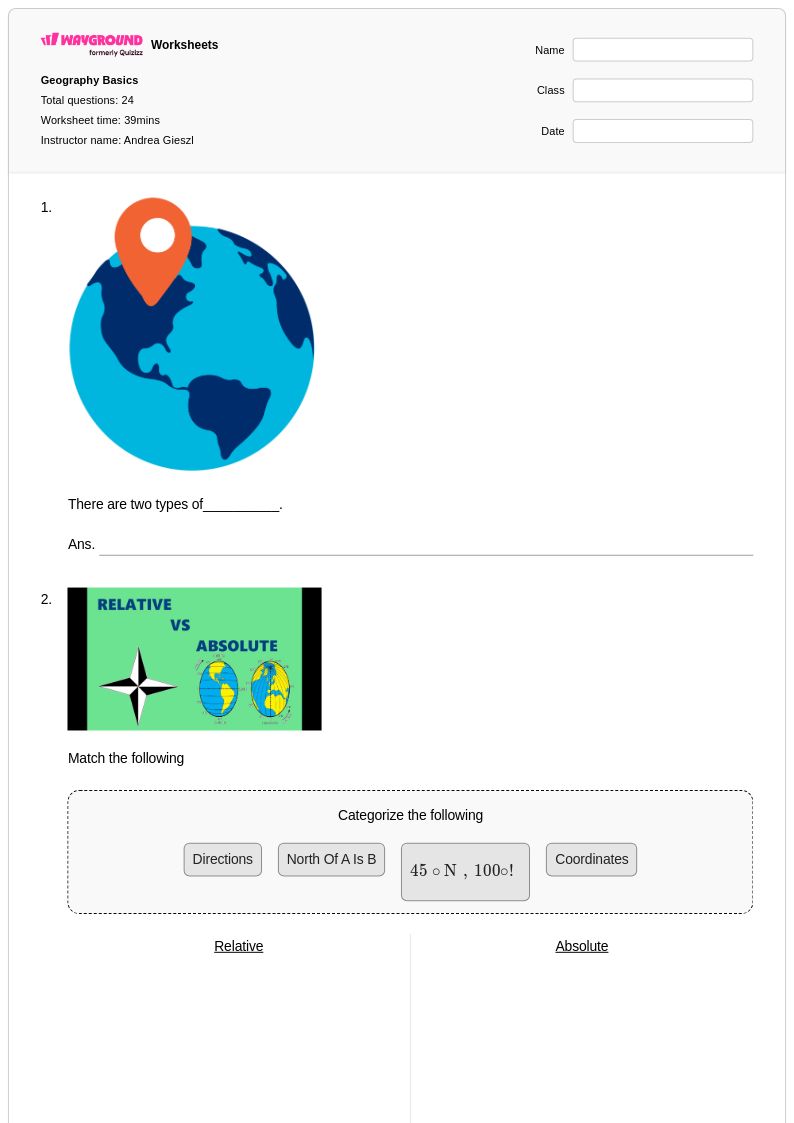
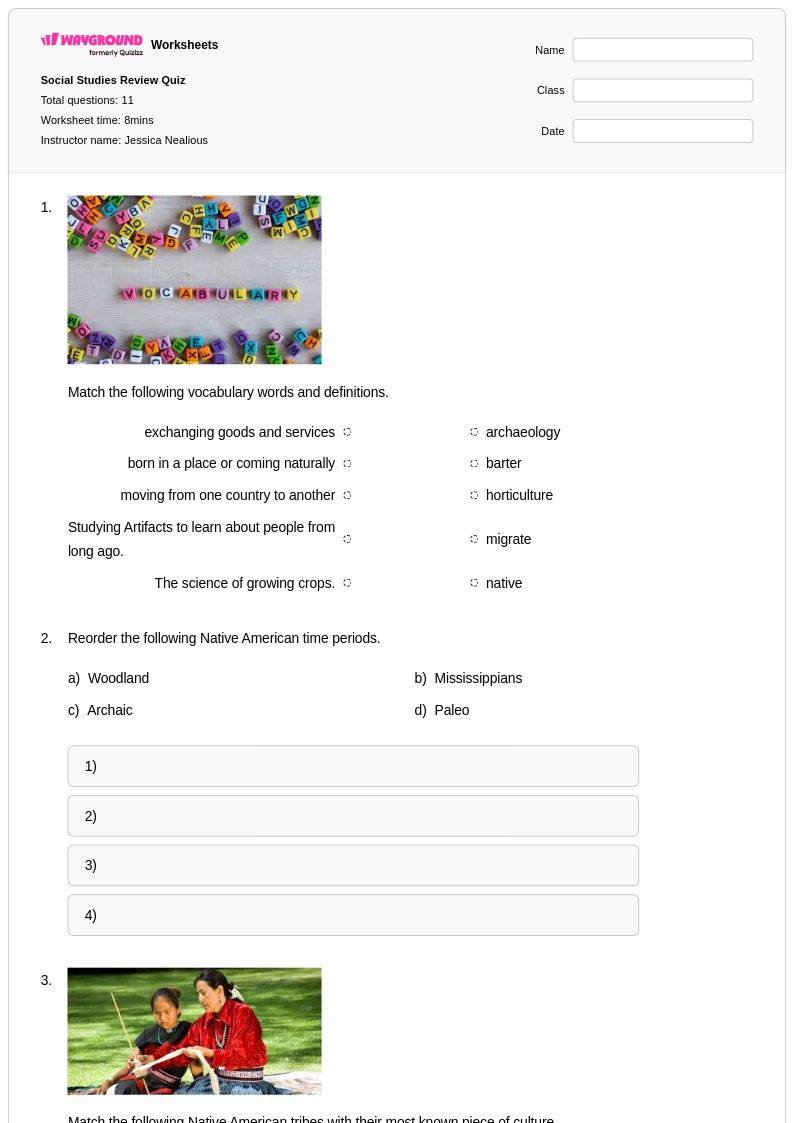
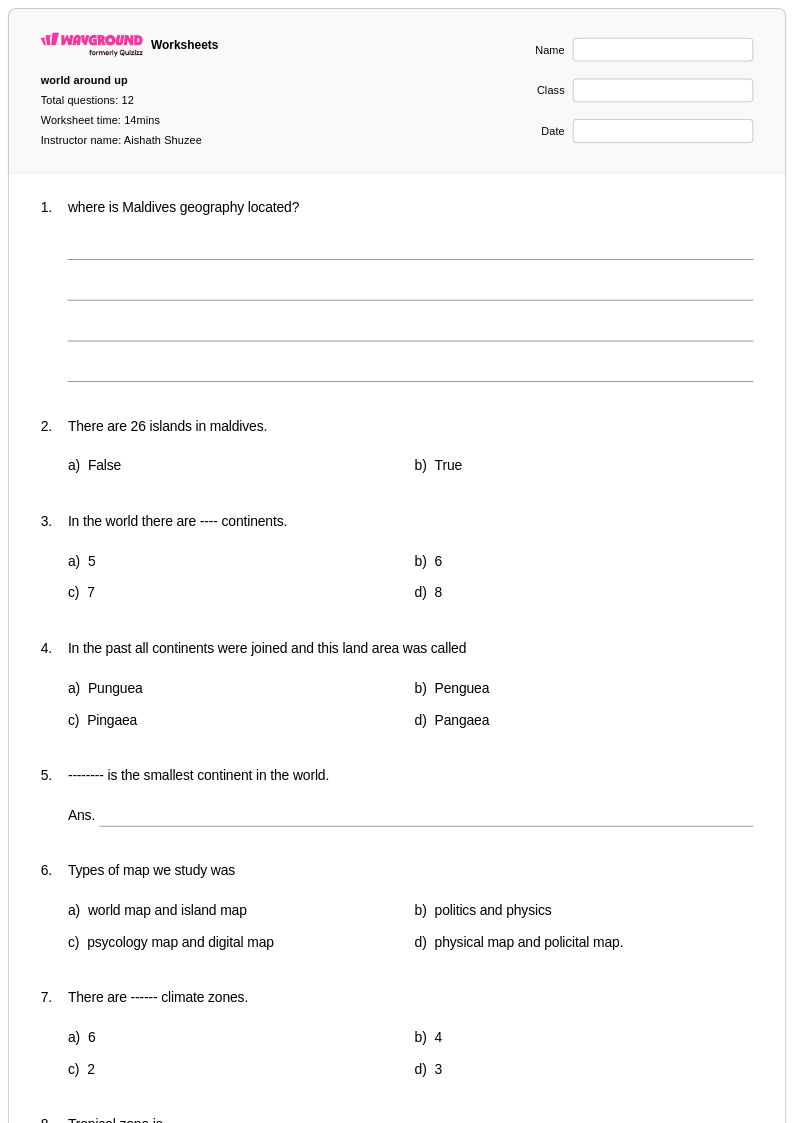
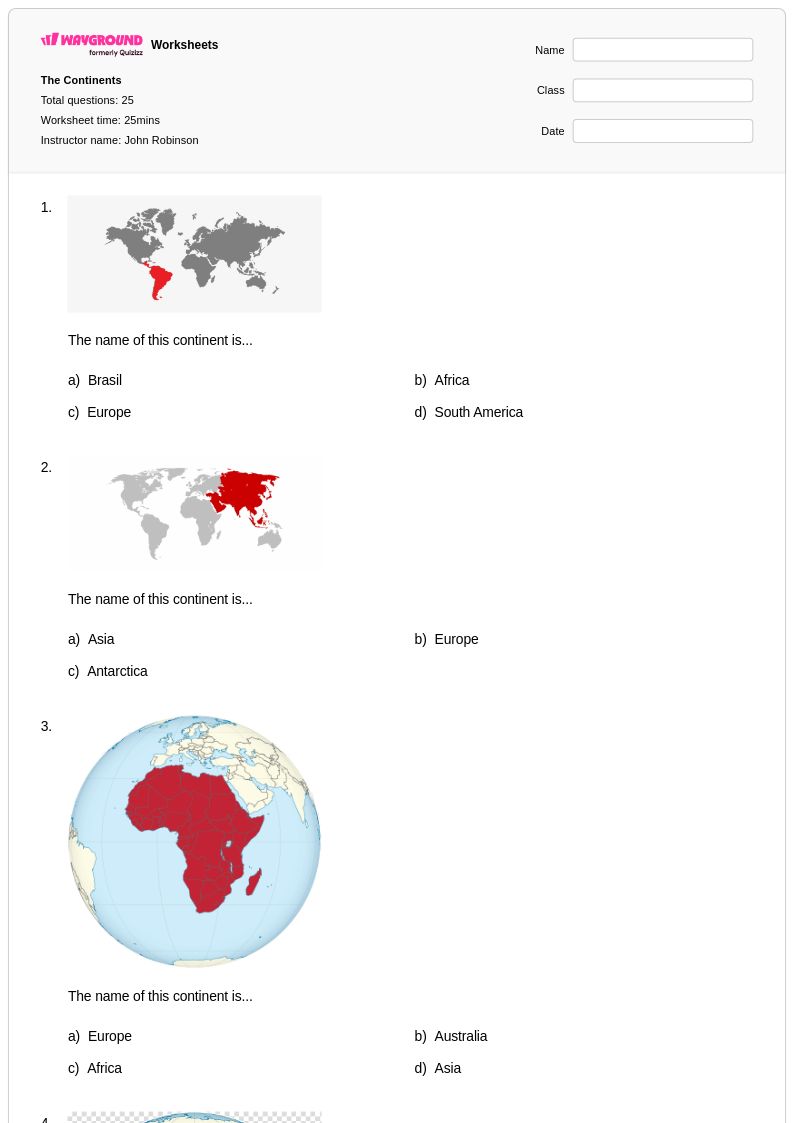
Explore Year 4 Australia geography worksheets and printables that help students learn about the continent's states, landmarks, and physical features through engaging practice problems with answer keys.
Year 4 Australia geography worksheets from Wayground provide comprehensive resources for elementary students to explore the diverse continent of Australia and develop essential geographic literacy skills. These expertly designed materials guide young learners through Australia's unique physical features, including the Outback, Great Barrier Reef, and distinctive wildlife, while building critical thinking abilities through map reading, location identification, and cultural comparison activities. Each worksheet collection includes detailed answer keys and is available as free printable pdf resources, offering educators flexibility in classroom implementation and enabling students to engage with practice problems that reinforce their understanding of Australian geography, climate patterns, and the relationship between people and their environment.
Wayground's extensive library features millions of teacher-created Year 4 Australia geography resources that support educators in delivering engaging and differentiated instruction. The platform's robust search and filtering capabilities allow teachers to quickly locate materials aligned with curriculum standards, while customization tools enable modification of worksheets to meet diverse learning needs and ability levels. Available in both printable pdf format and interactive digital versions, these resources facilitate seamless lesson planning and provide teachers with versatile options for skill practice, remediation, and enrichment activities that help students master fundamental concepts about Australia's geography, from its major cities and landmarks to its role in the Pacific region.
FAQs
How do I teach students about Australia's geography in a way that actually sticks?
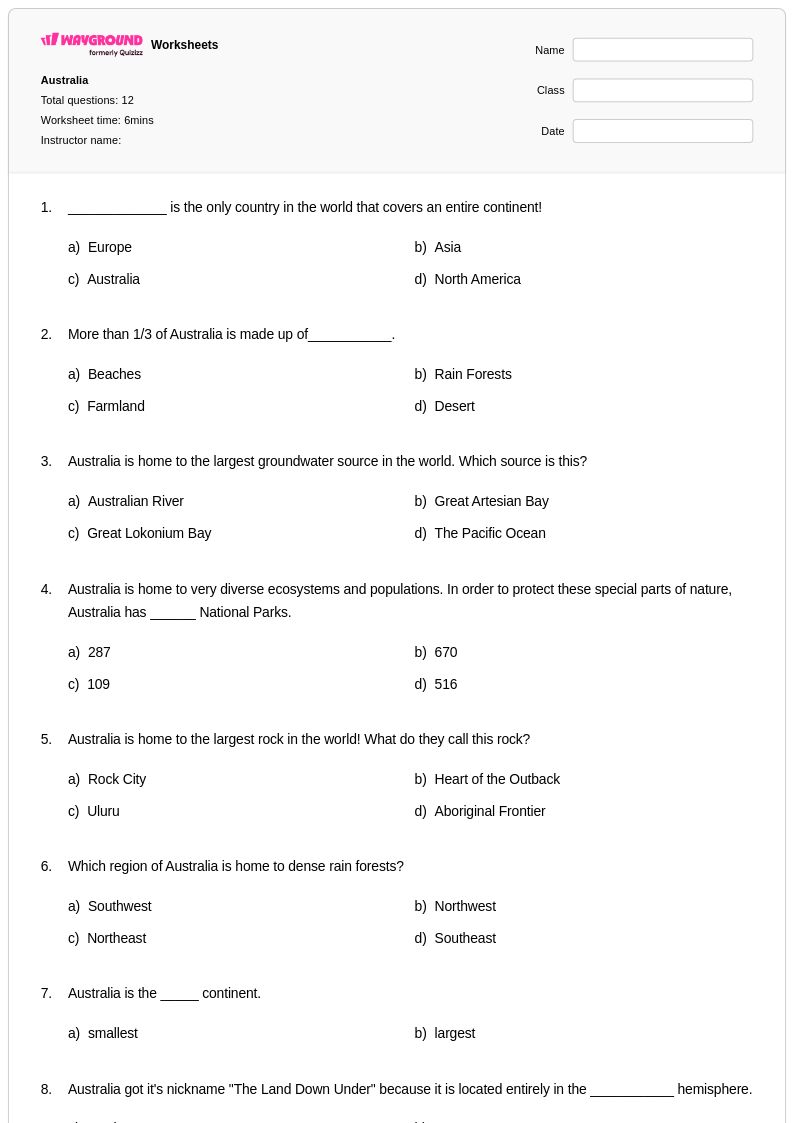
Start with Australia's dual identity as both a continent and a country, since this distinction consistently trips students up. Build outward from that anchor concept by connecting physical features to human settlement patterns — for example, explaining why most of Australia's population clusters along the coastal fringe while the interior Outback remains sparsely inhabited. Pairing map-labeling activities with short readings on climate zones and landmarks helps students form spatial mental models that are easier to retain than isolated facts.
What are the most common misconceptions students have about Australia?
The most frequent misconception is that Australia is simply a large island rather than its own continent, which causes confusion when students encounter classification questions. Students also tend to underestimate geographic diversity, assuming Australia is mostly desert when in fact it contains tropical rainforests, alpine areas, and fertile coastal plains. A third common error is conflating Aboriginal Australian cultures with a single homogeneous group, rather than recognizing them as hundreds of distinct language groups and nations.
What exercises help students practice identifying Australia's states, territories, and major cities?
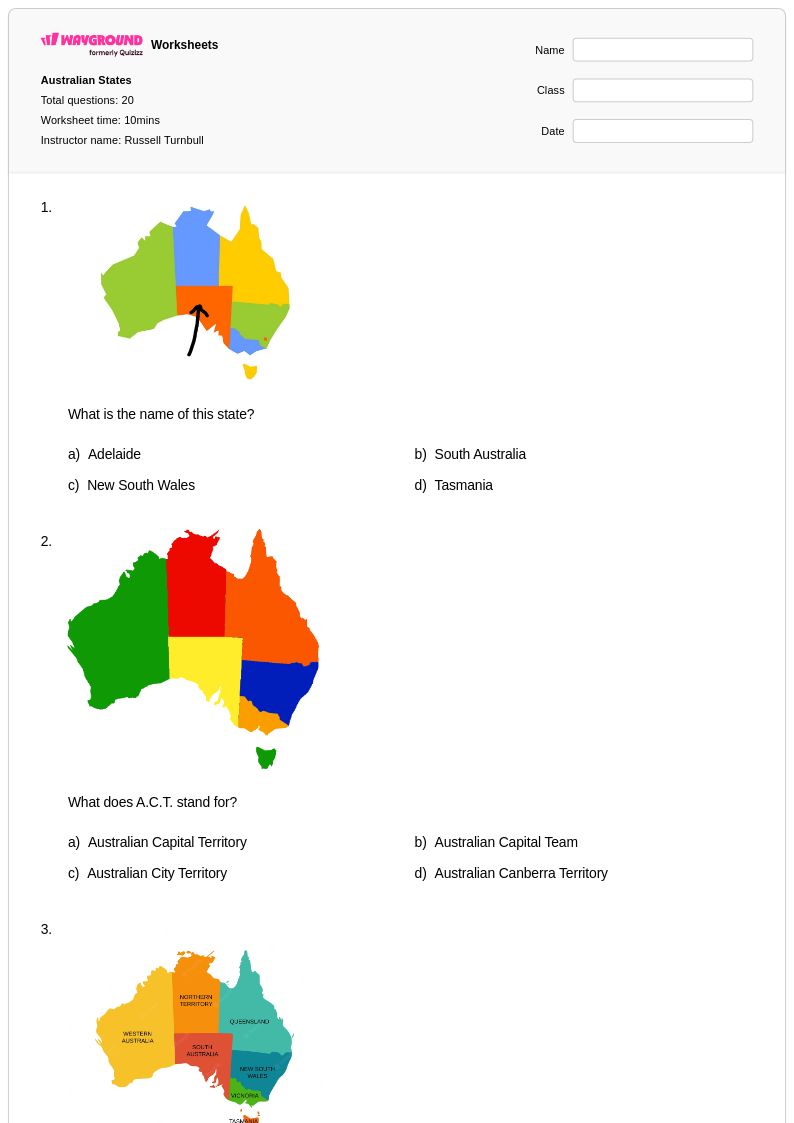
Blank map exercises where students label the six states and two territories are highly effective because they require active recall rather than passive recognition. Follow-up activities that match capital cities to their states, and then place those cities on a physical map, reinforce both political and physical geography simultaneously. Adding a landmark or climate descriptor to each region as students label it deepens the conceptual connections beyond simple memorization.
How do I differentiate Australia geography instruction for students at different skill levels?
For students who need additional support, reducing the number of labeled locations on a map task or providing a word bank lowers the cognitive load while keeping the learning objective intact. Advanced learners benefit from comparative tasks, such as analyzing how Australia's physical geography has shaped its economic development or comparing Aboriginal land management practices to contemporary environmental policies. Wayground allows teachers to apply accommodations like reduced answer choices and read-aloud support to individual students, so differentiation can happen at the assignment level without singling students out.
How can I use Australia worksheets from Wayground in my classroom?
Wayground's Australia worksheets are available as printable PDFs for traditional classroom use and in digital formats for technology-integrated or remote learning environments. Teachers can also host worksheets as a live or self-paced quiz directly on Wayground, which gives students immediate feedback and gives teachers real-time visibility into class performance. Answer keys are included with every worksheet, reducing prep time and making it straightforward to use these materials for independent practice, homework, or formative assessment.
How do I connect Australia geography to broader social studies standards?
Australia geography aligns naturally with standards around physical geography, human-environment interaction, and cultural diversity within the Asia-Pacific region. Teachers can use Australia as a case study for concepts like climate zone classification, indigenous land rights, and the relationship between geographic isolation and biodiversity. Framing Australia within global contexts, such as its role in Pacific trade networks or the impact of the Great Barrier Reef on international environmental policy, helps students see geography as an analytical lens rather than a memorization exercise.

![Wonders the World [Japan, Egypt, America, Australia] - Printable Australia Worksheets Year 4 - Wayground](https://quizizz-static.s3.amazonaws.com/_media/worksheets-new/631a62cb70efd5001eb55e75-wonders-the-world-japan-egypt-america-australia)