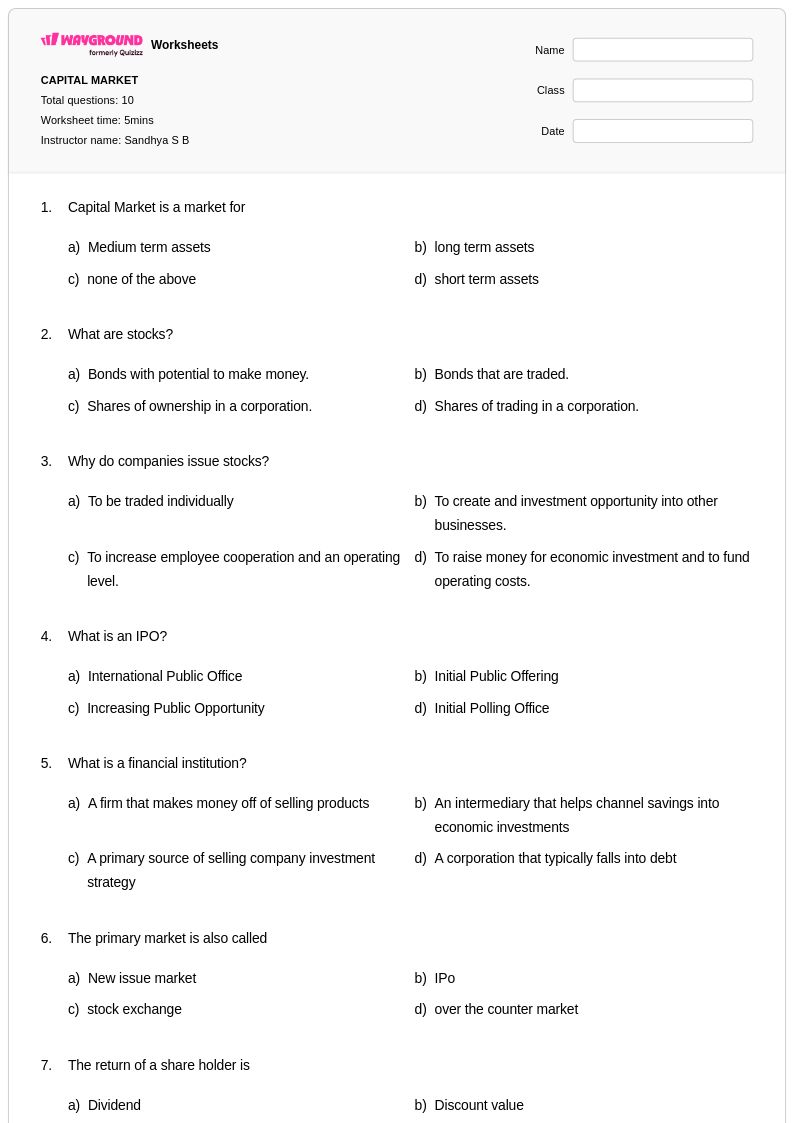
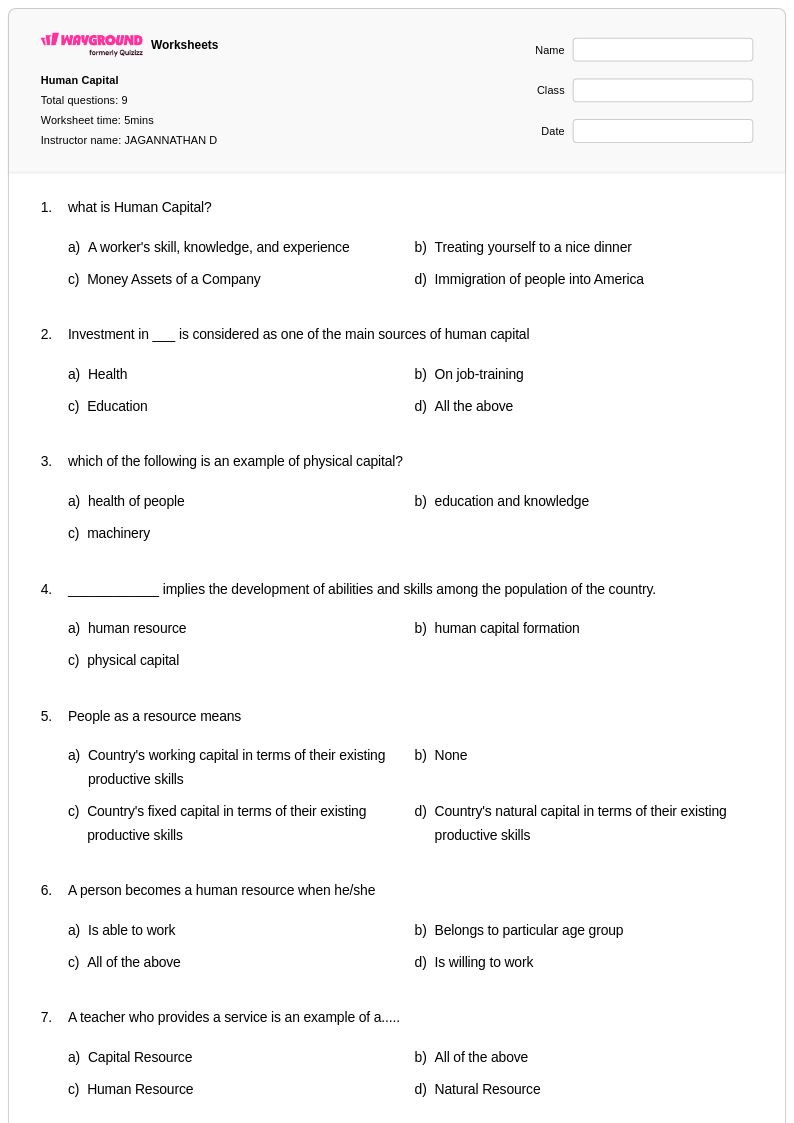
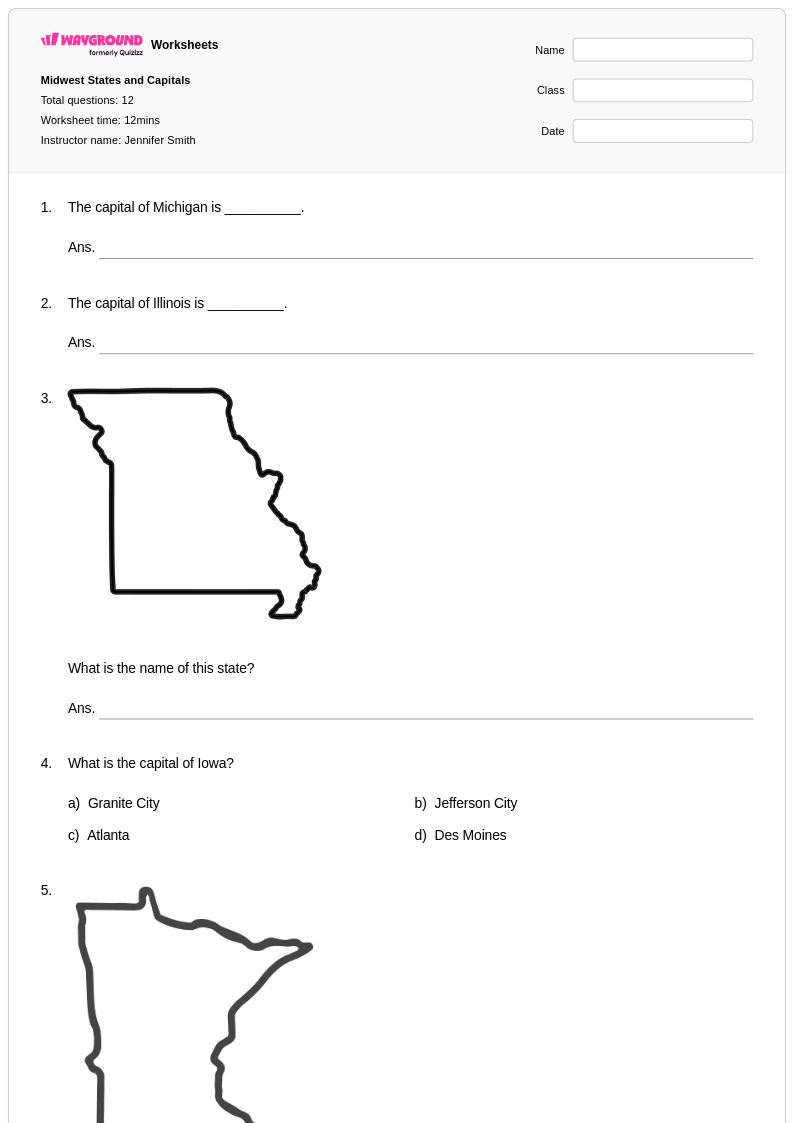
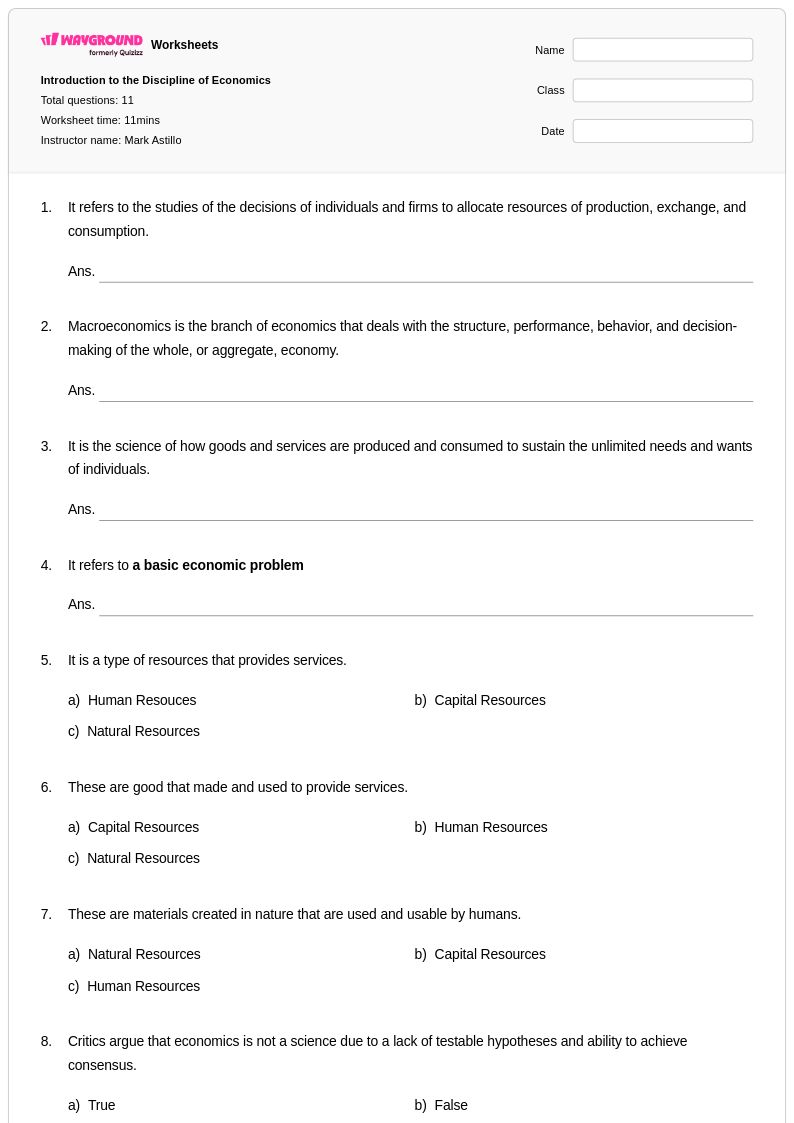
Explore Wayground's comprehensive collection of capital gains worksheets and printables that help students master investment returns, tax calculations, and financial literacy through engaging practice problems with detailed answer keys.
Capital gains worksheets available through Wayground (formerly Quizizz) provide comprehensive educational resources that help students understand one of the most important concepts in economics and personal finance. These expertly designed worksheets guide learners through the fundamental principles of capital gains, including the difference between realized and unrealized gains, short-term versus long-term capital gains tax implications, and how investment appreciation affects personal wealth building. Students develop critical analytical skills as they work through practice problems that demonstrate how assets like stocks, bonds, and real estate generate returns over time. Each worksheet collection includes detailed answer keys and is available as free printables in convenient PDF format, making it easy for educators to incorporate capital gains instruction into their economics curriculum while ensuring students can practice these essential financial literacy concepts independently.
Wayground (formerly Quizizz) empowers educators with millions of teacher-created capital gains resources that can be seamlessly integrated into any economics program. The platform's robust search and filtering capabilities allow teachers to quickly locate worksheets that align with specific learning standards and match their students' skill levels, while built-in differentiation tools enable customization for diverse learning needs. These comprehensive worksheet collections are available in both printable and digital formats, including downloadable PDFs that support flexible classroom implementation and remote learning environments. Teachers can effectively use these resources for lesson planning, targeted remediation for students struggling with investment concepts, enrichment activities for advanced learners, and regular skill practice that reinforces understanding of how capital appreciation impacts economic decision-making and long-term financial planning strategies.
FAQs
How do I teach capital gains to high school economics students?
Start by grounding students in the difference between realized and unrealized gains before introducing tax implications. Use concrete examples like buying and selling a stock or a piece of real estate to make the concept tangible. From there, layer in short-term versus long-term capital gains distinctions, since the tax treatment differs significantly and is a common point of confusion. Connecting these concepts to students' own financial futures tends to increase engagement.
What practice problems work best for helping students understand capital gains calculations?
Problems that walk students through the full lifecycle of an asset — purchase price, holding period, sale price, and resulting gain or loss — are most effective. Include problems that require students to classify a gain as short-term or long-term and then calculate the applicable tax liability. Mixing asset types such as stocks, bonds, and real estate helps students generalize the concept rather than memorizing a single formula.
What mistakes do students commonly make when learning about capital gains?
The most common error is conflating unrealized and realized gains — students often assume that an increase in an asset's value is automatically taxable, not understanding that the tax event is triggered only upon sale. Students also frequently confuse short-term and long-term holding period thresholds, which affects how the gain is taxed. A third misconception is assuming all assets are taxed identically, when in practice different asset classes can carry different tax treatments.
How do capital gains fit into a broader personal finance or economics curriculum?
Capital gains are a natural bridge between foundational investment concepts and real-world tax literacy. They connect directly to topics like compound growth, portfolio management, and economic decision-making, making them a useful anchor point late in a personal finance unit. Teaching capital gains also gives students a concrete reason to understand holding periods, asset diversification, and the long-term cost of short-term thinking.
How do I use Wayground's capital gains worksheets in my classroom?
Wayground's capital gains worksheets are available as printable PDFs for traditional classroom use and in digital formats for technology-integrated or remote learning environments, so they fit a range of instructional setups. Each worksheet includes a detailed answer key, which makes them practical for independent practice, homework, or guided remediation. You can also host them as a quiz directly on Wayground, giving you real-time visibility into student performance on investment and tax calculation problems.
How can I differentiate capital gains instruction for students at different skill levels?
For students who are still building foundational numeracy, start with single-asset problems using whole numbers before introducing percentage-based returns or tax rate calculations. Advanced learners can work through multi-asset portfolio scenarios that require them to calculate net capital gains across different holding periods. On Wayground, teachers can apply accommodations such as reduced answer choices or read-aloud support for individual students, allowing the same worksheet to serve diverse learners without requiring separate materials.