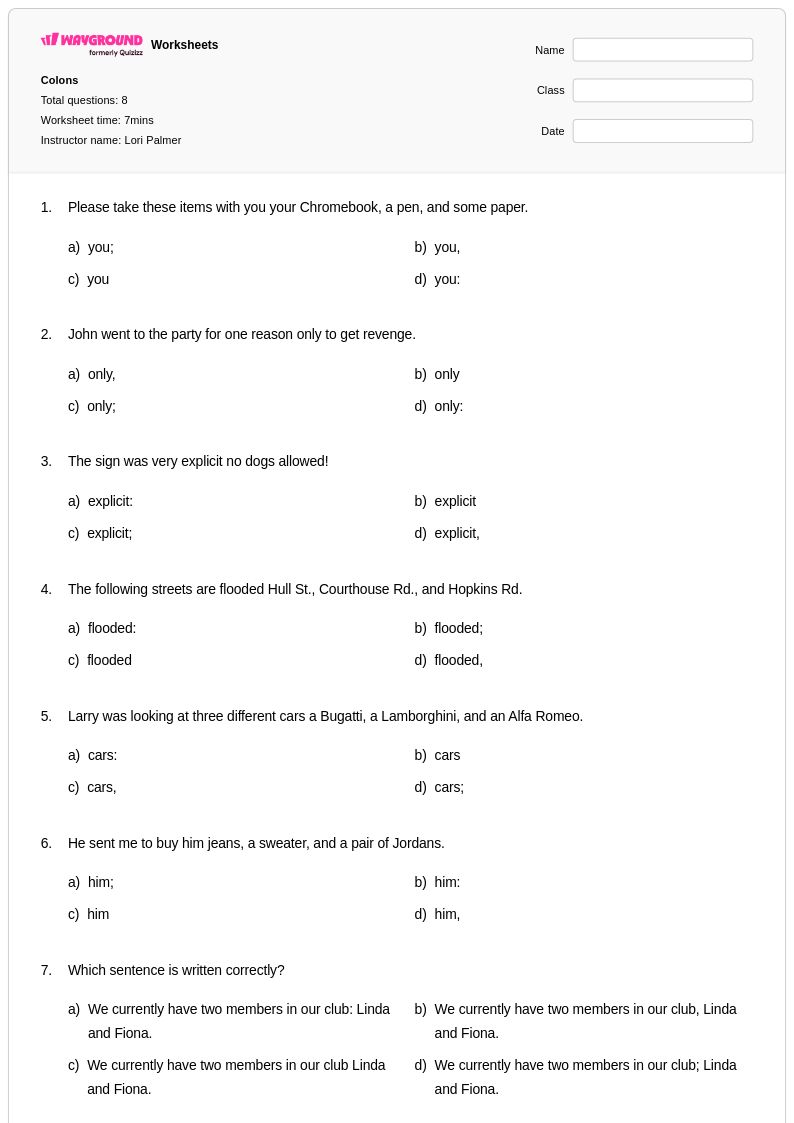
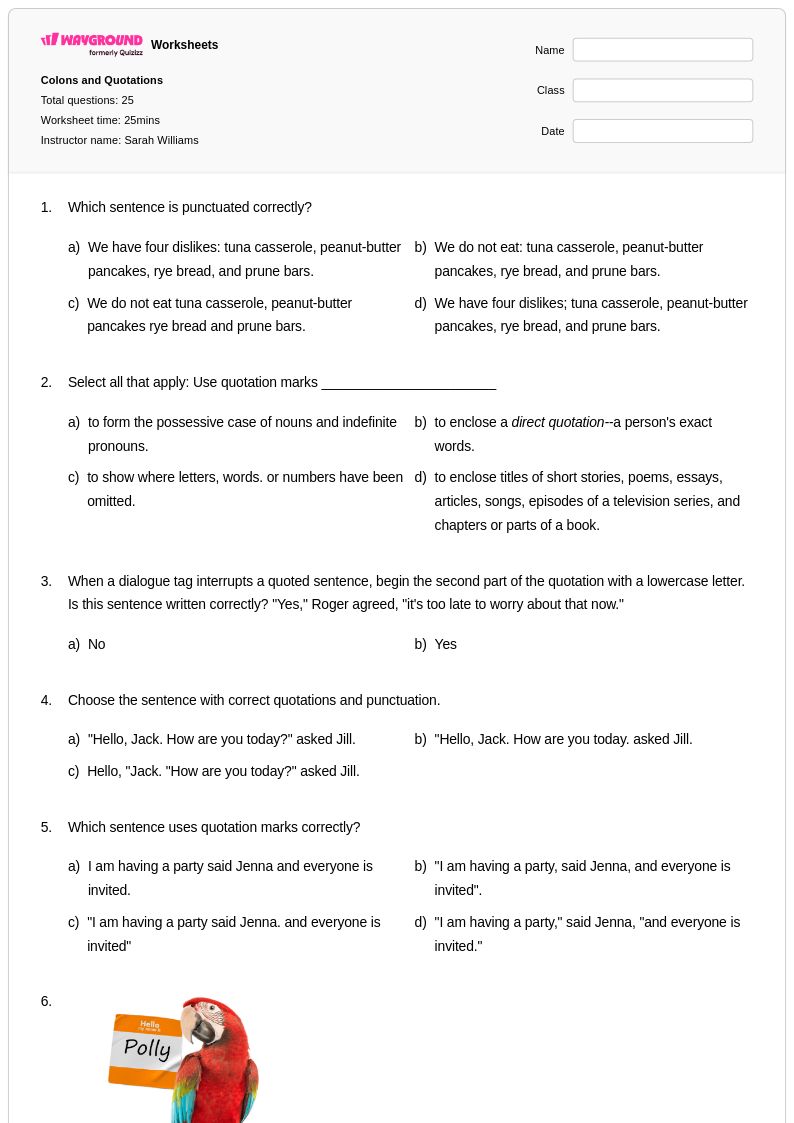
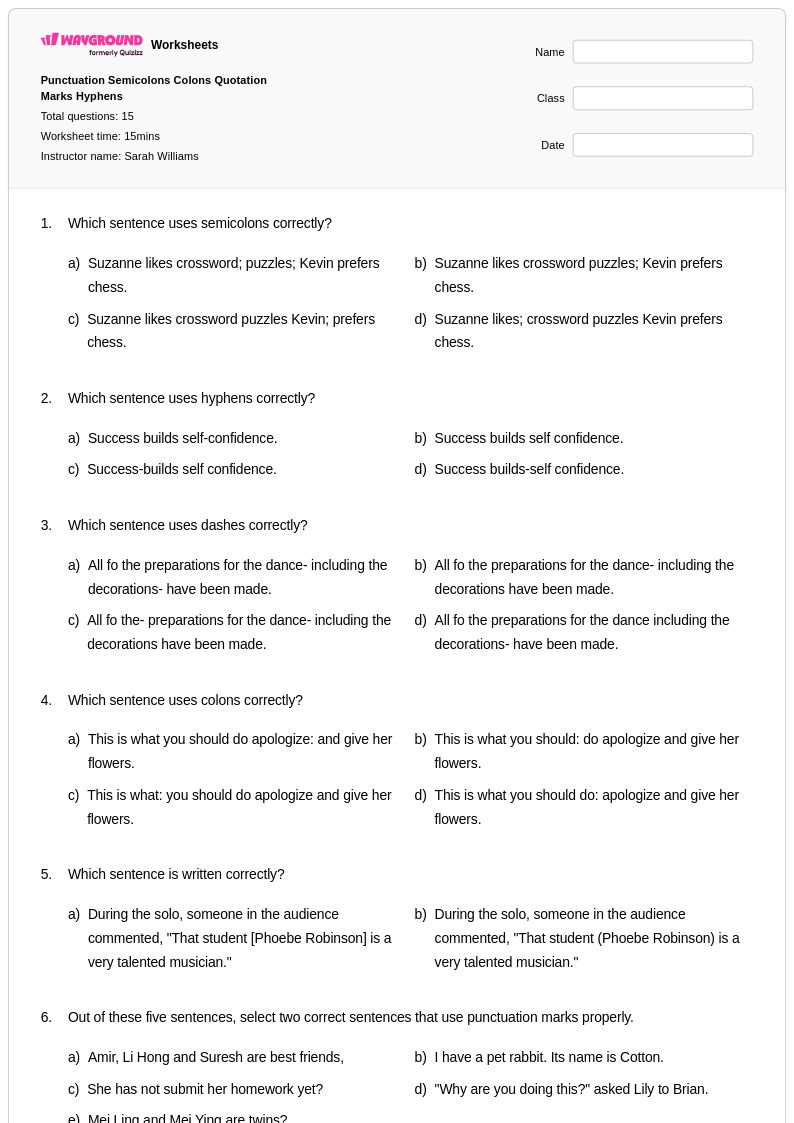
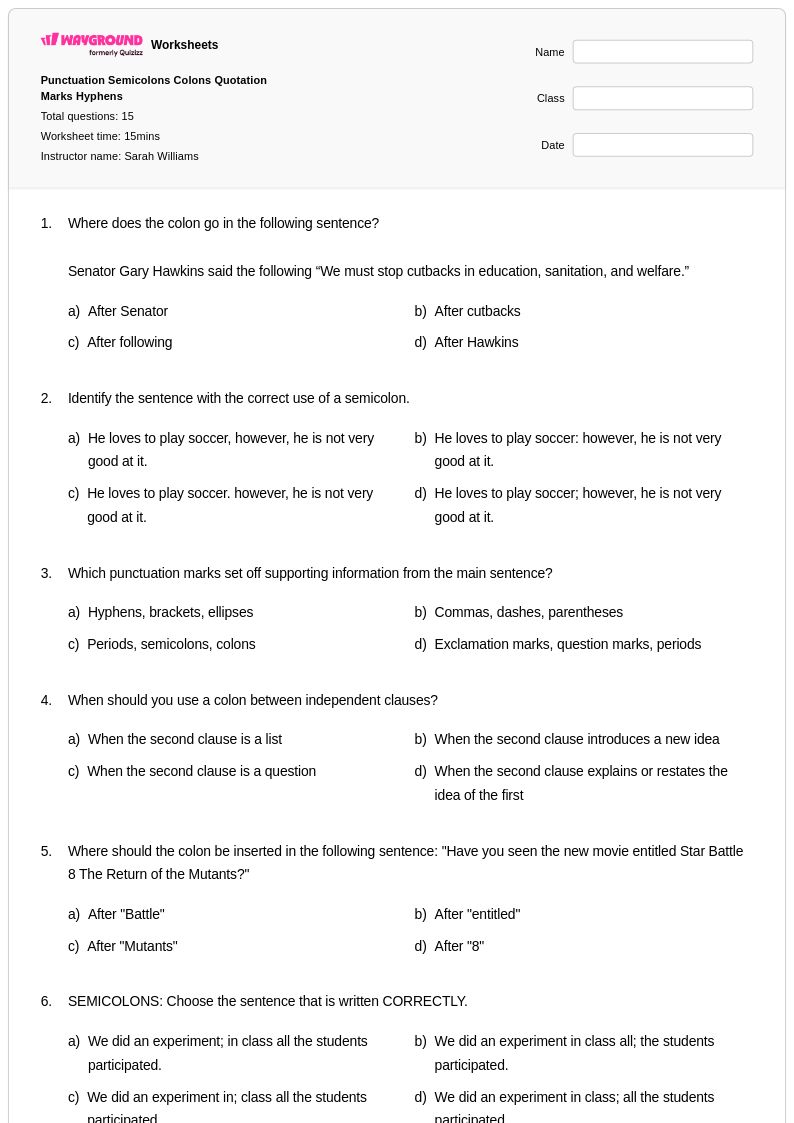
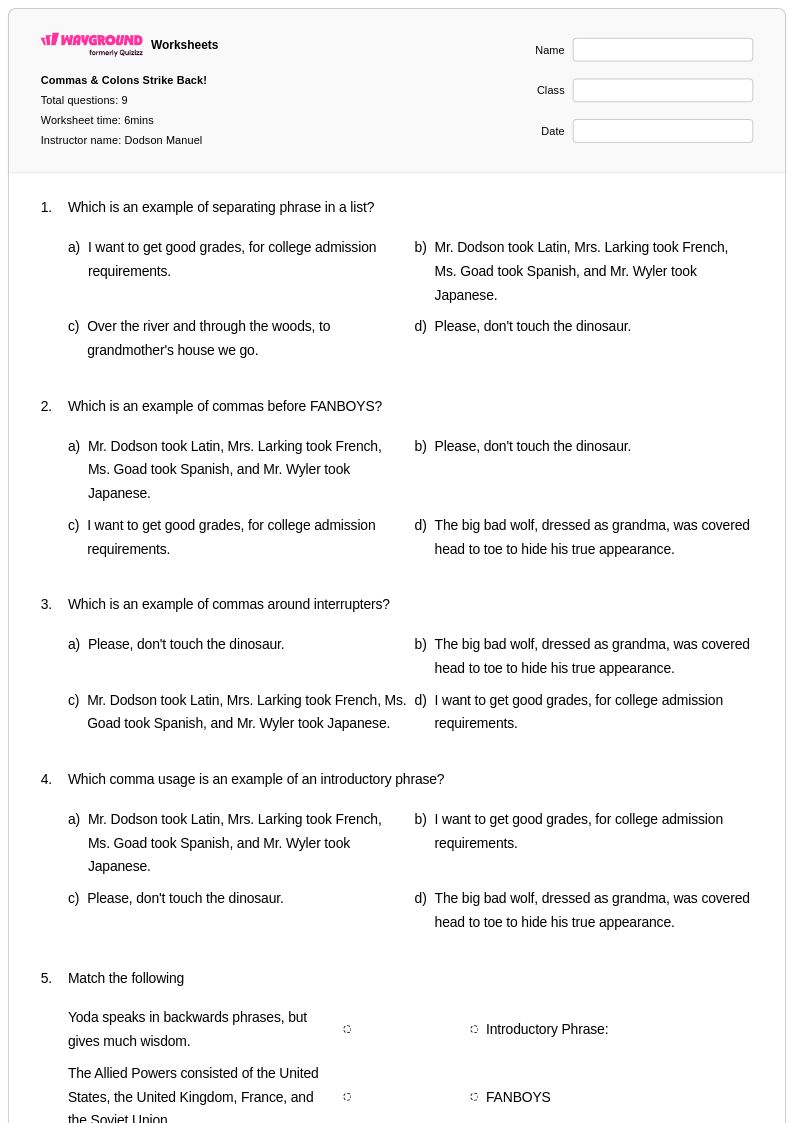
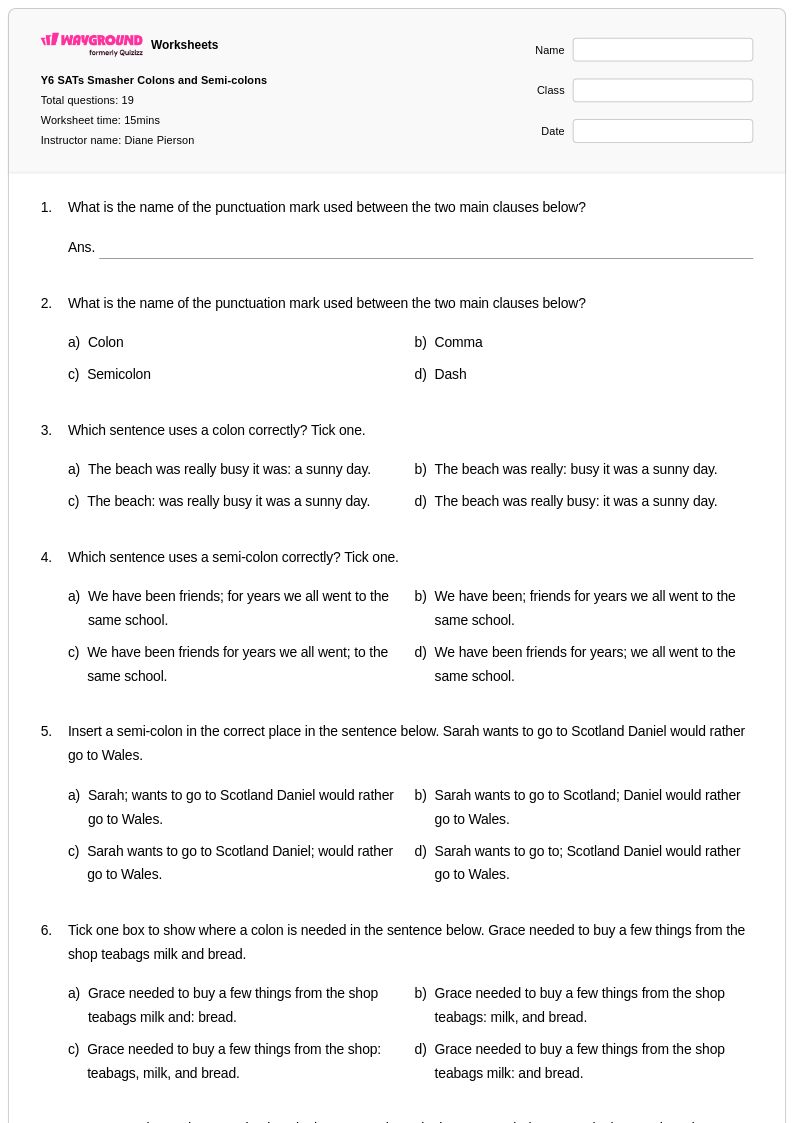
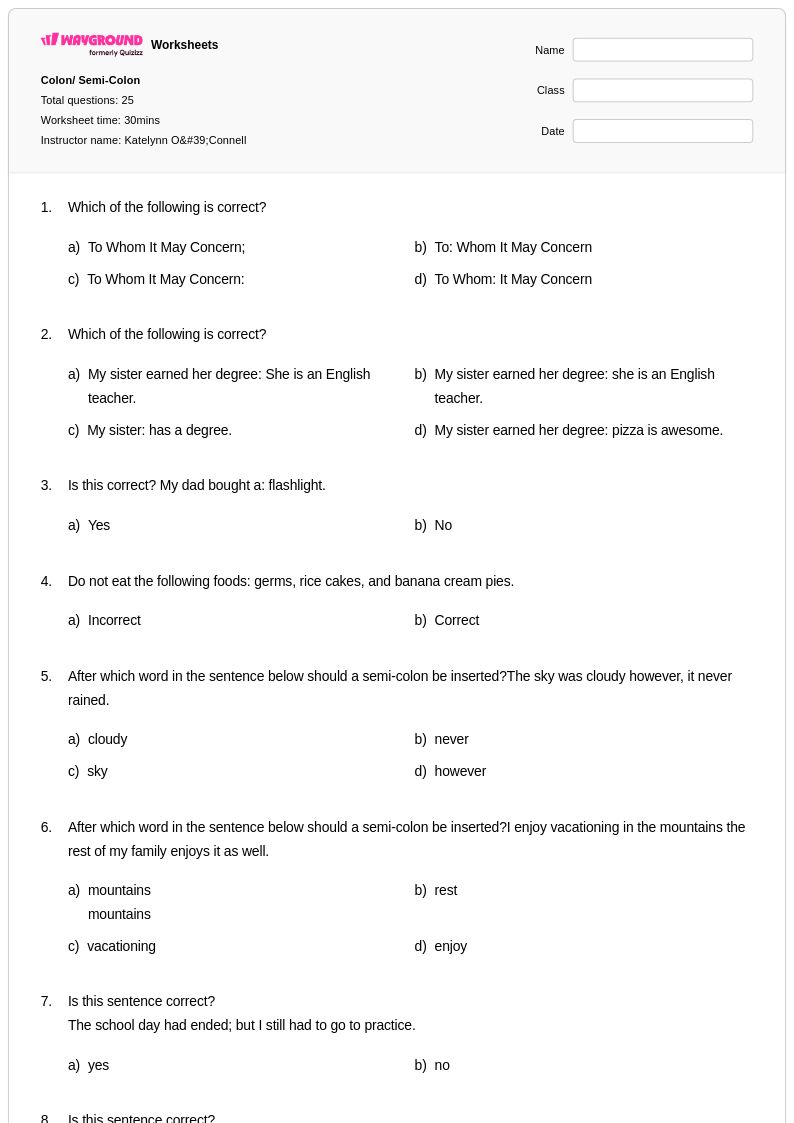
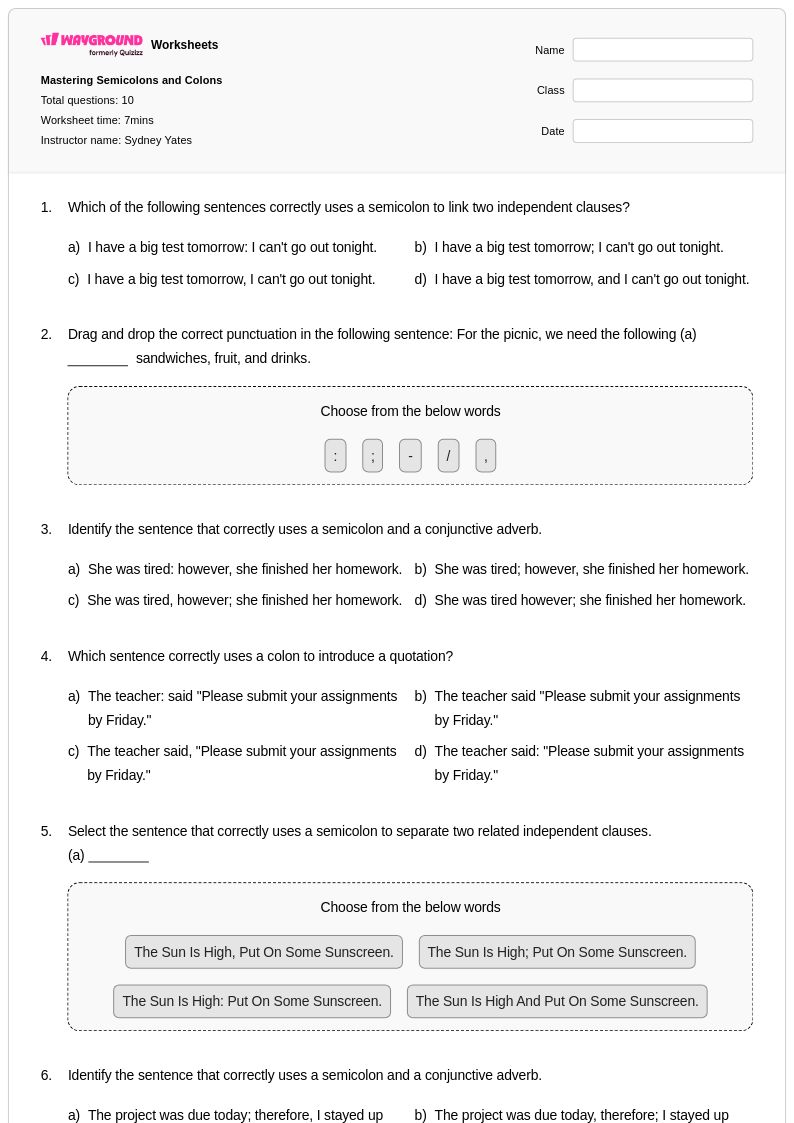
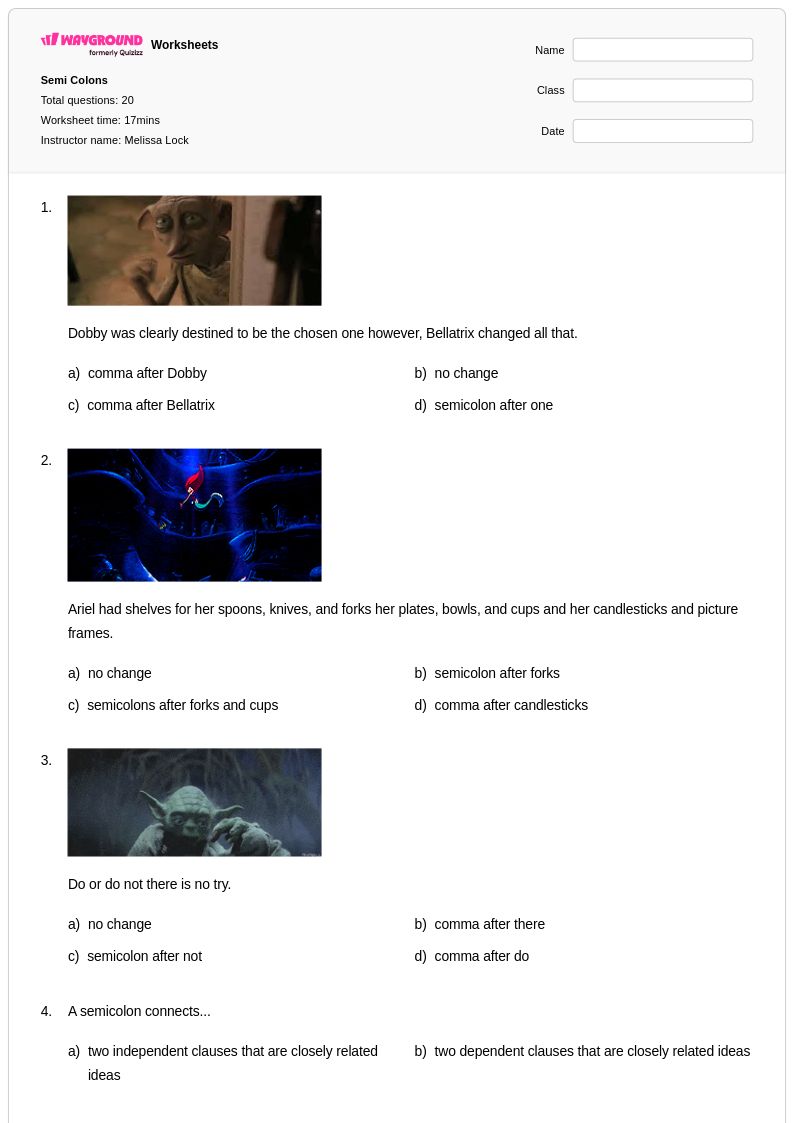
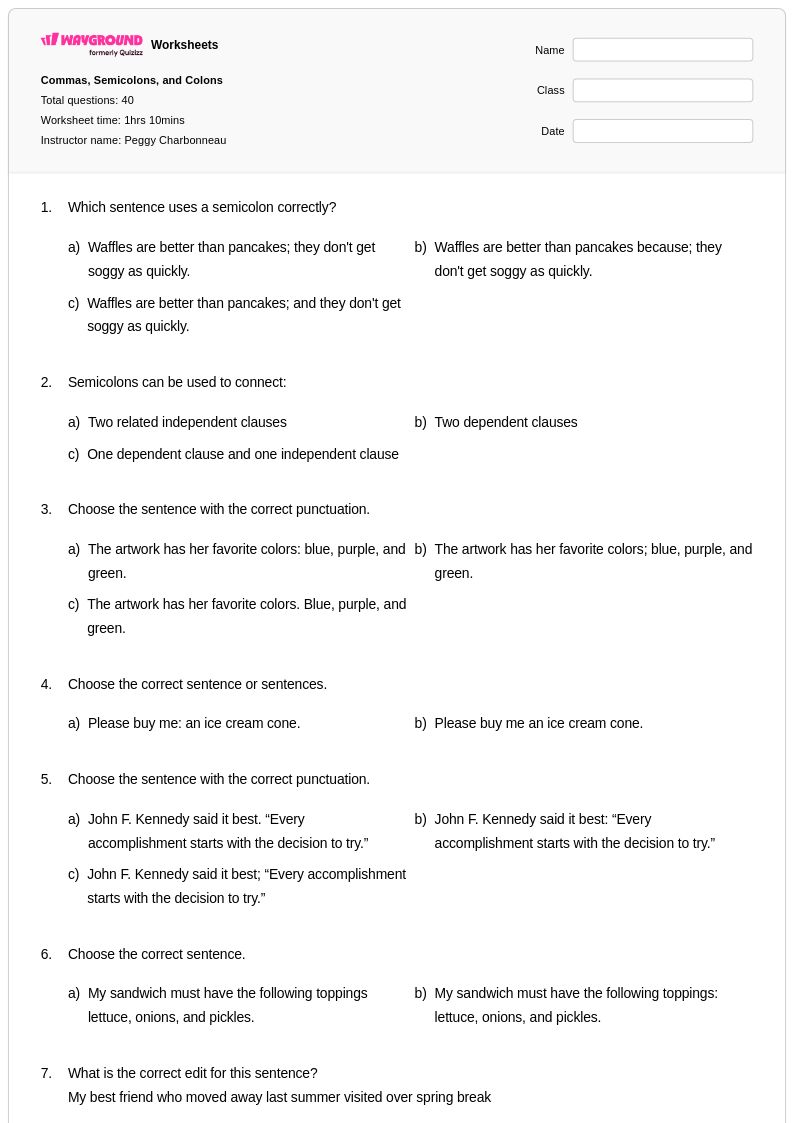
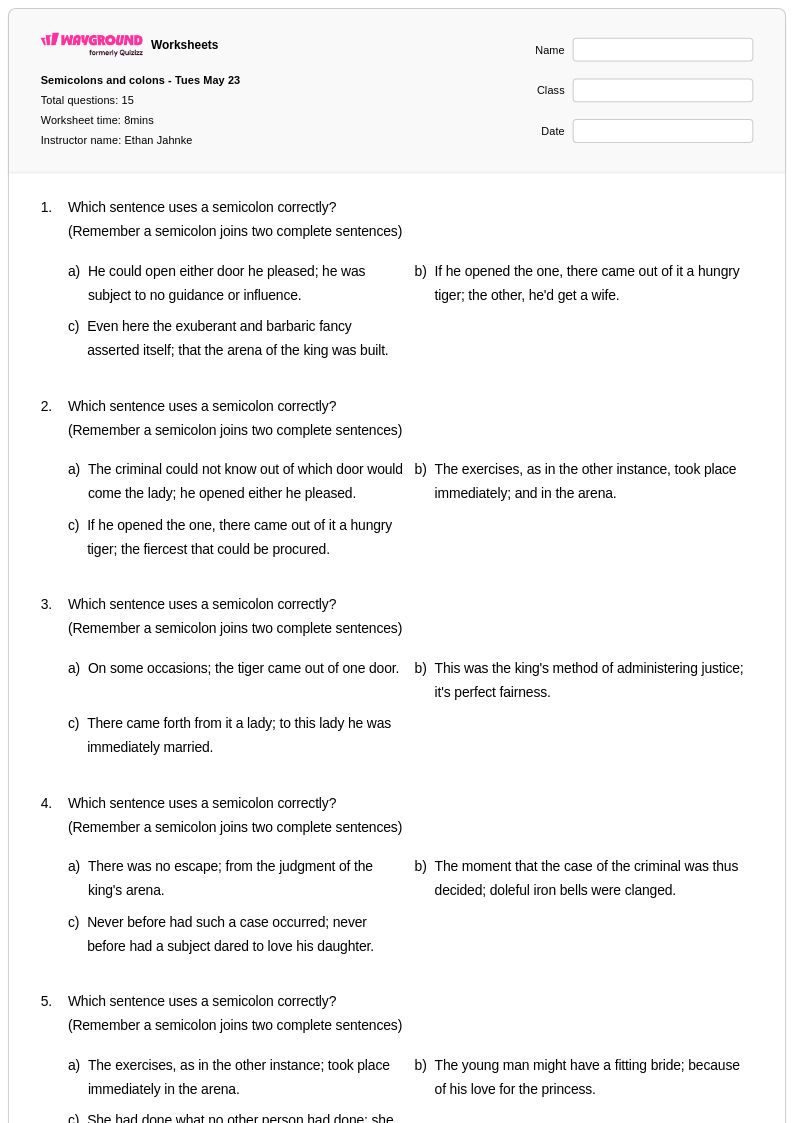
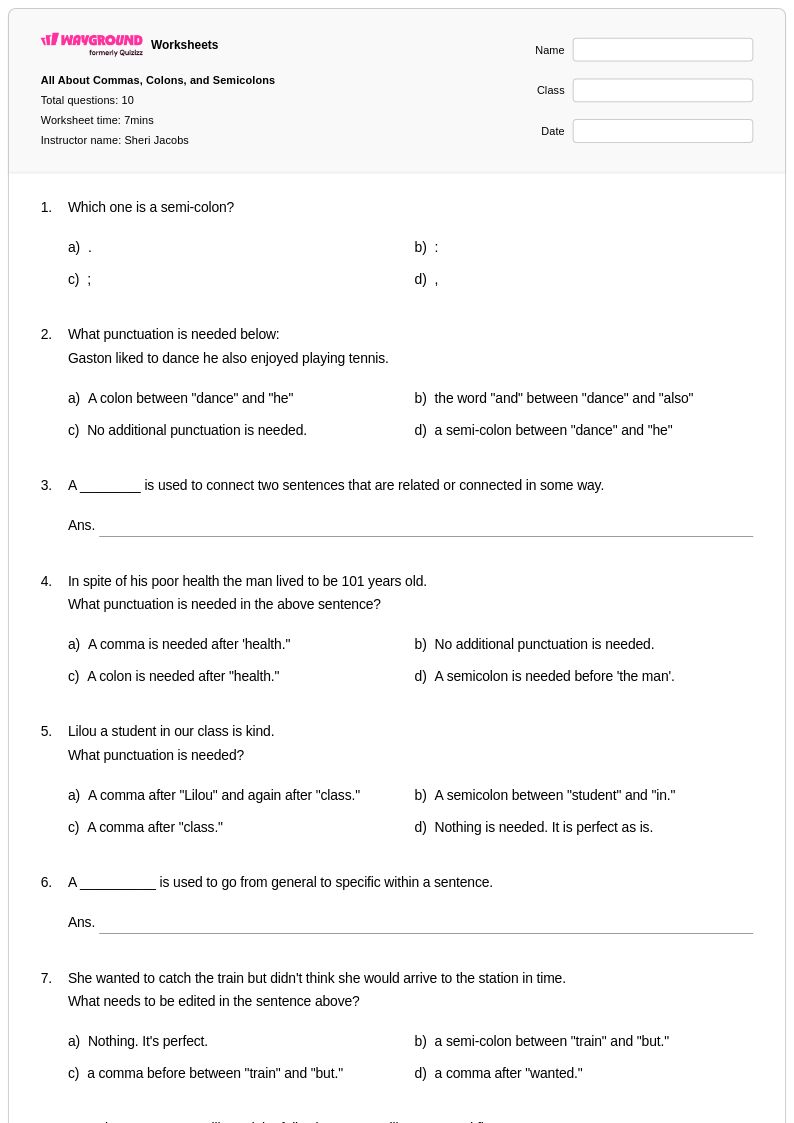
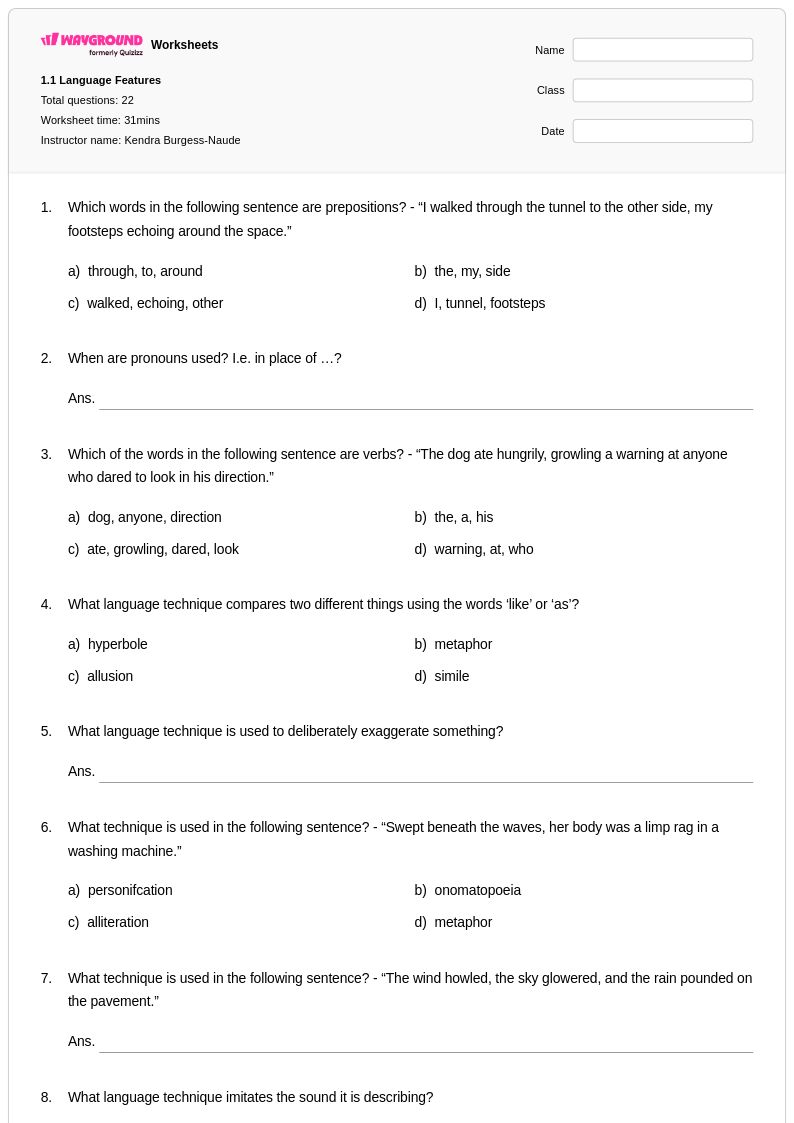
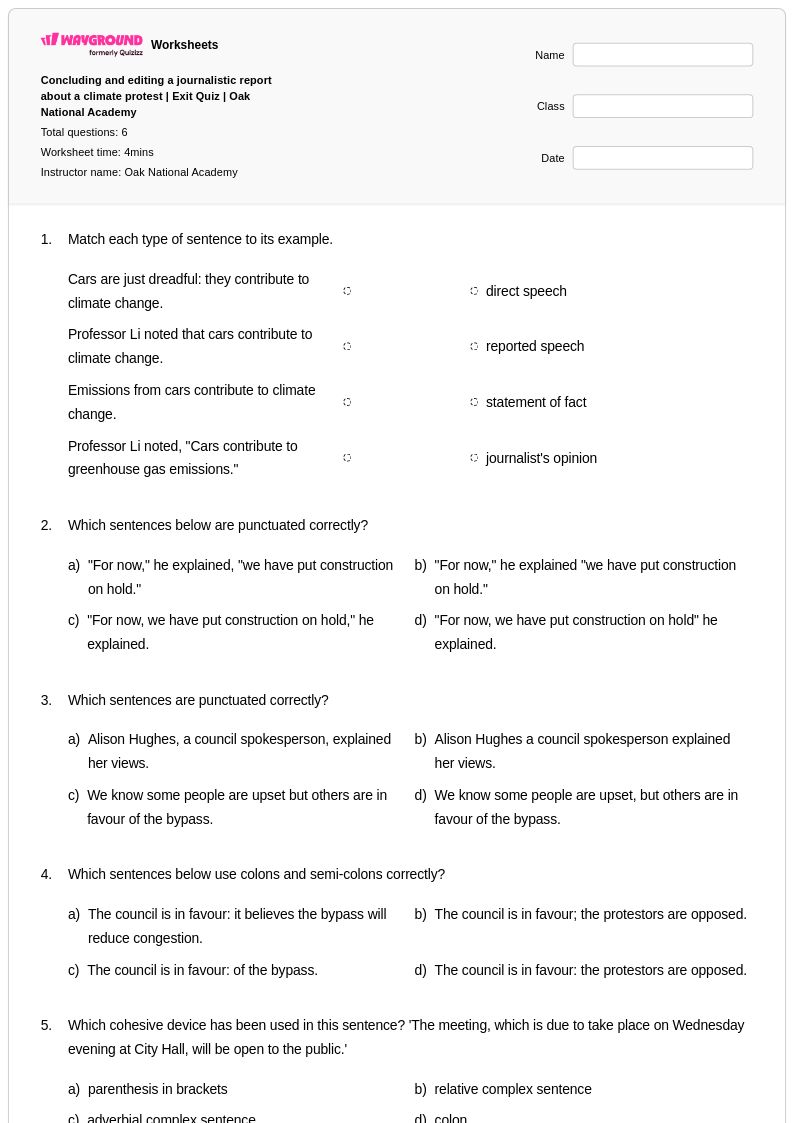
Enhance Year 11 students' understanding of colons with our comprehensive collection of free printable English worksheets, featuring targeted practice problems and complete answer keys to master advanced punctuation skills.
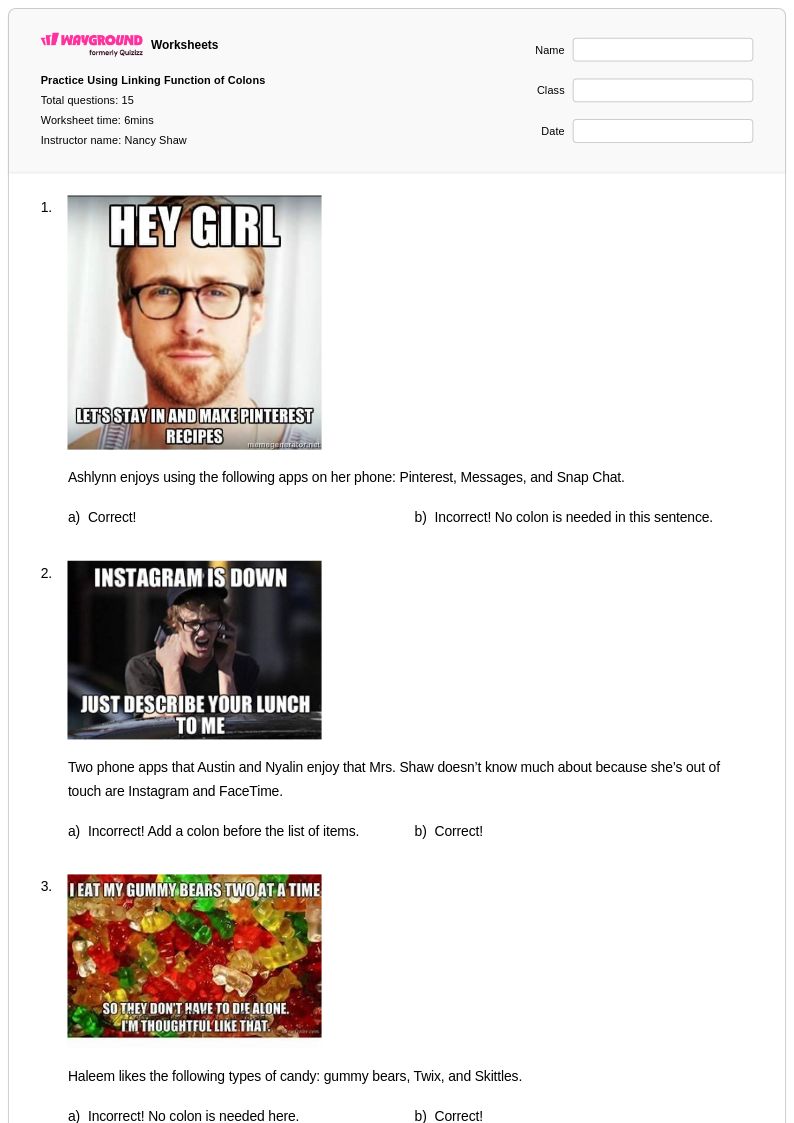
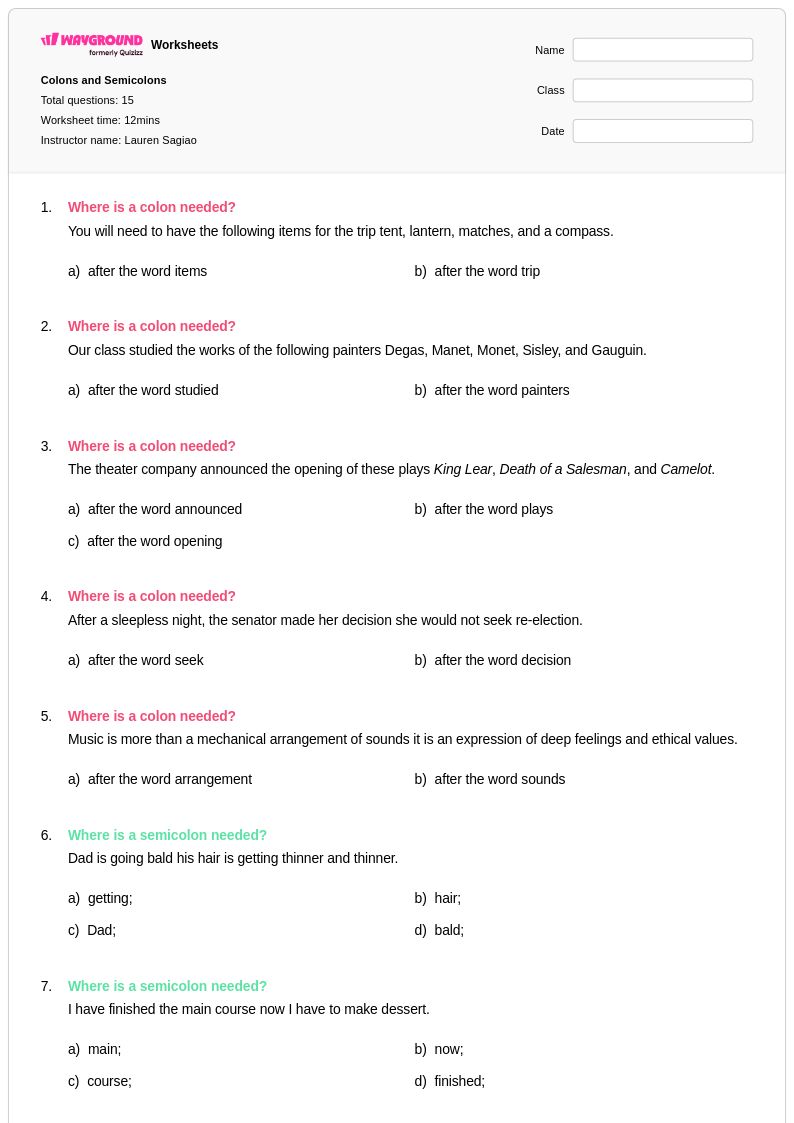
Colon usage worksheets for Year 11 students available through Wayground (formerly Quizizz) provide comprehensive practice with this essential punctuation mark that elevates academic and professional writing. These carefully designed resources help students master the sophisticated applications of colons, including introducing lists, explanations, and quotations, as well as separating independent clauses when the second clause elaborates on the first. Students work through targeted practice problems that cover colons in formal writing contexts, business correspondence, and literary analysis, strengthening their ability to create clear, purposeful connections between ideas. Each worksheet includes detailed answer keys and explanations that reinforce proper colon placement, while the free printable format ensures accessible practice for all learners seeking to refine their punctuation skills.
Wayground (formerly Quizizz) supports educators with an extensive collection of teacher-created colon worksheets that seamlessly integrate into Year 11 English curriculum planning and instruction. The platform's millions of resources feature robust search and filtering capabilities that allow teachers to locate materials aligned with specific standards and learning objectives, whether for initial skill introduction, targeted remediation, or advanced enrichment activities. Teachers can customize these differentiated worksheets to match individual student needs, accessing both printable pdf versions for traditional classroom use and digital formats for technology-enhanced learning environments. This flexibility enables educators to provide consistent practice opportunities across diverse learning settings while addressing varying skill levels, ensuring that every student develops confidence with sophisticated punctuation usage essential for college and career readiness.
FAQs
How do I teach students when to use a colon?
Teach colons by focusing on three core functions: introducing a list, elaborating on or explaining a preceding independent clause, and separating two independent clauses when the second explains the first. A reliable rule of thumb is that a colon must always follow a complete sentence — students should be able to stop at the colon and have a grammatically complete thought. Using mentor sentences from real texts helps students internalize the pattern before applying it independently.
What exercises help students practice using colons correctly?
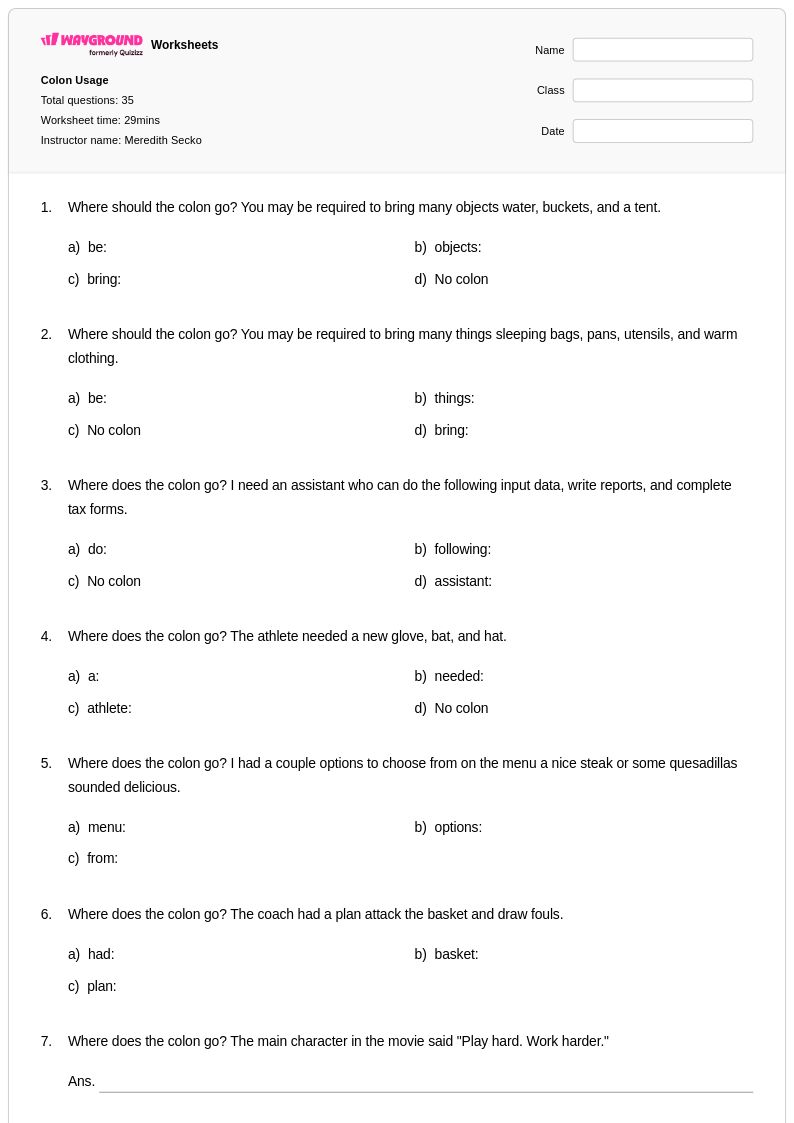
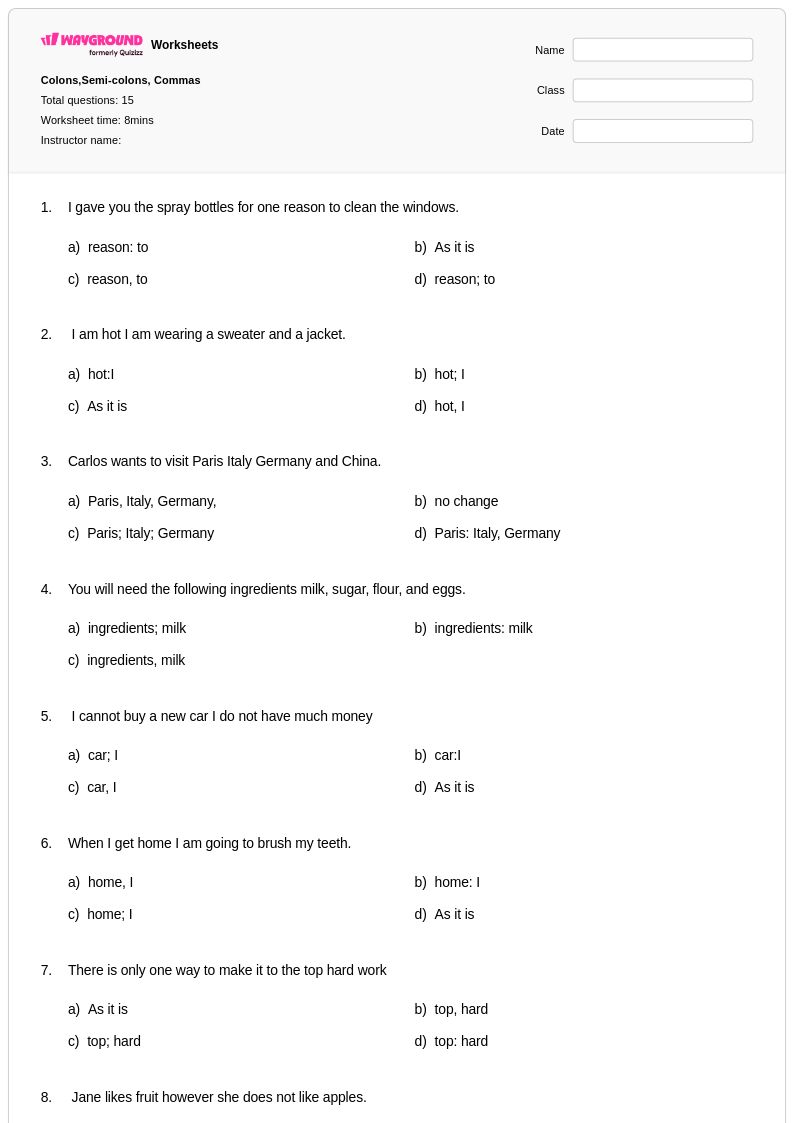
Effective colon practice includes sentence-completion tasks where students insert colons in context, rewriting exercises where they combine two sentences using a colon, and error-correction activities where they identify misplaced colons. Targeted practice problems that isolate each colon function — lists, elaboration, and clause separation — help students build confidence in each use case before applying them together.
What mistakes do students commonly make with colons?
The most frequent error is placing a colon after an incomplete sentence, such as writing 'My favorite fruits are: apples, bananas, and oranges' — the phrase before the colon must be an independent clause. Students also confuse colons with semicolons, using them interchangeably when the two marks serve distinct purposes. Another common mistake is overusing colons to introduce single words or short phrases that don't require any punctuation at all.
How is a colon different from a semicolon, and how do I explain this to students?
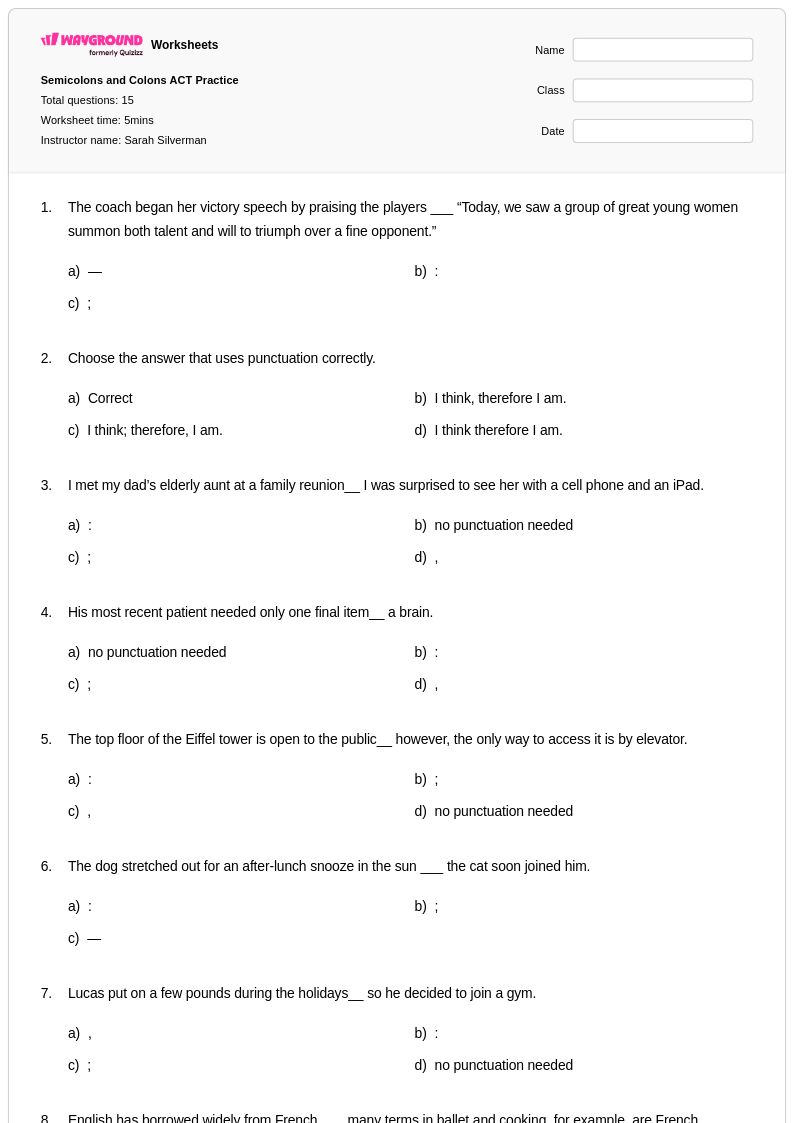
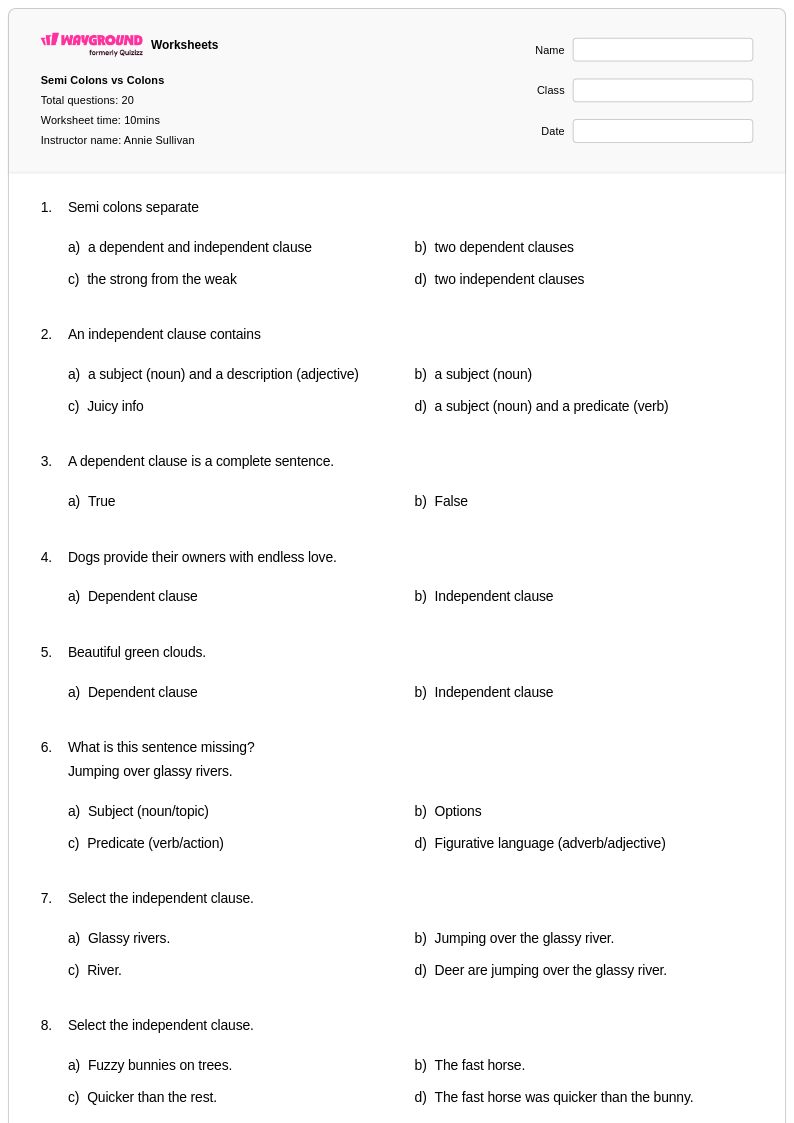
A colon points forward — it introduces what comes next, such as a list, explanation, or elaborating clause. A semicolon links two closely related independent clauses of equal weight without one explaining the other. A simple classroom heuristic: if the second part answers 'what?' or 'why?' in relation to the first, a colon is likely correct; if both parts stand equally on their own and just relate to each other, a semicolon fits better.
How do I use Wayground's colon worksheets in my classroom?
Wayground's colon worksheets are available as printable PDFs for traditional classroom distribution and in digital formats for technology-integrated learning environments, including the option to host them as a quiz directly on Wayground. Teachers can use them for initial instruction, targeted remediation, or independent practice, and each worksheet includes a detailed answer key to streamline grading. For students who need additional support, Wayground's accommodation tools allow teachers to enable read-aloud, extended time, or reduced answer choices on an individual basis.
How do I differentiate colon instruction for students at different skill levels?
For struggling learners, start with a single colon function — typically introducing a list — before layering in elaboration and clause-separation uses. Advanced students can work on identifying colon misuse in complex texts or writing original sentences that demonstrate all three functions. On Wayground, teachers can apply differentiation settings such as reduced answer choices or extended time to individual students while the rest of the class works with default settings.