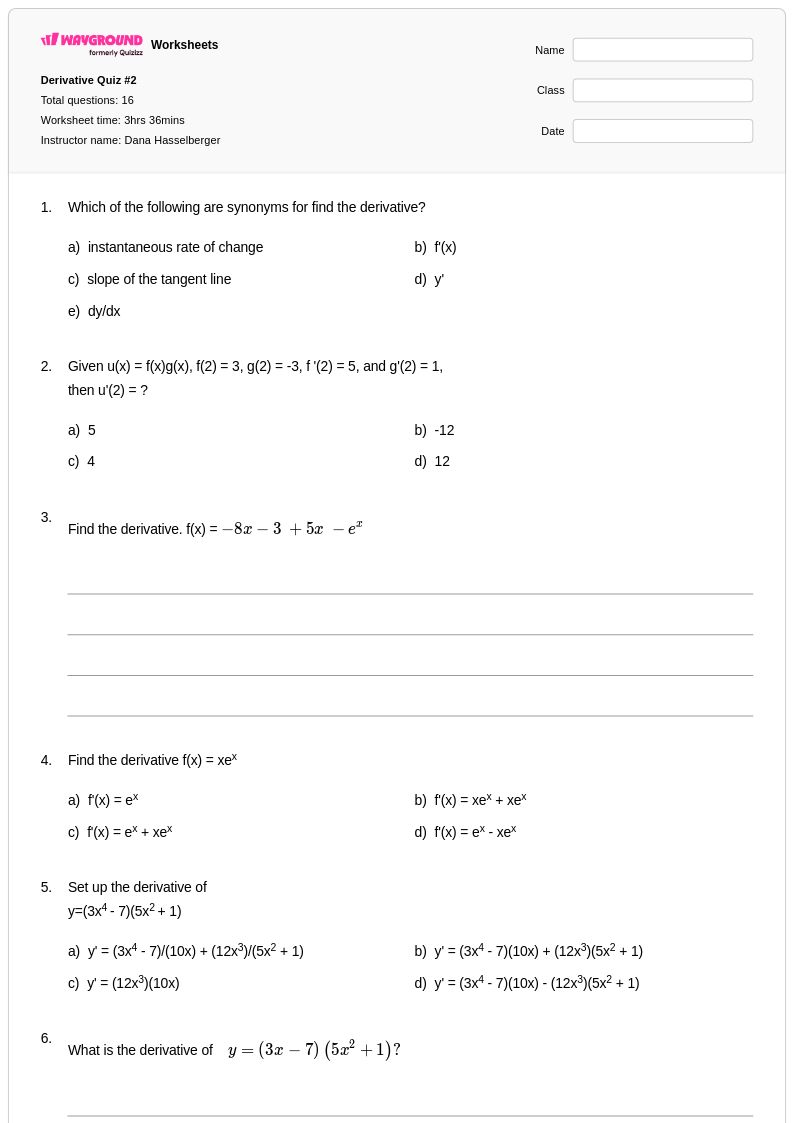
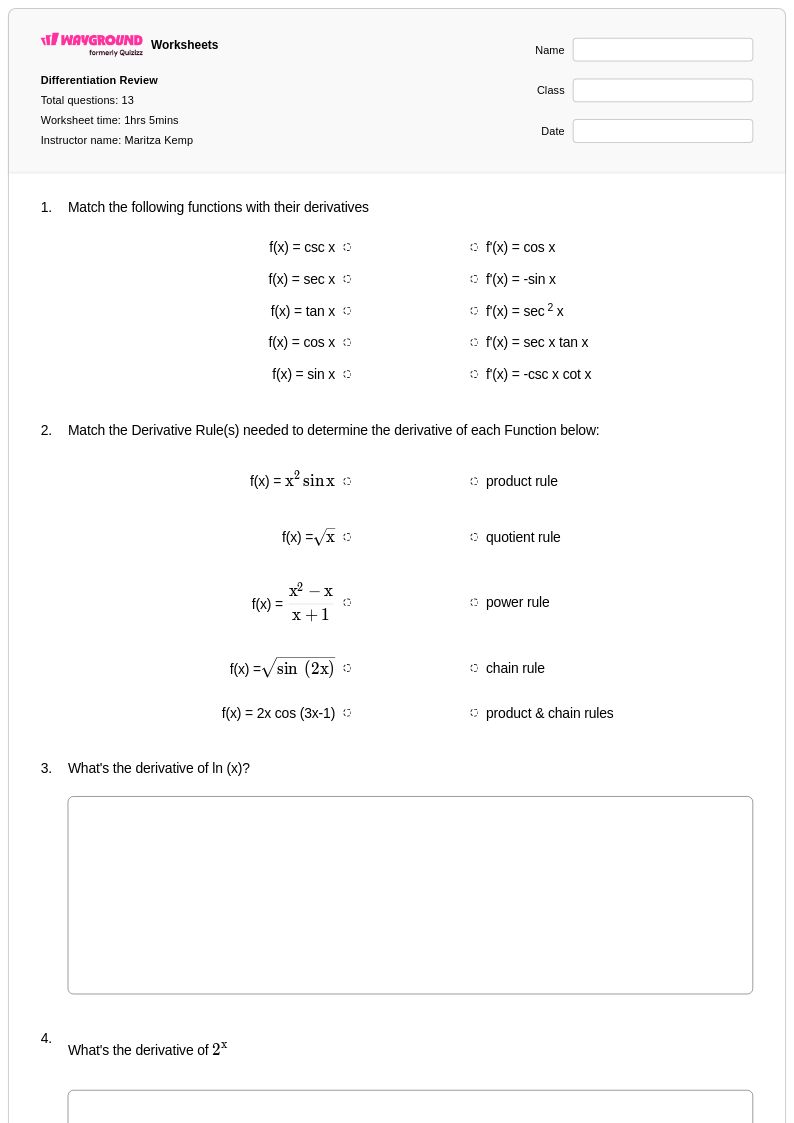
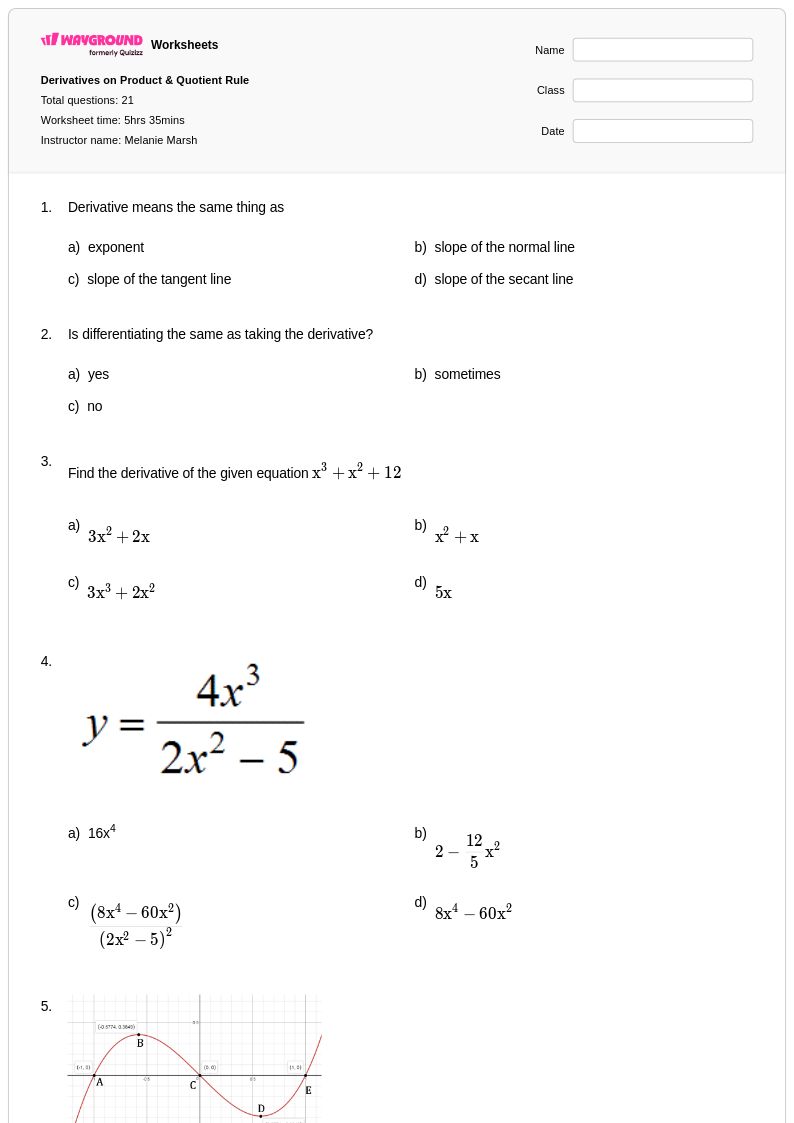
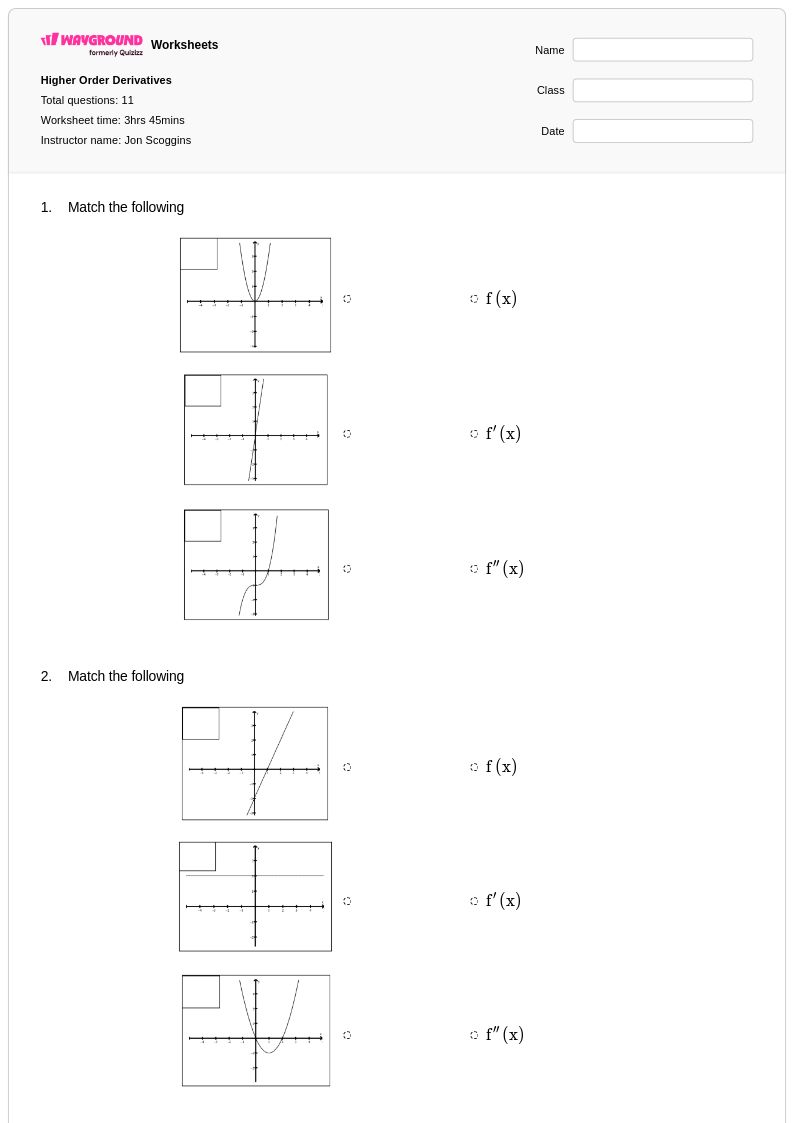
Free Printable Derivative by Definition worksheets
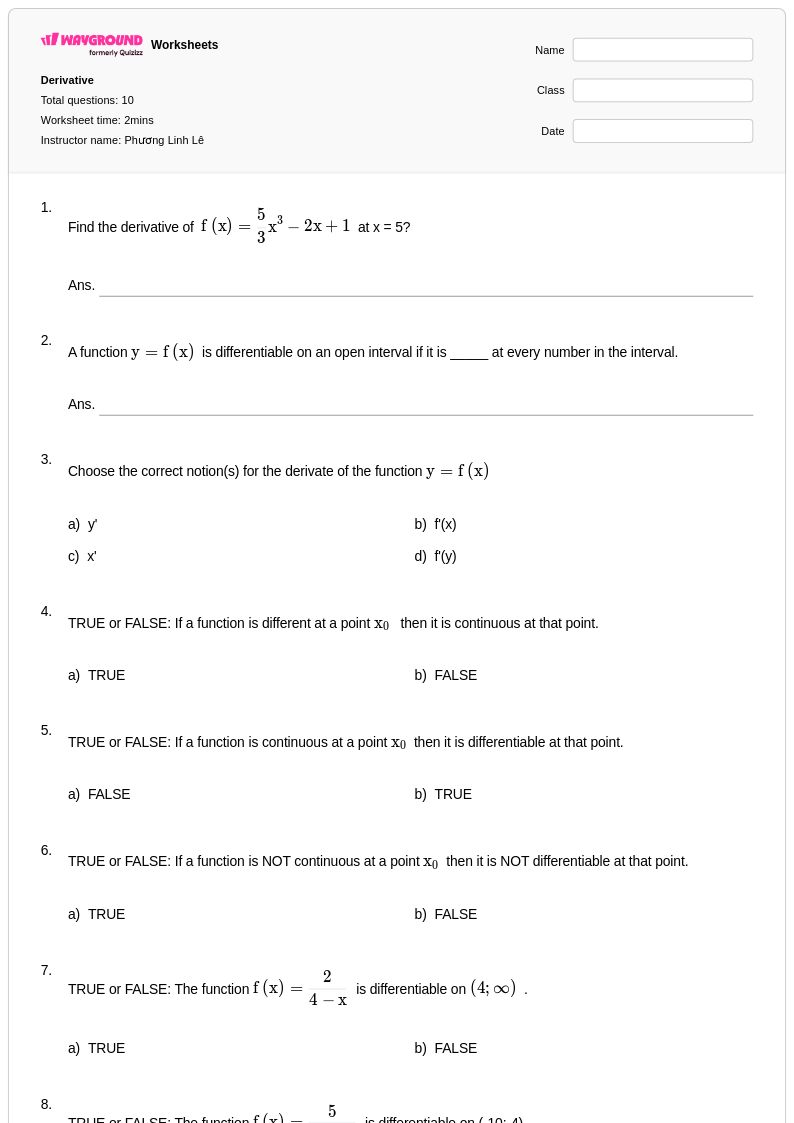
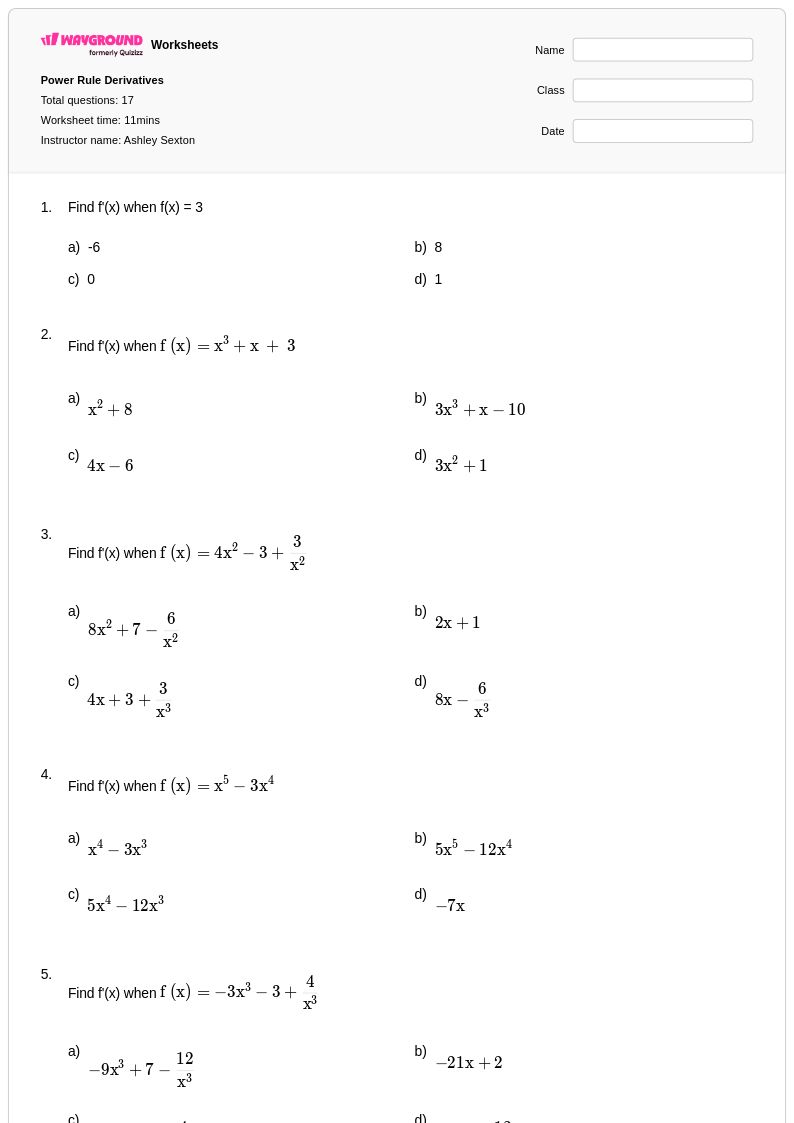
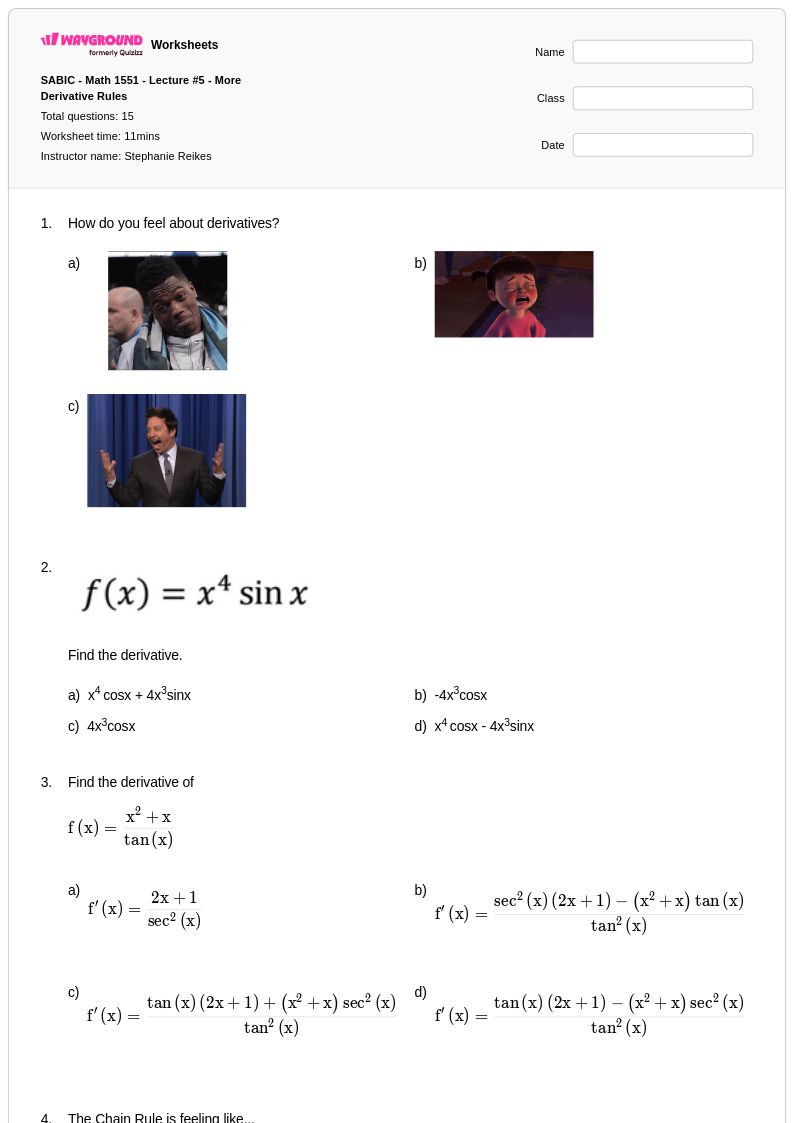
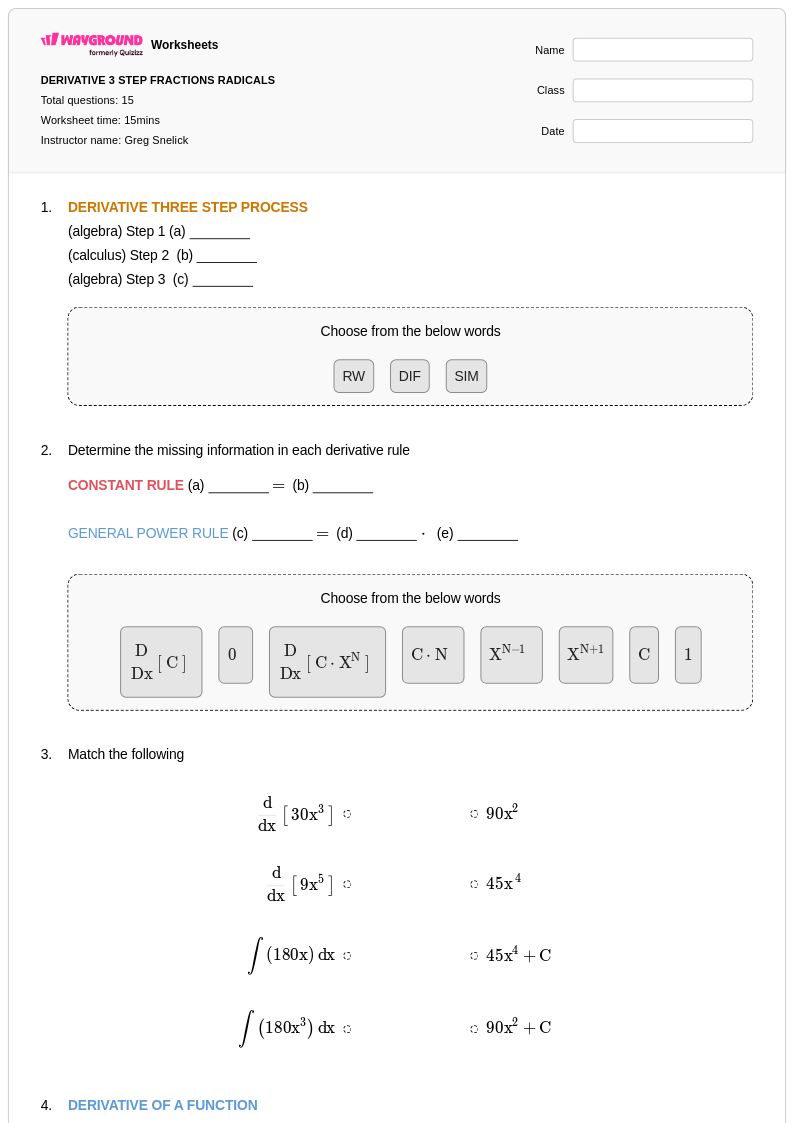
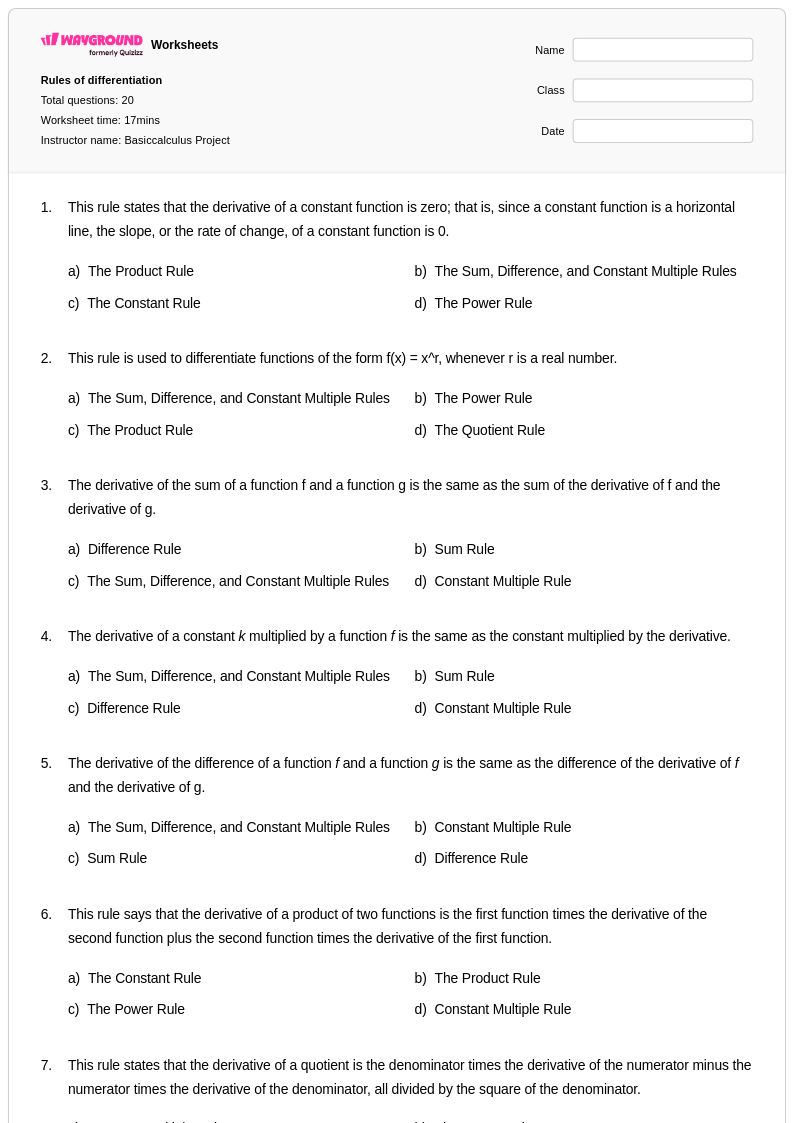
Master derivative by definition with Wayground's comprehensive collection of free calculus worksheets featuring step-by-step practice problems, printable PDFs, and detailed answer keys to strengthen fundamental differentiation skills.
Explore printable Derivative by Definition worksheets
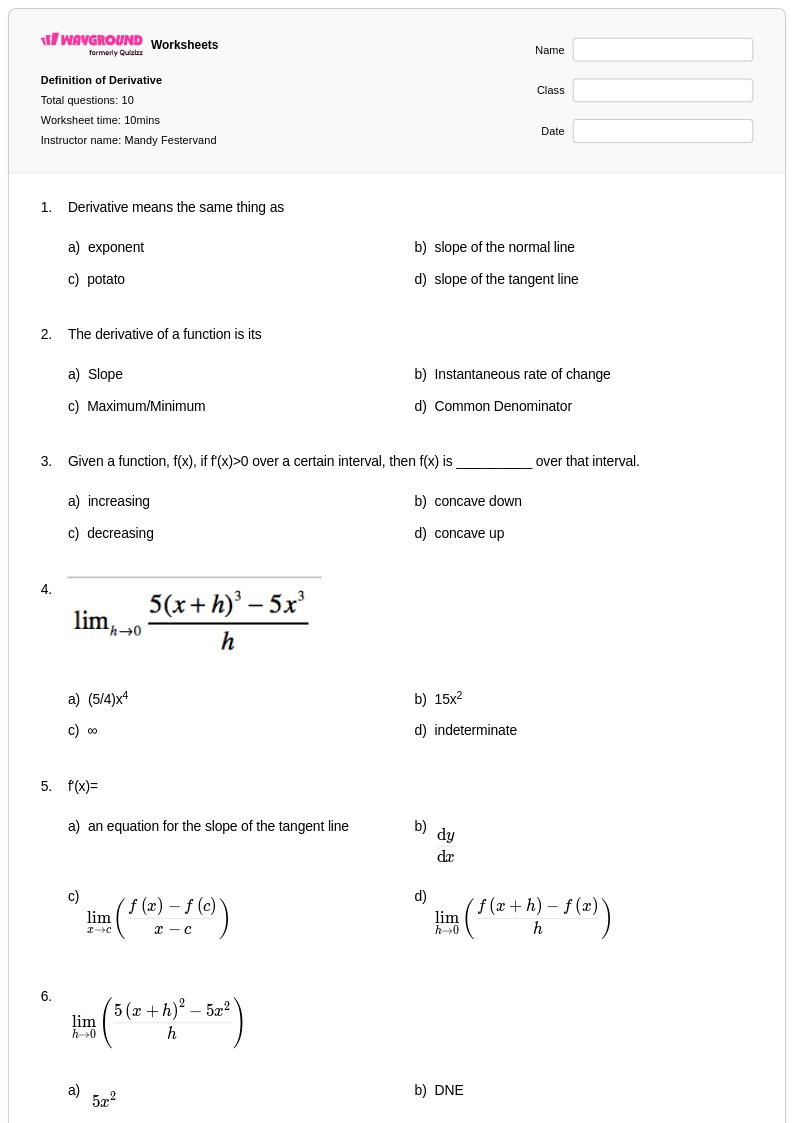
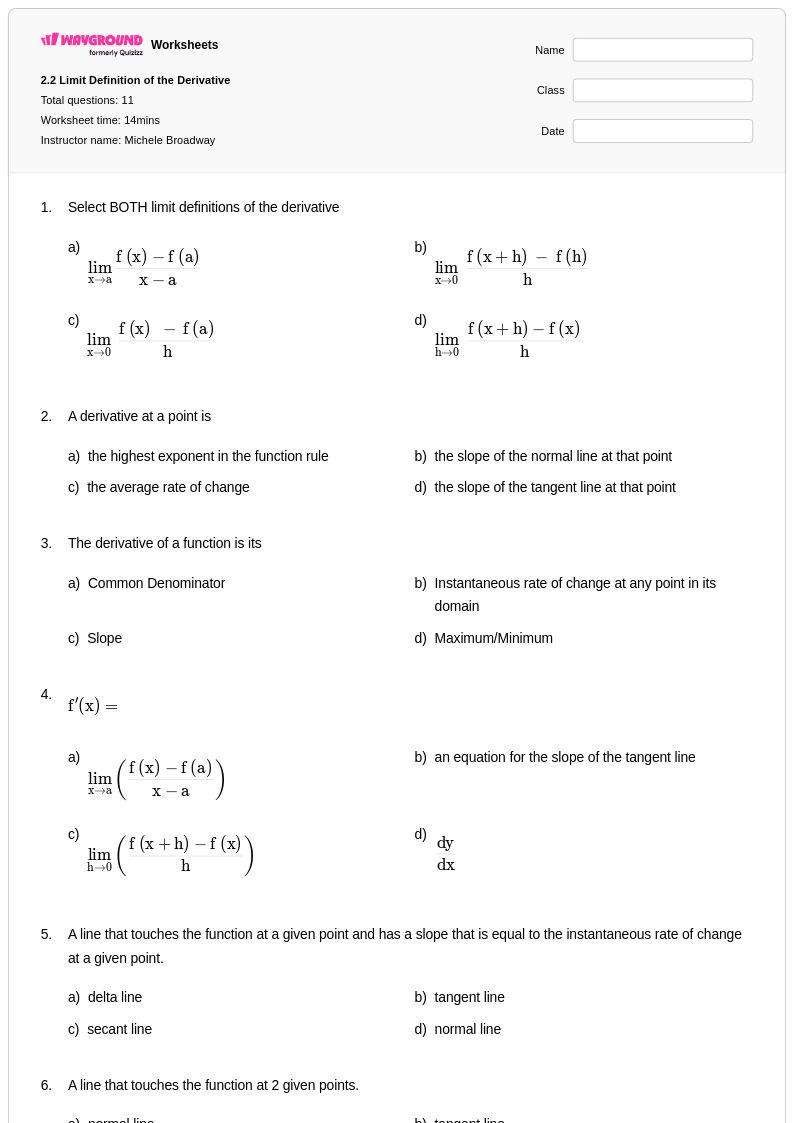
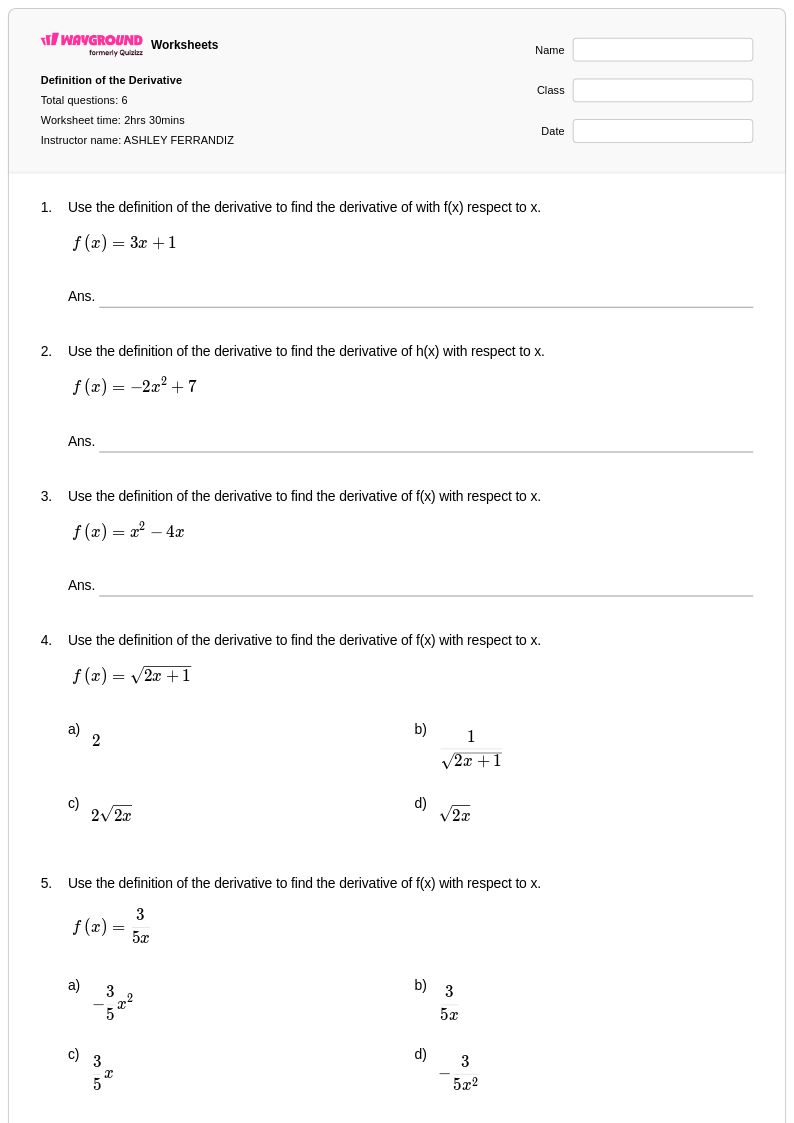
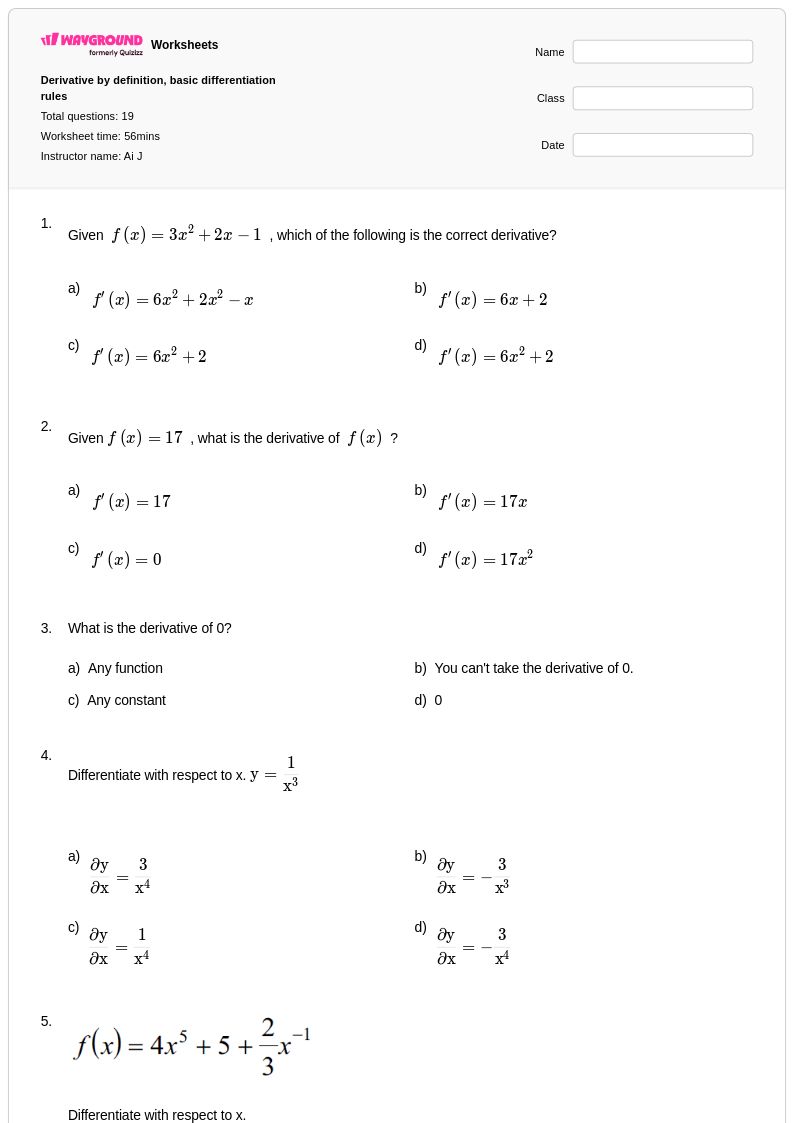
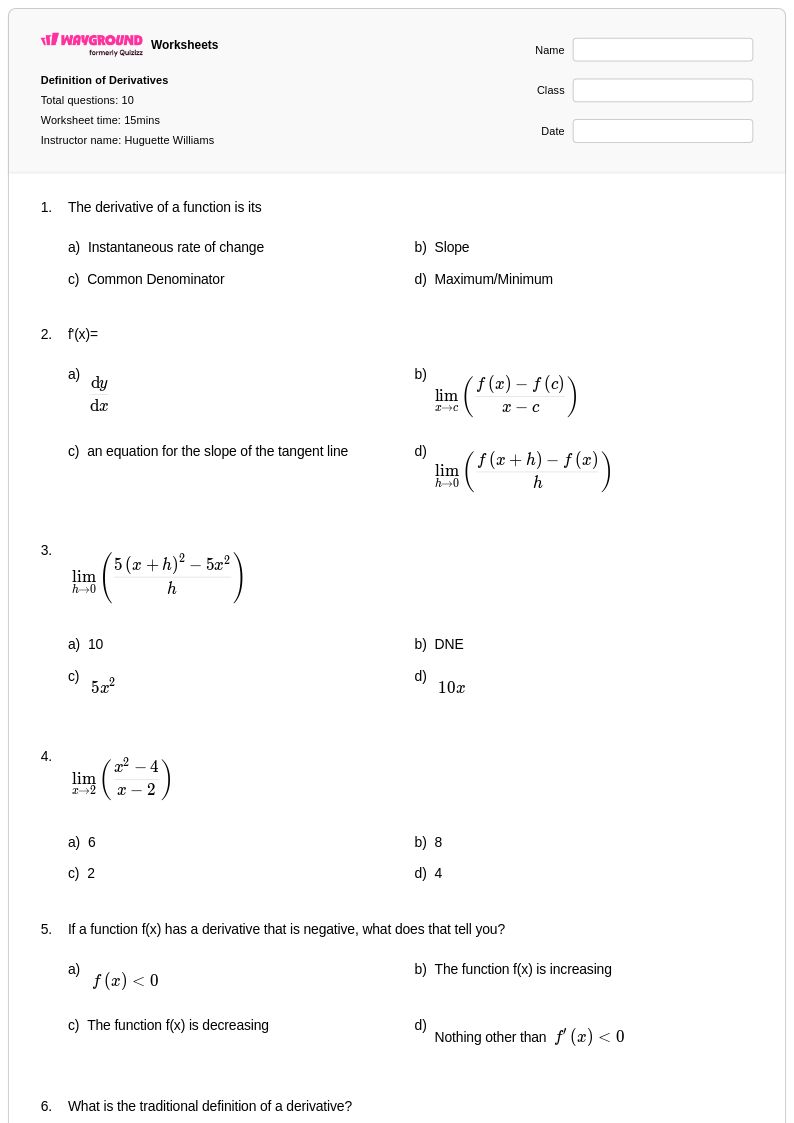
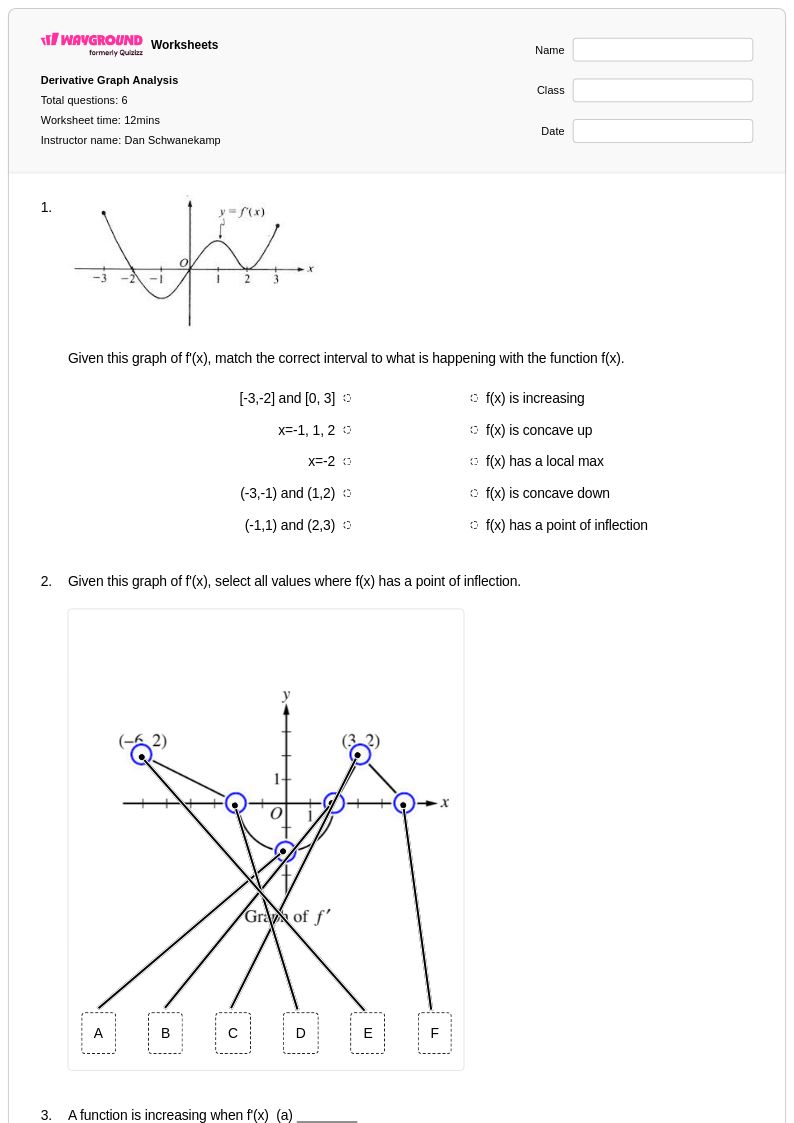
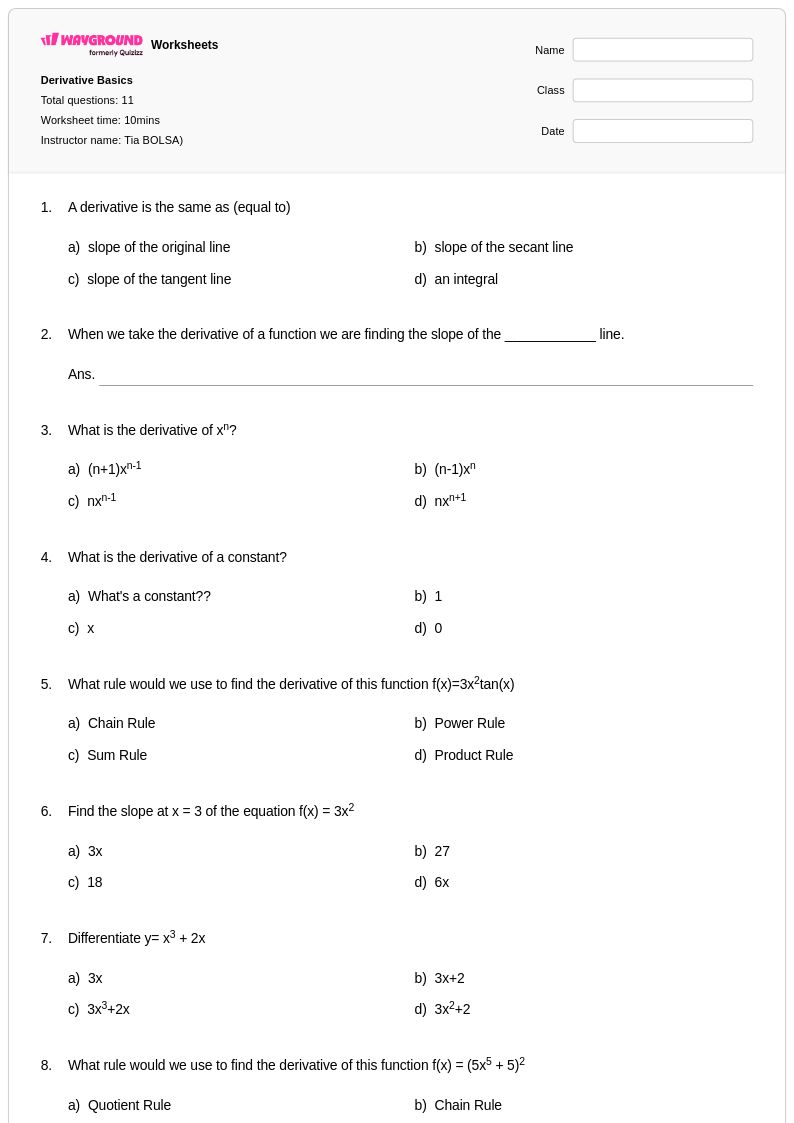
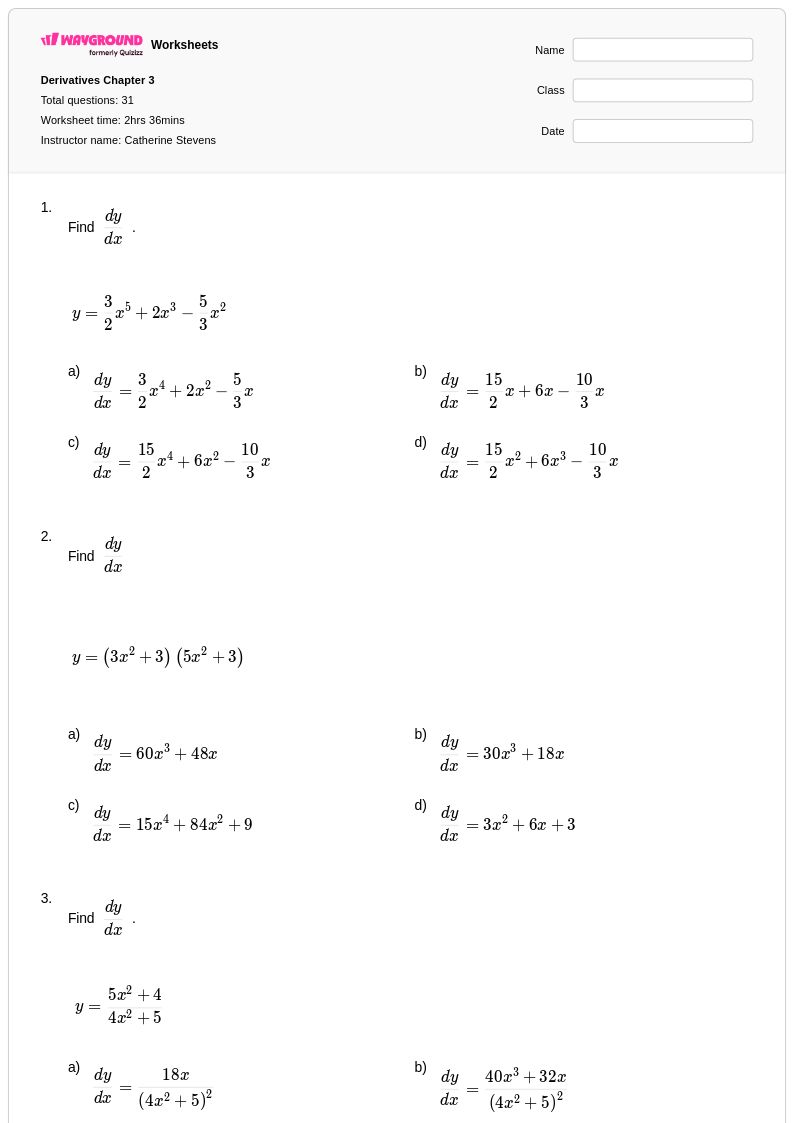
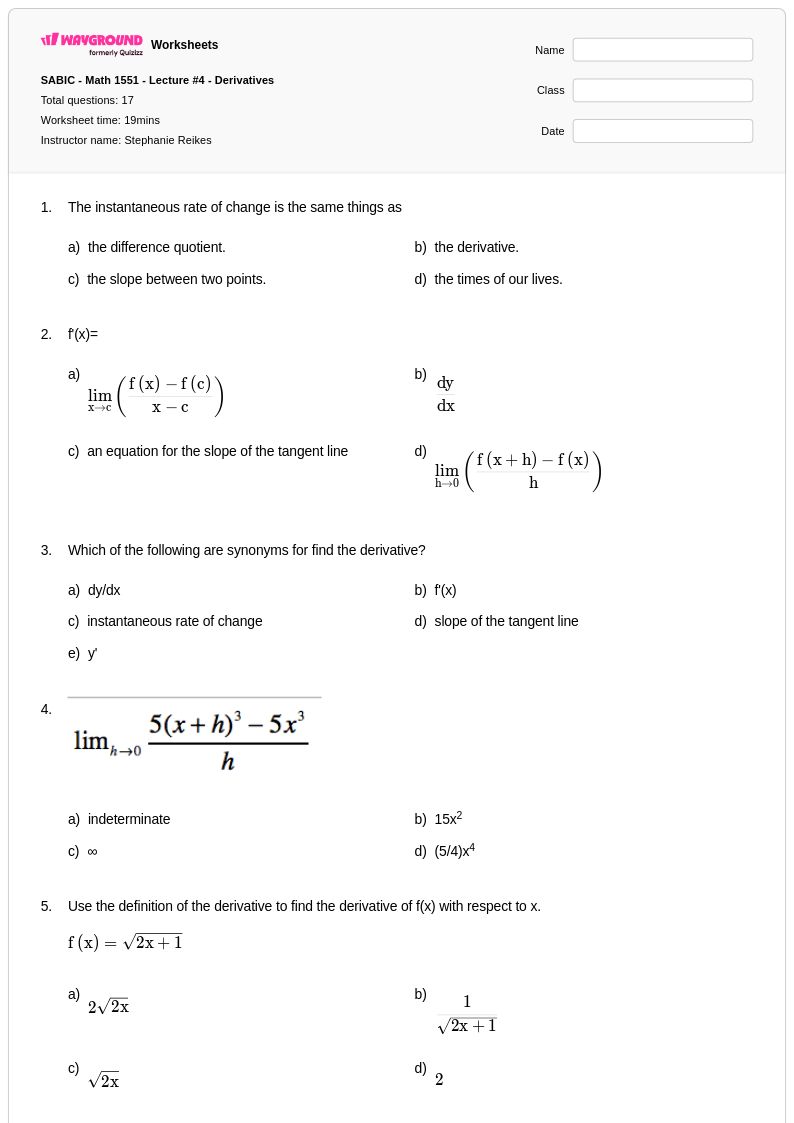
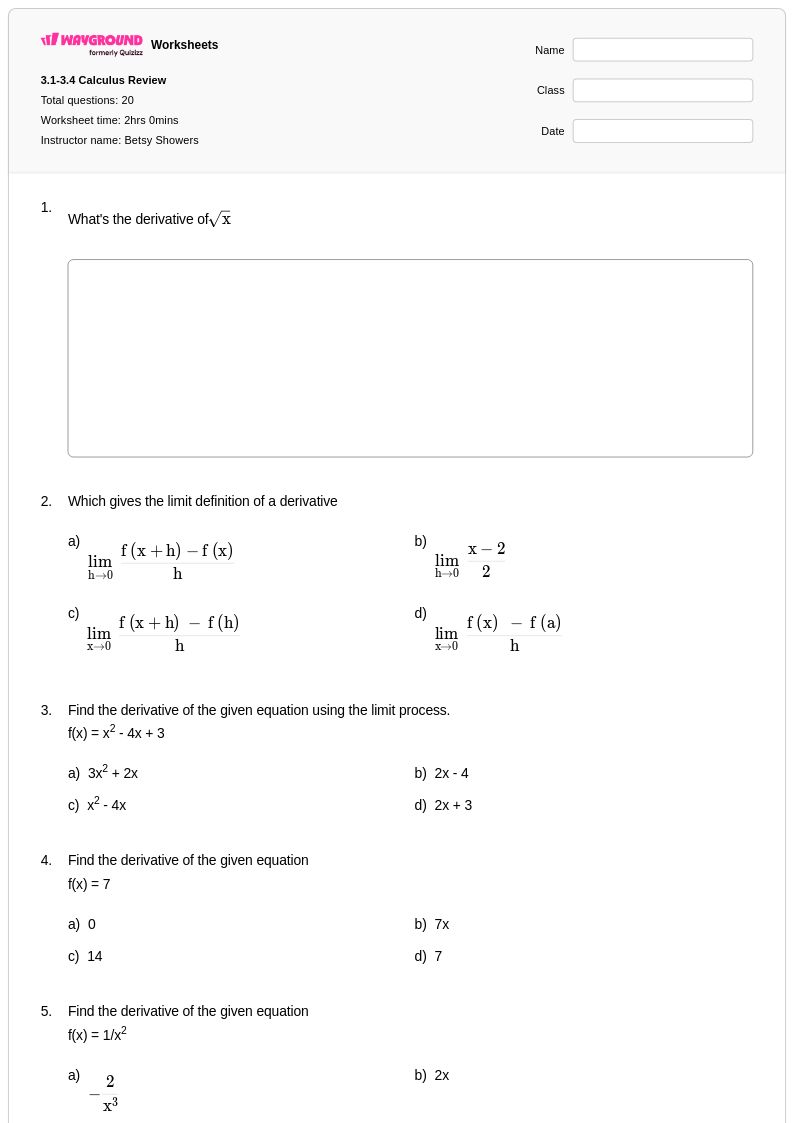
Derivative by Definition worksheets available through Wayground (formerly Quizizz) provide students with essential practice in understanding the fundamental concept of derivatives through the limit definition. These comprehensive worksheets focus on developing mastery of the limit process that defines the derivative as the instantaneous rate of change, strengthening students' ability to apply the formal definition f'(x) = lim[h→0] (f(x+h) - f(x))/h to various functions. The practice problems systematically guide learners through the algebraic manipulation required to evaluate these limits, building conceptual understanding of how derivatives emerge from average rates of change. Each worksheet includes detailed answer keys and is available as free printables in pdf format, allowing students to work through increasingly complex examples while developing the foundational skills necessary for advanced calculus concepts.
Wayground (formerly Quizizz) supports mathematics educators with an extensive collection of teacher-created derivative by definition resources, drawing from millions of worksheets developed by experienced calculus instructors. The platform's advanced search and filtering capabilities enable teachers to locate materials that align with specific curriculum standards and match their students' varying skill levels. These differentiation tools allow educators to customize worksheets for remediation, standard practice, or enrichment activities, with flexible options for both digital classroom integration and traditional printable pdf formats. The comprehensive nature of these resources streamlines lesson planning while providing teachers with reliable materials for skill practice, assessment preparation, and targeted intervention, ensuring students develop a solid understanding of the derivative concept before progressing to more advanced differentiation techniques.
FAQs
How do I teach the derivative by definition?
Start by grounding students in average rate of change, slope of a secant line, before introducing the limit process. The key conceptual move is showing what happens as h approaches zero: the secant line becomes a tangent line, and average rate of change becomes instantaneous. Work through f'(x) = lim[h→0] (f(x+h) - f(x))/h with a simple polynomial first, narrating each algebraic step out loud. Students need to see the algebra fully expanded and simplified before the limit is taken, that's where most confusion lives.
What exercises help students practice the derivative by definition?
The most effective practice moves from simple to complex in a deliberate sequence: start with linear functions (where the limit is trivial), then quadratics (which require expanding (x+h)²), then square roots and rational functions (which require conjugate multiplication or algebraic tricks to cancel h from the denominator). Each function type introduces a new algebraic challenge, so sequencing matters. These worksheets are structured exactly that way, giving students repeated exposure to the limit setup before the algebra gets demanding.
What mistakes do students commonly make with the derivative by definition?
Three errors come up constantly. First, students substitute h = 0 too early, before canceling h from the denominator, which produces 0/0 and a dead end. Second, they incorrectly expand (x+h)² as x² + h² — forgetting the 2xh cross term. Third, they drop the limit notation partway through the work, treating the expression as if the limit has already been evaluated. That last one is worth addressing explicitly: the lim[h→0] must appear on every line until h is actually eliminated.
How do I use these derivative by definition worksheets in my class?
You can run them as a digital quiz hosted on Wayground, students submit answers online and you get instant results, or print the PDF and assign them on paper, which works well for in-class practice where you want students working without a screen. Either way, every worksheet includes a complete answer key. If you go the print route, the Wayground for Teachers app lets you scan or capture student work to grade submissions without re-entering everything by hand.
How does the derivative by definition fit into the calculus curriculum?
The limit definition of the derivative is the conceptual foundation that everything else in differential calculus rests on. Students typically arrive here after studying limits and continuity, and the definition bridges that work to differentiation. The critical progression is: average rate of change → difference quotient → limit of the difference quotient → derivative rules. Common Core's high school math framework treats this conceptual grounding as essential before students apply shortcut rules like the power rule — the idea being that students who understand where the rules come from are far better equipped to handle non-standard functions and applications later.
How can I differentiate derivative by definition practice for mixed-ability students?
The algebraic manipulation required here varies enormously by function type, so differentiation is straightforward: assign simpler function types (linear, basic quadratic) to students who are still shaky on limit notation, and push stronger students toward rational functions or functions with radicals where the algebra is genuinely demanding. On Wayground, you can also apply reduced answer choices for students who are overwhelmed by the multi-step process, and enable Read Aloud for students who benefit from hearing the question while working through the algebra. Worksheet-level tools let you adjust font size or apply a dyslexia-friendly font without creating a separate assignment.